

Summary: Neutron backscatter is a non-intrusive inspection technique for checking levels and phase interfaces inside vessels, separators, storage tanks, and spheres without shutdown. A probe is placed against the outer wall, and the neutron response at each elevation shows where gas, foam, hydrocarbons, water, emulsion, and solids are located. The results are used to verify level gauges, determine sludge height before cleaning, and monitor emulsion layers.
This guide is for production operators, process engineers, and maintenance teams who doubt their level readings, are dealing with emulsions that are hard to separate, or need to know deposit height without opening a vessel. We cover how neutron backscatter works, the six phases it can distinguish, how to read its profile, and when pipe problems are better addressed with a gamma pipe scan.
Table of Contents
What Is Neutron Backscatter and How It Reads Levels from Outside the Wall
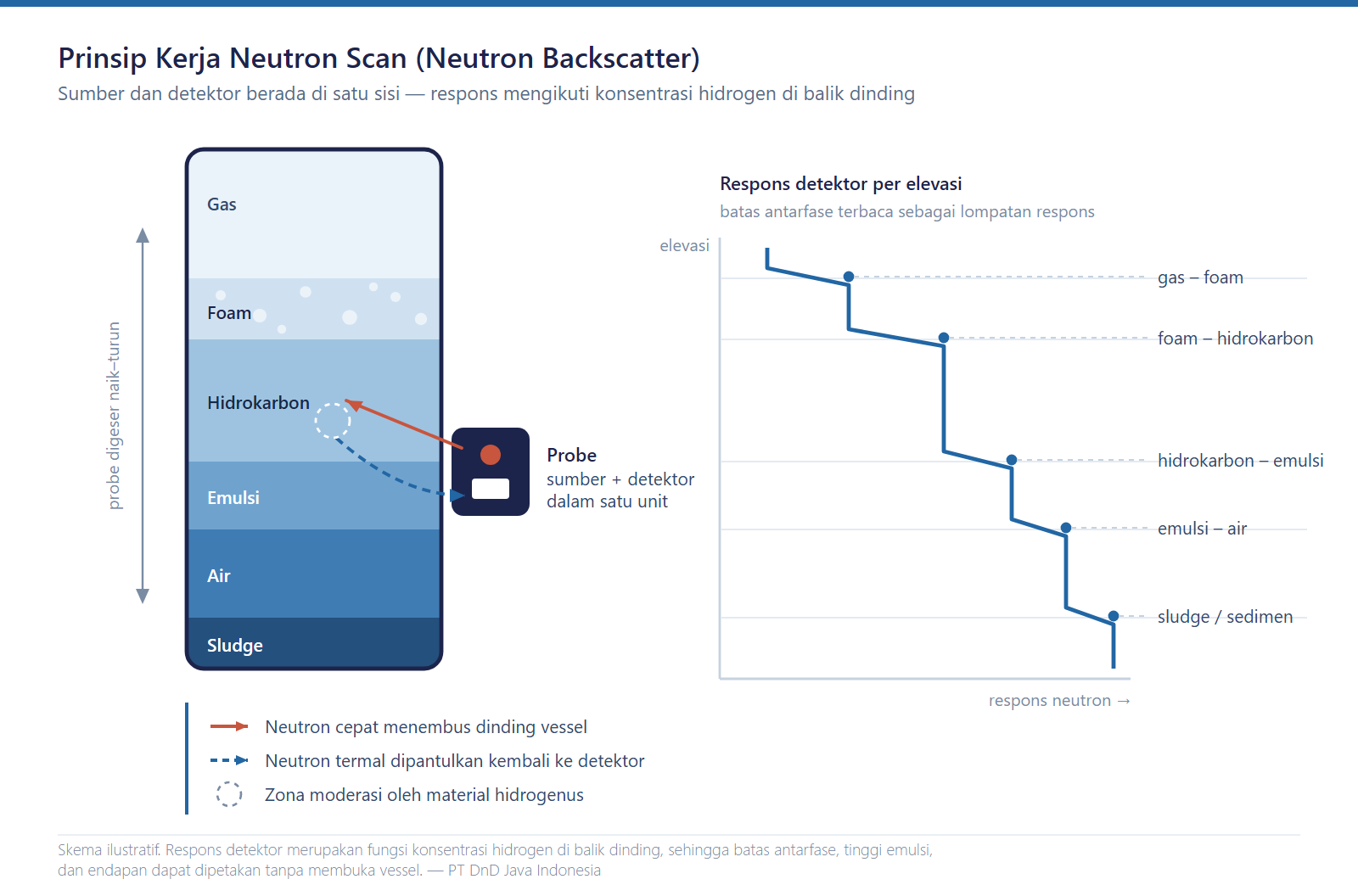
In neutron backscatter, the probe contains a high-energy fast neutron source and a slow or thermal neutron detector. The probe is placed against the vessel wall, then moved up and down along the height to be examined.
Fast neutrons penetrate the wall and interact with the material inside. If the material is hydrogenous, the neutrons are slowed down to slow neutrons, some are reflected back, and they are then captured by the detector.
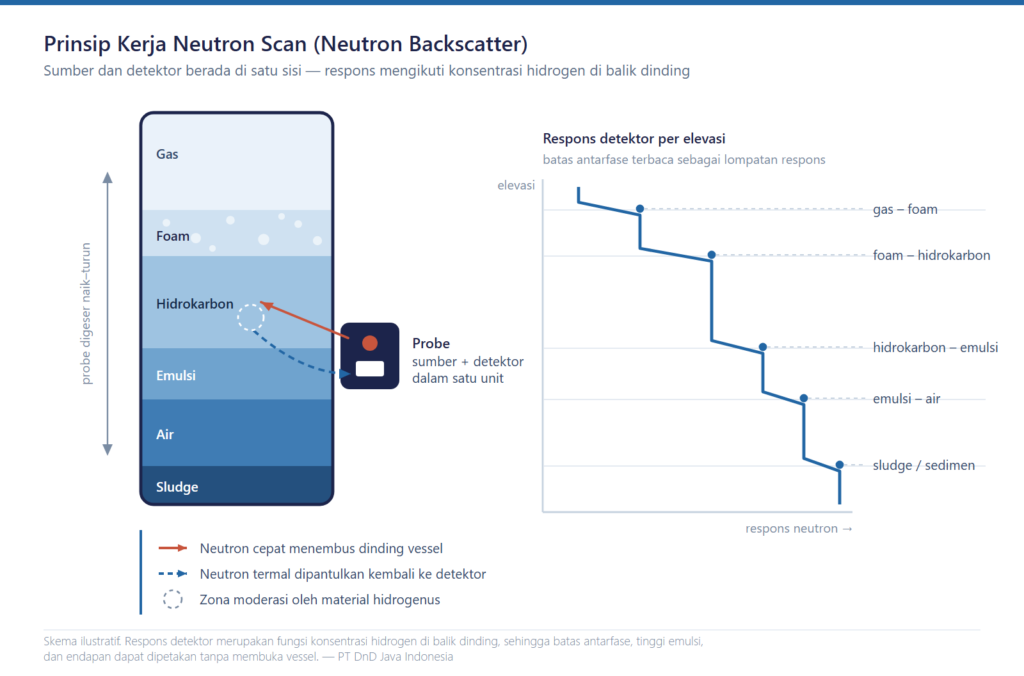
The detector response is a function of the hydrogen concentration behind the wall. Because each phase has a different hydrogen concentration, phase interfaces show up as a step change in response at specific elevations.
Unlike gamma scanning, which straddles the object from two sides, neutron backscatter works from one side only. This makes it practical for large-diameter storage tanks, spheres, and separators that are hard to access from two opposite sides.
Level and Interface Problems Answered by Neutron Backscatter
Field level instruments read a single point or a single quantity. When vessel contents are layered, a single level figure is often not enough to make a decision. The following five problems most often prompt a check from outside the wall.
| Field problem | Question to answer | What the profile shows |
|---|---|---|
| Operators doubt the level gauge reading | Where is the actual liquid level? | Elevation of the gas-liquid boundary |
| Unstable separator output quality | How thick is the emulsion layer? | Upper and lower boundaries of the emulsion zone |
| Foam carried over to downstream equipment | How high is the foam layer above the liquid? | Response zone between gas and liquid |
| Tank cleaning schedule still uncertain | How high is the sludge or sediment at the bottom? | Top boundary of the solids layer |
| Deposits or coking inside the vessel | How far has coking or sedimentation built up? | Height of the coking or sediment layer |
Why level gauge readings can be wrong
Most level instruments rely on a single measuring principle in a specific zone, such as differential pressure, a float, or wave reflection. This principle works well as long as the vessel contents separate neatly into gas and liquid.
Problems arise when emulsion, foam, or sludge covers the instrument's measuring zone. Changing mixture density, floating foam, or accumulating deposits can make the instrument show a figure that looks reasonable while the actual interface position is different.
This is where neutron backscatter is useful as an independent cross-check. Measurement from outside the wall does not depend on the installed instruments, so any difference between the two is clearly visible.
Because it is carried out while the unit runs normally, neutron backscatter can be used at the initial suspicion stage. Costly decisions such as shutting down the unit or opening a manhole can then be made once the vessel contents are actually known.
6 Phases Neutron Backscatter Can Distinguish
Phase measurement is the main strength of this technique. The table below summarises the six phases that can be mapped and their operational meaning for vessel owners.
| Phase | Profile signature | Meaning for operations |
|---|---|---|
| Gas | Low response at the top of the vessel | Vapour space; its lower boundary is the liquid level |
| Foam | Transition zone above the liquid surface | Risk of carry-over to downstream equipment |
| Hydrocarbon | Layer with a relatively stable response | Volume of product that can be separated |
| Water | Layer with a response level different from hydrocarbon | Interface position for water draw-off |
| Emulsion | Transition zone between hydrocarbon and water | Thickness that affects separation performance |
| Solids | Layer at the vessel bottom, such as sludge or sediment | Basis for planning vessel cleaning |
The order and thickness of the layers differ in every vessel. That is why a neutron backscatter profile is always read together with the vessel drawing and the operating conditions at the time of measurement.
Neutron Backscatter on Vessels, Separators, Storage Tanks, and Spheres
This technique is applicable to large-diameter storage tanks, spheres, separators, process vessels, and pipelines. The questions it answers differ for each type of equipment.
Separators
In separators, the main concern is the position of the hydrocarbon-water interface and the thickness of the emulsion between them. Neutron backscatter helps monitor sludge, sediment, emulsion, and foam levels for production optimisation.
Large-diameter storage tanks
Large storage tanks often hold a sludge layer of unknown height at the bottom. Measuring it from the outside helps optimise the timing of tank cleaning operations.
Spheres
In spheres, the most common need is to confirm the actual liquid level and verify level gauge calibration. Measuring from one side makes work on this spherical shape easier.
Vessels with coking or sedimentation
In vessels affected by coking or sedimentation, neutron backscatter is used to evaluate the height of these layers. This data helps determine when cleaning is actually needed.
Insulated pipelines
On insulated pipelines, this technique is used to detect moisture under insulation (MUI). Early detection of MUI is a preventive step against corrosion under insulation (CUI).
How to Read a Neutron Backscatter Response Profile
The measurement profile is a graph of elevation against neutron response. Its outline can be understood in four simple steps.
- Match elevations to the vessel drawing. Mark the nozzles, internals, and level gauge position on the profile so that every change has a reference point.
- Look for step changes in response. Every distinct change in response level marks a phase interface.
- Watch the transition zones. A gradual rather than sharp change often indicates foam or emulsion of a certain thickness.
- Compare with the instruments. The difference between the boundary on the profile and the level gauge reading is the basis for calibration verification.
Unsure about the level readings in your vessel?
Tell us the vessel type, diameter, and the level or interface problem you are facing; we will help define the right scope for neutron backscatter. Contact us via WhatsApp or email us at [email protected].
The final reading is not done automatically from the graph. Our team interprets the neutron backscatter profile together with process data, then presents a phase map by elevation along with recommendations.
Neutron Backscatter Compared with Other Ways to Check Vessel Contents
There are several common ways to find out what is inside a vessel or tank. Each has its place, and understanding their limitations helps you choose the most cost-effective step.
| Method | What it reveals | Limitations |
|---|---|---|
| Installed level instruments | Continuous level reading in the control room | Can be wrong if emulsion, foam, or sludge covers the measuring zone |
| Multi-level sampling from nozzles | Fluid type at the available nozzle points | Only at nozzle elevations; does not give a complete profile |
| Opening the vessel during shutdown | Direct view of internal condition and deposits | Production stops, and the contents during operation cannot be seen |
| Neutron backscatter | Phase profile and phase interfaces by elevation during operation | Interpreted together with vessel drawings and process data |
In practice, these methods complement each other. Neutron backscatter gives a complete picture by elevation, nozzle samples confirm fluid properties in the laboratory, and installed instruments remain the daily monitor once their calibration has been verified.
An efficient sequence usually starts from the most pressing operating question. If the answer concerns the position of layers inside the vessel, measurement from outside the wall is the first step and the least disruptive to production.
When to Check Tank Levels with Neutron Backscatter
- Before cleaning a vessel or tank. Measured sludge and sediment height helps determine the cleaning schedule and scope.
- When level gauge readings are in doubt. Neutron backscatter provides an independent reference for calibration verification.
- When separator performance drops. Emulsion and foam thickness explain why separation is not meeting expectations.
- Periodic monitoring. Repeat measurements at the same points show changes in sludge, emulsion, and foam levels over time.
- Insulated pipeline inspection. MUI detection as early prevention of CUI.
In many cases, neutron backscatter and gamma scanning complement each other. Gamma scanning maps overall density, while neutron backscatter confirms which phase occupies each layer.
The first profile from a vessel that is operating well is also worth keeping as a baseline. When problems appear later, new neutron backscatter results can be compared directly with the healthy condition of the same vessel, so changes in sludge, emulsion, or foam height become visible sooner and maintenance decisions can be made earlier.
Illustrative Scenarios: Reading Vessel Contents Without Opening the Vessel
Note: the following two scenarios are general illustrations to explain diagnostic thinking. Neither is a real case, and neither depicts any particular customer.
Scenario A: separator level gauge suspected of being wrong
Suppose separator operators see an interface level that looks normal, but water is being carried into the oil line. The suspicion is a thick emulsion layer causing the instrument to read the wrong position.
In a typical pattern, the neutron backscatter profile shows a wide transition zone between hydrocarbon and water. This emulsion thickness data then becomes the basis for evaluating separator operation.
Scenario B: deciding the cleaning schedule for a storage tank
Suppose a storage tank manager needs to decide whether cleaning can be postponed to the next period. Opening the tank just to measure sludge is clearly inefficient.
Measurement from outside the wall at several elevations can show the top boundary of the solids layer. The decision to postpone or bring forward cleaning is then based on data, not estimates.
Pipe Problems: When to Switch to a Gamma Pipe Scan
Neutron backscatter answers questions about phases and levels. If the problem is a pipe flow rate that is gradually declining due to blockage or deposits, the technique used is a pipe scan with gamma radiation.
A pipe scan locates blockages or deposits and measures their thickness across a range of pipe sizes, with vertical scanning from the 12 to 6 o'clock positions and horizontal scanning from 3 to 9 o'clock. Details are on our page about pipe scanning in our gamma scan service.
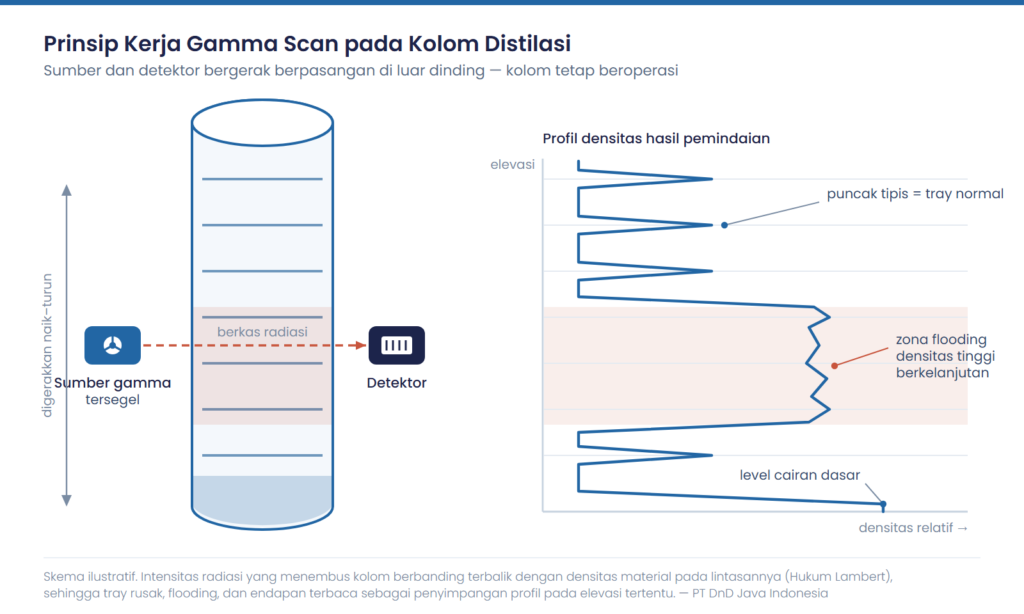
The same density principle is used for process columns; we discuss the symptom guide in our article on distillation column gamma scanning. If pipe deposit samples can be taken, our scale analysis service for pipelines helps identify the type of scale and its cause.
| Your question | The right technique |
|---|---|
| Where is the liquid level or interface inside the tank or separator? | Neutron backscatter |
| How high is the sludge, sediment, or coking inside the vessel? | Neutron backscatter |
| Is there moisture under insulation on the pipeline? | Neutron backscatter |
| At which point is the pipe blocked, and how thick is the deposit? | Gamma pipe scan |
| Are the column trays or packing still working normally? | Column gamma scan |
Measurement Preparation and Workflow
Good preparation makes the profile easier to interpret. The following data should be prepared before the scope discussion.
- Vessel or tank drawings with dimensions, nozzle positions, and internals.
- P&ID and the positions of the level instruments to be verified.
- Planned operating conditions during measurement, including the type of fluid being processed.
- The problem being faced and the questions to be answered.
- Previous measurement results, if any, for comparison.
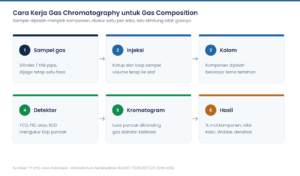
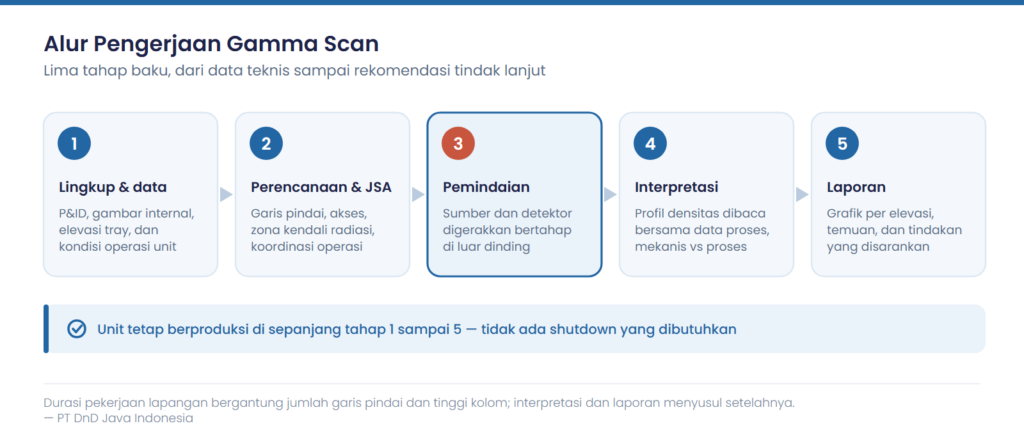
Field scanning work in our service follows five standard stages: scope and technical data discussion, planning and job safety analysis, scanning, data processing and interpretation, then the report and recommendations. The specific scope for neutron backscatter is confirmed during the initial discussion.
Common mistakes when planning measurements
A few habits make neutron backscatter results less conclusive, yet they are easy to prevent at the planning stage.
- Measuring when conditions do not reflect the problem. If the emulsion only thickens at certain production rates, measuring under other conditions can produce a profile that looks normal.
- Vessel drawings are not available. Without nozzle and internal positions, phase interfaces are hard to link to operating points such as the water outlet or oil outlet.
- Process data is not recorded. Without records of flow rate, temperature, and fluid type during measurement, the profile is harder to interpret.
- Measuring only once. Changes in sludge and emulsion height only become visible when there is a comparison measurement at the same point.
- Using one technique for every question. Pipe blockages and column tray condition are better answered by gamma scanning, not neutron backscatter.
All of the above is discussed during the scope discussion stage, so the measurement plan already addresses the right questions before the team travels to site.
Radiation Safety During Measurement
Scanning uses sealed radioactive sources that are stored in shielded containers when not in use. The work area is restricted by a controlled zone, access is supervised, and personnel wear dosimeters.
In Indonesia, the use of radioactive sources is supervised by the Nuclear Energy Regulatory Agency, BAPETEN. Work planning therefore takes into account licensing, worker protection, and the safety of the surrounding area.
An overview of nuclear techniques applied in industry can be found in the IAEA publication on industrial applications of nuclear technology.
Neutron Backscatter Report and Follow-Up
- Unit identity, measurement date, and operating conditions during measurement.
- Neutron response graphs for each scan line.
- Interpretation by elevation in the form of a phase map and phase interfaces.
- Comparison with the previous baseline if measurements have been taken before.
- Follow-up recommendations for operations, cleaning, or maintenance.
Neutron backscatter results can be followed up with laboratory sample analysis if needed. For example, samples from the layer in question are collected via Sampling and Onsite Analysis, then their water and sediment content is tested through Crude Oil Analysis.
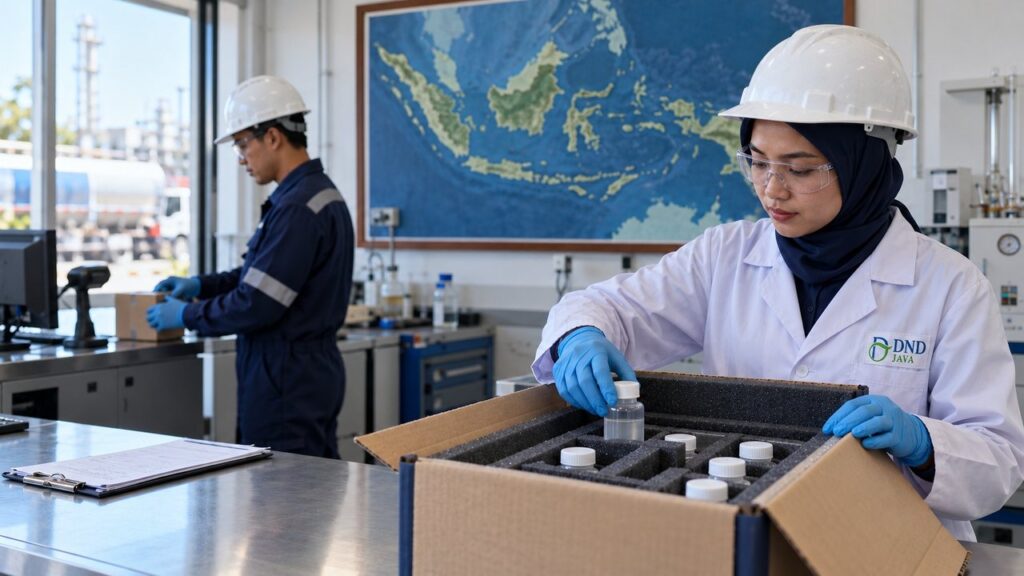
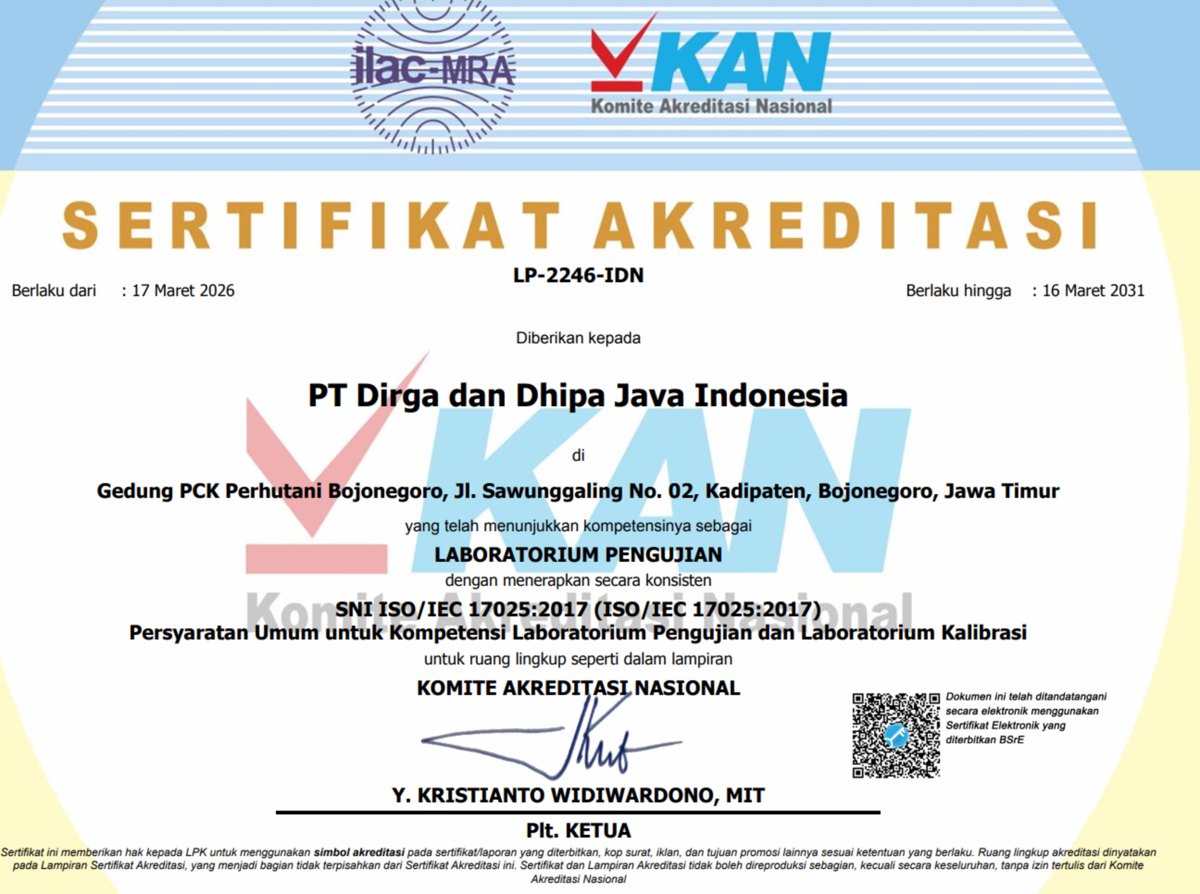
PT DnD Java Indonesia is an oil and gas testing laboratory in Bojonegoro, East Java, accredited to ISO/IEC 17025:2017 under number LP-2246-IDN. Our team mobilises throughout Indonesia; an overview of our coverage is on our page for oil and gas laboratory service areas.
Technique scope, working principles, and report contents are available on the page for our Gamma Scan & Neutron Scan service. For a full comparison of gamma scan and neutron scan, including when to choose one over the other, open that service page. Initial discussions can start via the contact page or our neutron scan and gamma scan services without shutdown.
Key Terms in Level and Interface Measurement
| Term | Short meaning |
|---|---|
| Level | Height of the liquid surface inside a vessel or tank |
| Interface | Boundary between two phases, such as hydrocarbon and water |
| Emulsion | A mixture of hydrocarbon and water that has not fully separated |
| Foam | Foam on the liquid surface that can be carried over to downstream equipment |
| Sludge and sediment | Solid or semi-solid deposits at the bottom of a vessel |
| Coking | Solid carbon deposits that build up inside process equipment |
| Fast and slow neutrons | High-energy neutrons from the source and neutrons that have been slowed down |
| MUI and CUI | Moisture under insulation and corrosion under insulation on insulated pipes |
| Baseline | Reference profile from a previous measurement at the same point |
Understanding these terms helps operations teams frame the right questions before requesting neutron backscatter measurement, and makes the reports they receive easier to read.
Frequently Asked Questions about Neutron Backscatter
What is neutron backscatter?
Neutron backscatter is a non-intrusive inspection technique in which a probe containing a fast neutron source and a slow neutron detector is placed against the vessel wall. The detector response follows the hydrogen concentration behind the wall, so levels and phase interfaces can be mapped by elevation.
Can tank levels be checked without shutdown?
Yes. The probe works from outside the wall while the unit operates normally, so levels and interfaces in tanks, separators, or spheres can be measured without stopping operations and without opening the vessel.
Which phases can be distinguished?
Gas, foam, hydrocarbons, water, emulsion, and solids such as sludge or sediment. The technique is also used to evaluate coking or sedimentation height inside vessels.
How is it different from a gamma scan?
A gamma scan measures density with a source and detector straddling the object, suited to columns and pipes. Neutron backscatter works from one side and reads hydrogen concentration, suited to levels and interfaces in tanks, separators, and spheres.
What if the problem is a pipe blockage?
For blockages or deposits in pipes, the technique used is a gamma pipe scan. A pipe scan locates deposits and measures their thickness in the vertical and horizontal directions.
Related Articles and Services
- Gamma Scan & Neutron Scan — diagnostic services for columns, vessels, and pipes without shutdown
- Distillation Column Gamma Scan — from operating symptoms to diagnosis of trays, flooding, and packing
- Sampling and Onsite Analysis — on-site sampling and analysis
- Crude Oil Analysis — water content, sediment, and crude oil characteristics
- Scale Analysis Services — identification of pipeline scale and deposits
Need to know what is inside a vessel without opening it?
Send us the vessel type, diameter and height, the fluid being processed, and the level or interface problem you are facing. Our team will prepare the neutron backscatter scope along with an estimated schedule.
WhatsApp 0888-9507-534 · [email protected] · Phone (0353) 8940000