

Mini LNG and CNG are two ways to bring natural gas to factories beyond the pipeline network. With mini LNG, gas is liquefied at small scale and transported in ISO tanks. With CNG, gas is compressed to high pressure and carried in cylinders on trucks. Both are growing fast in East and Central Java, and both depend heavily on one type of data: gas composition, the content of each component in the gas measured by gas chromatography.
This article covers how mini LNG and CNG facilities work, the five points where gas needs to be analysed, the parameters and standards used, how to read the results for operations and billing, and common mistakes. It is written for mini LNG plant operators, CNG mother and daughter stations, gas suppliers to industrial estates, and the factories they serve.
What Are Mini LNG and CNG
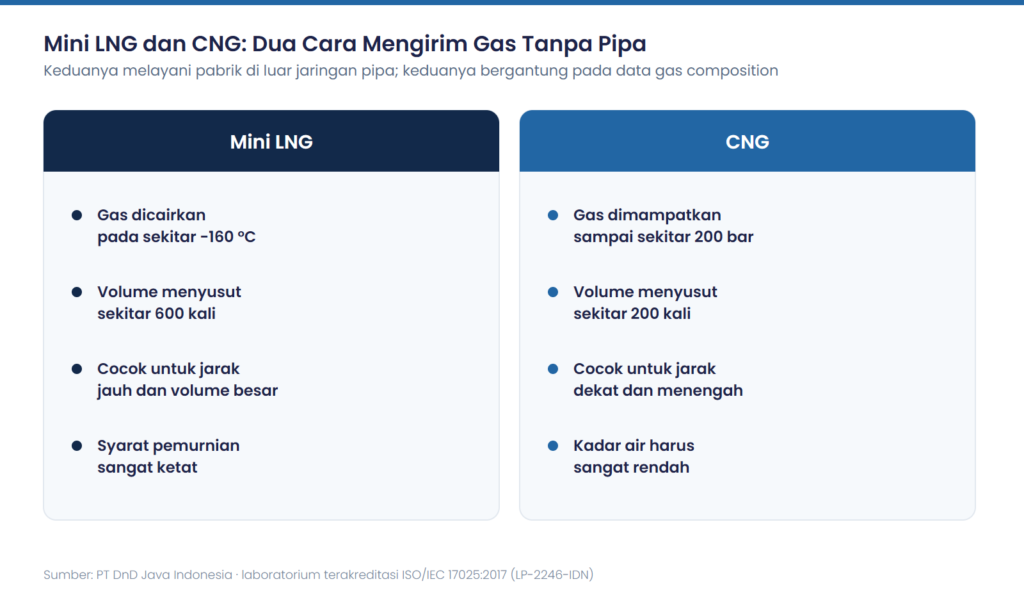
LNG (liquefied natural gas) is natural gas cooled to about minus 160 degrees Celsius so it becomes liquid and its volume shrinks about 600 times. Large LNG plants serve exports by tanker, while mini LNG plants operate at tens to hundreds of tonnes per day to serve domestic customers by ISO tank truck.
CNG (compressed natural gas) is natural gas compressed to about 200 bar without liquefaction. Its volume shrinks about 200 times. CNG is filled at a mother station, transported in a gas transport module (GTM) holding dozens of cylinders, then depressurised at a daughter station or directly at the customer's plant. In Indonesia, CNG is also known as BBG for vehicles.
| Aspect | Mini LNG | CNG |
|---|---|---|
| State during transport | Liquid at about −160 °C | Gas at about 200 bar |
| Volume reduction | About 600 times | About 200 times |
| Economic distance | Long, large volumes | Short to medium |
| Facility investment | Higher, needs a liquefaction unit | Lower, needs compressors |
| Gas quality requirements | Very strict purification: CO2, H2S, water, mercury | Very low moisture, low H2S |
| At the customer | Regasification with a vaporiser | Decompression with regulators and heaters |
Why Gas Composition Matters for Mini LNG and CNG
On large pipeline networks, gas quality is maintained by the transmission operator and monitored continuously by online GCs. Mini LNG and CNG facilities are usually smaller, often draw gas from sources whose composition changes, and rarely have their own laboratory. Yet three important decisions depend on composition data.
1. Unit safety and reliability
CO2 freezes at temperatures far above LNG liquefaction temperature. If the purification unit lets CO2 or water through, ice crystals and solid CO2 block the cold heat exchangers. In CNG, residual water can condense and form hydrates or cause corrosion inside high-pressure cylinders, especially when H2S is present.
2. Basis for energy billing
Mini LNG and CNG customers usually pay on an energy basis, for example per MMBTU. Energy is calculated from volume or mass multiplied by heating value, and heating value is calculated from composition per ISO 6976 or GPA 2172. Composition that is not measured correctly means billing that can be disputed.
3. Compatibility with customer equipment
Burners, boilers, and gas engines at customer plants are tuned for a specific Wobbe index range. Gas that is too rich or too lean can cause unstable flames, lower efficiency, or trigger alarms. Composition data helps ensure the gas delivered suits the customer's equipment.
Five Gas Analysis Points at Mini LNG and CNG Facilities
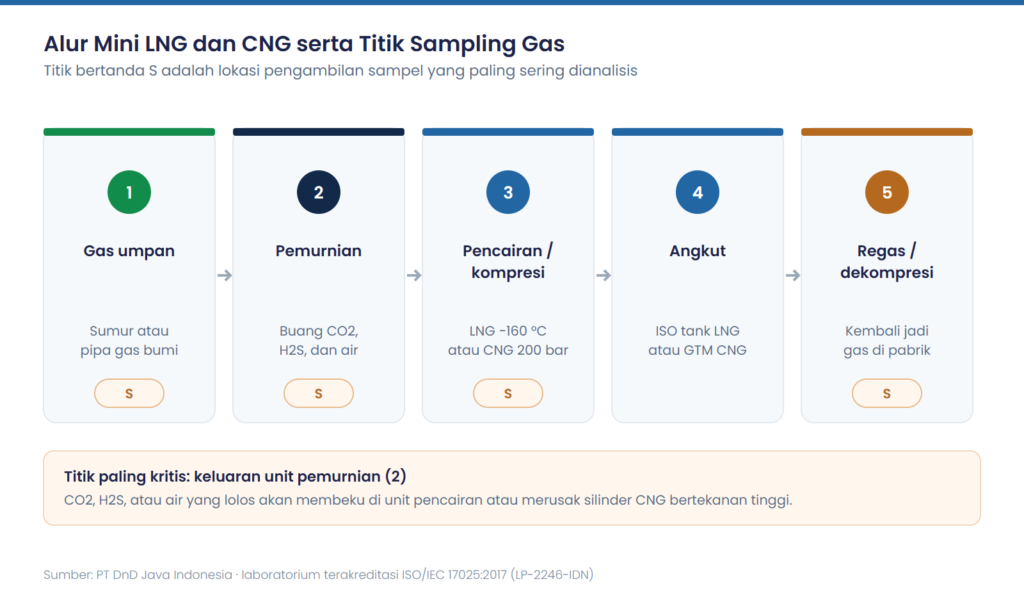
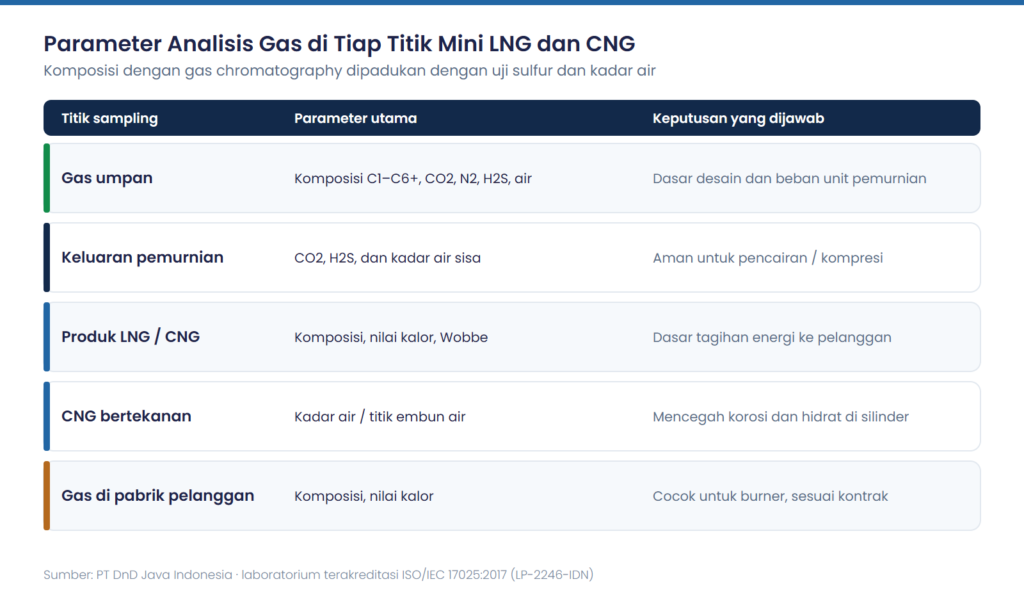
Point 1: Feed gas
Gas entering from wells or pipelines is fully analysed: C1 to C6+ hydrocarbons, nitrogen, CO2, H2S, and moisture. This data sets the purification unit load, expected product yield, and base heating value. Because small-scale gas sources often change composition, feed gas analysis needs to be repeated periodically.
Point 2: Purification unit outlet
This is the most critical point. Analysis confirms CO2, H2S, and water have fallen below safe limits for the liquefaction unit or compressor. For mini LNG, mercury must also be confirmed very low because it can damage aluminium heat exchangers.
Point 3: LNG or CNG product
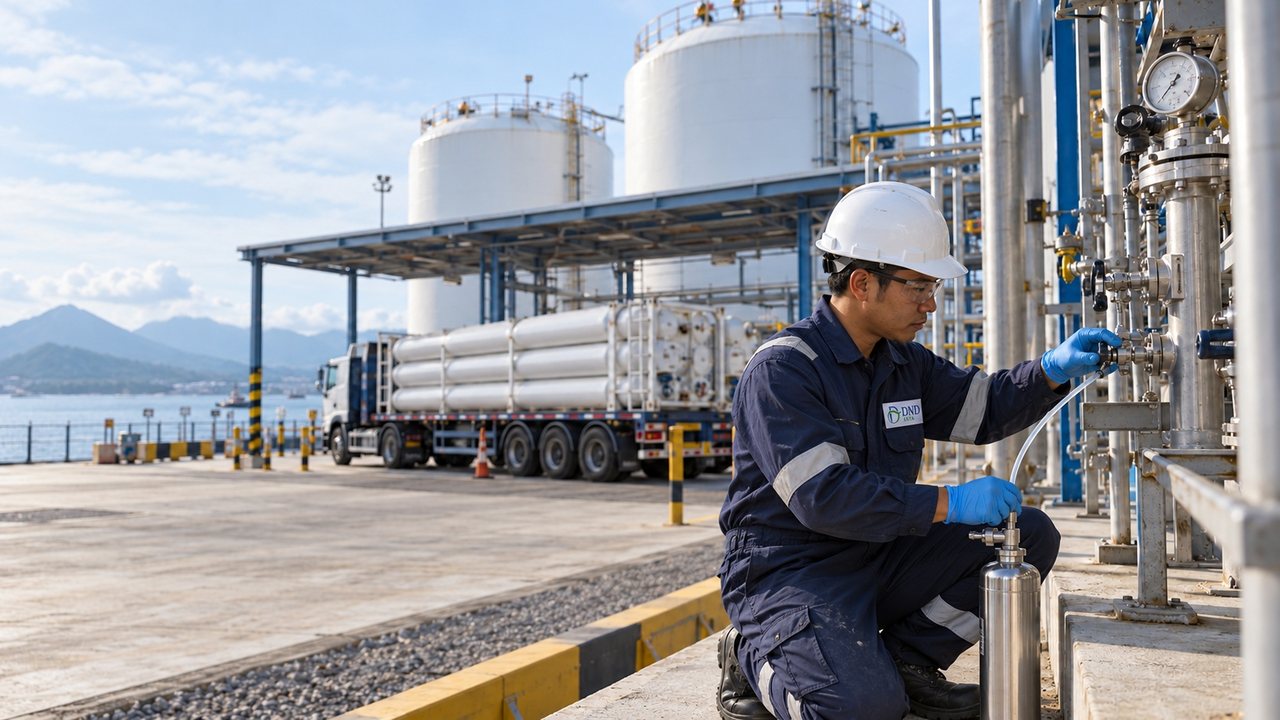
Product composition is the basis for the heating value, density, and Wobbe index stated in delivery documents. For LNG, liquid samples are vaporised in a controlled way before analysis so light and heavy components do not separate.
Point 4: Pressurised CNG in cylinders
Moisture or water dew point at high pressure is checked to prevent condensation when the gas is decompressed and cools. Moisture testing follows ASTM D1142 or an equivalent analyser method.
Point 5: Gas at the customer plant
After regasification or decompression, the gas actually entering customer equipment can be analysed as independent verification. This point matters when a customer disputes the heating value or burner performance.
Gas Analysis Parameters and Standards for Mini LNG and CNG
| Parameter | Method standard | For |
|---|---|---|
| C1–C6+, N2, CO2 composition | GPA 2261, ASTM D1945, ISO 6974 | All points |
| Extended composition C9+ | GPA 2286, ISO 6975 | Rich feed gas, hydrocarbon dew point |
| Heating value, density, Wobbe | ISO 6976, GPA 2172 (calculated) | Product and billing |
| H2S and sulphur compounds | ASTM D5504, ISO 19739 | Feed gas, purification outlet |
| Moisture / water dew point | ASTM D1142 | Purification outlet, CNG |
| Gas sampling | GPA 2166 | All gas-phase points |
The standards used should be agreed with the customer from the start and written into the contract. That way, laboratory results can be used directly as the basis for billing and settling differences.
Example: How Nitrogen Affects Mini LNG Billing
Nitrogen does not burn, so every percent of nitrogen in the gas lowers the heating value. In mini LNG, nitrogen also tends to concentrate in the tank vapour phase (boil-off) and can shift LNG composition during storage.
| Nitrogen content | Estimated effect on heating value | Business impact |
|---|---|---|
| 0,5% | Almost no effect | Stable billing |
| 2% | Falls about 1.5% | Difference becomes noticeable at large volumes |
| 5% | Falls about 4–5% | Needs to be addressed in the contract and specification |
The figures above are illustrative for methane-dominated gas. Actual values are calculated from the full gas chromatography composition. The point is that without accurate composition data, seller and buyer have no common basis for calculating the energy traded.
How to Sample Correctly
Most differences between laboratories come from sampling. For mini LNG and CNG facilities, a few points need special attention.
| Point | Sampling method | What must be controlled |
|---|---|---|
| Feed gas and purification outlet | Gas cylinders per GPA 2166 | Adequate purging, clean and dry cylinders |
| Liquid LNG | Liquid sample vaporised with a controlled vaporiser | Complete vaporisation to avoid fractionation |
| High-pressure CNG | Stepwise pressure reduction into the cylinder | Avoid condensation as pressure drops |
| Moisture content | On-site measurement or special cylinders | Short, dry sampling lines |
Sample cylinders should reach the laboratory as quickly as possible. A laboratory close to the facility reduces the risk of leaks and sample change in transit.
Boil-Off and LNG Composition Changes During Delivery
LNG in an ISO tank keeps absorbing a little heat from the surroundings even though the tank is insulated. This heat makes some LNG evaporate as boil-off gas. The most volatile components are nitrogen and methane, so over time the remaining LNG becomes slightly richer in ethane and propane. This process is called LNG ageing or weathering.
As a result, the LNG heating value on arrival can differ slightly from when it was loaded, especially on long trips or if LNG is stored long in the customer's tank. For long-distance deliveries, analysis at loading and unloading points gives a fairer picture of the energy actually transferred and helps seller and buyer agree on the billing reference point.
How to Read Results for Operations and Billing
| Figure in the report | Read by | Question answered |
|---|---|---|
| CO2, H2S, water at purification outlet | Operations team | Is the purification unit working as designed? |
| Product composition and heating value | Commercial team | How much energy is billed per delivery? |
| Wobbe index | Customer technical team | Is the gas suitable for our burners? |
| Feed gas composition trend | Management | Is the gas source changing and does it need adjustment? |
| Pre-normalisation total | Laboratory and auditors | Can the sample and calibration be trusted? |
A good report shows composition, calculated properties with reference conditions, methods used, and sampling data. For periodic programmes, month-by-month trend charts are far more useful than one-off figures.
Common Mistakes at Mini LNG and CNG Facilities
| Mistake | Consequence | Prevention |
|---|---|---|
| Feed gas analysed only at design stage | Source changes go undetected | Periodic feed gas analysis |
| Relying only on an online CO2 analyser | Drift goes undetected | Verify with laboratory analysis |
| Heating value uses old contract figures | Billing does not match the real gas | Calculate from the latest composition |
| LNG sample partially vaporised | Composition biased towards light components | Correct vaporiser and procedure |
| CNG moisture not monitored | Corrosion and hydrates in cylinders | Routine moisture testing after the dryer |
For Factories Switching to Mini LNG or CNG
Many factories are switching from diesel, fuel oil, or LPG to natural gas delivered via mini LNG or CNG. The switch usually lowers energy costs and emissions, but raises new questions for plant engineering teams: is the gas received always the same quality, and does the billed energy match what was actually received?
| Factory question | Data that answers it |
|---|---|
| Do burners need retuning when the supply changes? | Wobbe index and composition of the gas received |
| Is the per-MMBTU bill correct? | Heating value from composition, compared with delivery documents |
| Why has boiler efficiency changed? | Composition and heating value trends over time |
| Is the gas safe for our equipment? | H2S and moisture after decompression or regasification |
Independent analysis at the receiving point gives the factory its own data to compare with the supplier's. The supplier-customer relationship becomes healthier because both rely on traceable figures from an accredited laboratory.
Recommended Analysis Schedule
- Commissioning — full analysis at every point before the facility reaches full operation.
- Monthly — feed gas, purification outlet, and product, as the basis for trends and billing.
- Every change of source — new wells, new suppliers, or blending gas from several sources.
- After maintenance — replacement of adsorbents or dryers, or compressor repairs.
- When customers complain — independent verification at the custody transfer point.
Link with LPG and Condensate
Feed gas rich in propane and butane is often processed first to recover LPG and condensate before the remaining gas is liquefied or compressed. Such facilities need gas composition analysis for feed and sales gas, as well as LPG analysis for their liquid products. One laboratory handling both makes the facility's mass and energy balance easier to build.
Mercury: A Hidden Risk in Mini LNG
Some natural gas in Indonesia contains mercury at very low levels. At room temperature, mercury causes no visible problems. But in mini LNG liquefaction units, heat exchangers are usually made of aluminium, and mercury can react with aluminium, making the metal brittle and prone to cracking. This damage is hard to detect until a leak occurs.
That is why mini LNG facilities install mercury removal units, and mercury levels after these units must be confirmed periodically. Mercury analysis in gas uses a dedicated method, separate from gas chromatography, and its results complement the composition data from the same point.
Growth of Mini LNG and CNG in East Java and Central Java
East Java has onshore and offshore gas fields, a pipeline network serving the Gresik, Surabaya, Sidoarjo, and Pasuruan industrial estates, and many factories beyond pipeline reach. This makes mini LNG and CNG increasingly popular: gas is taken from supply points, processed in small facilities, then trucked to ceramics, food, textile, and other plants switching from diesel or LPG.
Central Java follows a similar pattern, with industrial estates in Semarang, Kendal, and along the north coast corridor needing cleaner, cheaper energy. Blora and Cepu, bordering East Java, are part of the same oil and gas region. For operators in both provinces, the laboratory in Bojonegoro is a few hours away, so samples can be analysed quickly.
Choosing a Laboratory for Mini LNG and CNG Facilities
| Question | Why it matters |
|---|---|
| Is the gas chromatography method within the ISO/IEC 17025 accreditation scope? | Accreditation applies per method |
| Can the laboratory sample liquid LNG and high-pressure CNG? | Both need special equipment and procedures |
| Are moisture and sulphur tests available besides composition? | The purification outlet needs all three |
| How long is the trip from the facility to the laboratory? | Quickly analysed samples are more reliable |
| Do reports show trends for periodic programmes? | Trends are more useful than one-off figures |
Preparing to Start an Analysis Programme
- Facility flow diagram — to identify correct and safe sampling points.
- Purification unit design specification — the CO2, H2S, water, and mercury limits to be achieved.
- Gas sales contract — the agreed heating value calculation standard and reference conditions.
- Operating and delivery schedule — so sampling is done while the facility operates normally.
- Field staff contact — for work permits and safety escort during sampling.
With this information, the analysis programme can be set up once and run routinely without re-planning every time a sample is taken. A routine programme also makes internal audits, regulator inspections, and technical discussions with customers easier, because all mini LNG or CNG data is stored in the same format month to month and can be compared directly.
Key Terms
| Term | Short meaning |
|---|---|
| Mini LNG plant | A small-scale gas liquefaction facility for the domestic market |
| ISO tank | An insulated container-shaped tank for carrying LNG by truck |
| Mother station | A compression station where CNG is filled into transport cylinders |
| Daughter station | A CNG pressure-reduction station at the customer end |
| GTM (gas transport module) | An array of high-pressure CNG cylinders on a truck |
| Boil-off gas | Gas that evaporates from LNG during storage and transport |
| Regasification | The process of turning LNG back into gas |
| Wobbe index | A measure of gas compatibility with burners; heating value divided by the square root of relative density |
Mini LNG and CNG Gas Analysis Services in East Java and Central Java
PT DnD Java Indonesia operates a KAN-accredited ISO/IEC 17025:2017 laboratory (LP-2246-IDN) in Bojonegoro, at the heart of the Tuban, Bojonegoro, Cepu, and Gresik gas region and within reach of the Sidoarjo, Pasuruan, Surabaya, and Semarang industrial estates. We provide gas analysis for mini LNG plants, CNG mother and daughter stations, and their customer plants, from on-site sampling to reporting. Parameter and package details are on the page gas composition services.
For facilities that need routine data, we set up periodic monitoring programmes with a fixed sampling schedule per point, prepared cylinders, and composition and heating value trend reports. Our team can be mobilised anywhere in Indonesia for projects outside Java.
Frequently Asked Questions about Mini LNG and CNG
What is the difference between mini LNG and CNG?
Mini LNG liquefies natural gas at about minus 160 degrees Celsius, shrinking its volume about 600 times, and suits long distances. CNG compresses gas to about 200 bar, shrinking it about 200 times, and suits short to medium distances.
What analysis does a mini LNG facility need?
A mini LNG facility needs feed gas composition analysis; CO2, H2S, water, and mercury after the purification unit; and LNG product composition and heating value. All composition is measured by gas chromatography per GPA or ISO.
Why is moisture important for CNG?
Water in high-pressure CNG can condense when the gas is decompressed and cools. This forms hydrates that block regulators and causes corrosion in cylinders, especially when the gas contains H2S. Moisture is tested per ASTM D1142.
How often should mini LNG and CNG gas be analysed?
Usually monthly for feed gas, purification outlet, and product, plus whenever the gas source changes, after purification unit maintenance, and when customers complain. A full analysis is done at commissioning.
Related Articles
- gas chromatography — how it works, detectors, and gas composition analysis standards
- LPG analysis — ASTM D2163 composition, vapour pressure, and LPG sampling
- automated sampling system — how it works, components, and automated sampling standards
Operating a mini LNG plant or CNG station?
Tell us your sampling points and operating schedule; we will prepare the cylinders, methods, and periodic analysis programme. Choose your sector — the WhatsApp message is pre-filled, just send it.
WhatsApp — LNGWhatsApp — CNGWhatsApp — LPGWhatsApp — Natural Gas / Pipeline
Or call (0353) 8940000 · [email protected]