

LPG analysis is a series of laboratory tests to ensure liquefied petroleum gas has a composition and properties that are safe, on-specification, and fit for sale. At its core is hydrocarbon composition, the ratio of propane, butane, and other components, measured by gas chromatography per ASTM D2163. From that composition and supporting tests, vapour pressure, density, and LPG cleanliness can be confirmed. In short, LPG analysis answers one question: is this LPG safe and as promised to the buyer?
This article covers why LPG analysis is needed, the parameters and standards used, how to sample LPG correctly, where analysis is carried out, how to read the results, and the mistakes that most often skew them. It is written for refineries and gas processing units, terminals and depots, LPG filling plants, and industrial LPG users.
Why LPG Analysis Is Needed
LPG is stored and transported as a pressurised liquid, then used as a gas. This makes its composition critical to safety. LPG with too many light components such as ethane has a high vapour pressure that can exceed the cylinder's design limit. Conversely, LPG with too much pentane and heavy fractions leaves liquid residue at the bottom of the cylinder and does not vaporise completely.
| Risk | Cause | Detecting parameter |
|---|---|---|
| Excess cylinder pressure | Ethane or propane too high | Composition, vapour pressure |
| Gas does not run out, liquid left in the cylinder | High pentane and heavy fractions | C5+ composition, residue, weathering |
| Valve and regulator corrosion | Reactive sulphur compounds | Copper strip corrosion, total sulphur |
| Unstable burner flame | Composition changes between supplies | Composition, density |
| Billing differences at custody transfer | Density and composition not agreed | Density, composition |
On the business side, LPG analysis is the basis of custody transfer. LPG volume measured in tanks or meters is converted to mass using density, and density itself depends on composition. Without agreed data, small differences in composition turn into differences in tonnage and invoice value.
Six Key LPG Analysis Parameters
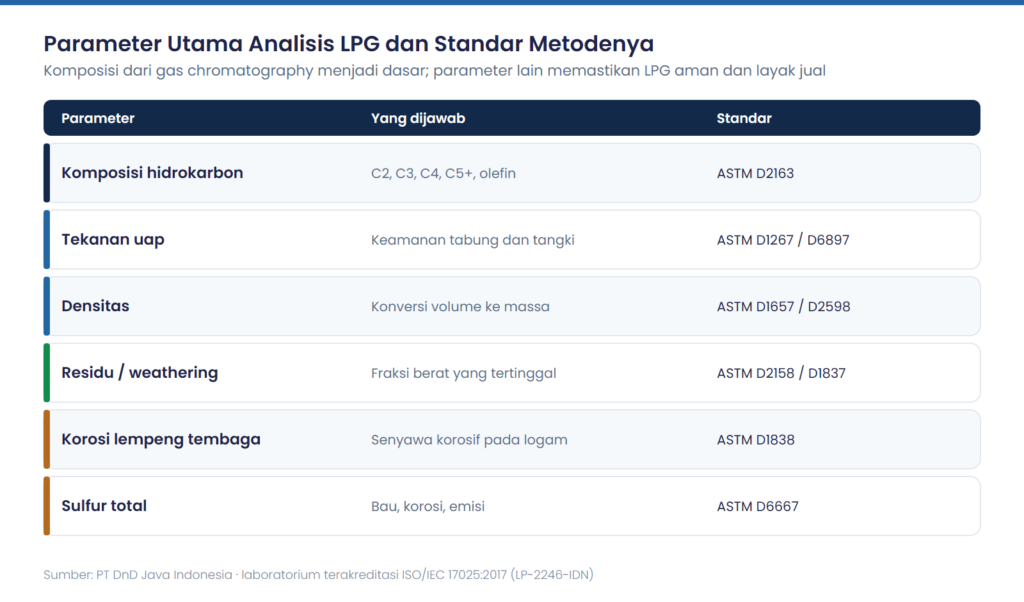
1. Hydrocarbon composition (ASTM D2163)
Composition is measured by gas chromatography and gives the content of ethane, propane, propylene, isobutane, n-butane, butylenes, and pentanes plus. The result is the basis for calculating other properties and shows whether the LPG is commercial propane, commercial butane, or a mixture.
2. Vapour pressure (ASTM D1267 or D6897)
Vapour pressure shows how strongly LPG pushes on the cylinder wall at a given temperature. It can be measured directly or calculated from composition per ASTM D2598. Vapour pressure is the most important safety parameter for cylinders and tanks.
3. Density (ASTM D1657 or calculated from composition)
Density is used to convert volume to mass at custody transfer and to set cylinder fill levels. Density calculated from composition must be consistent with direct measurement.
4. Residue and weathering (ASTM D2158 and D1837)
The residue test measures material left after LPG evaporates, while the weathering test looks at the temperature when most of the sample has evaporated. Both reveal heavy fractions and contaminants such as oil that do not evaporate.
5. Copper strip corrosion (ASTM D1838)
A copper strip is immersed in LPG and its colour change is rated. This test detects reactive sulphur compounds such as H2S that can damage valves, regulators, and brass components.
6. Total sulphur (ASTM D6667)
Total sulphur covers natural sulphur and the odorant deliberately added so leaks can be smelled. Its level must be enough for safety but not excessive, as it adds to emissions and corrosion.
Propane, Butane, and LPG Mixtures
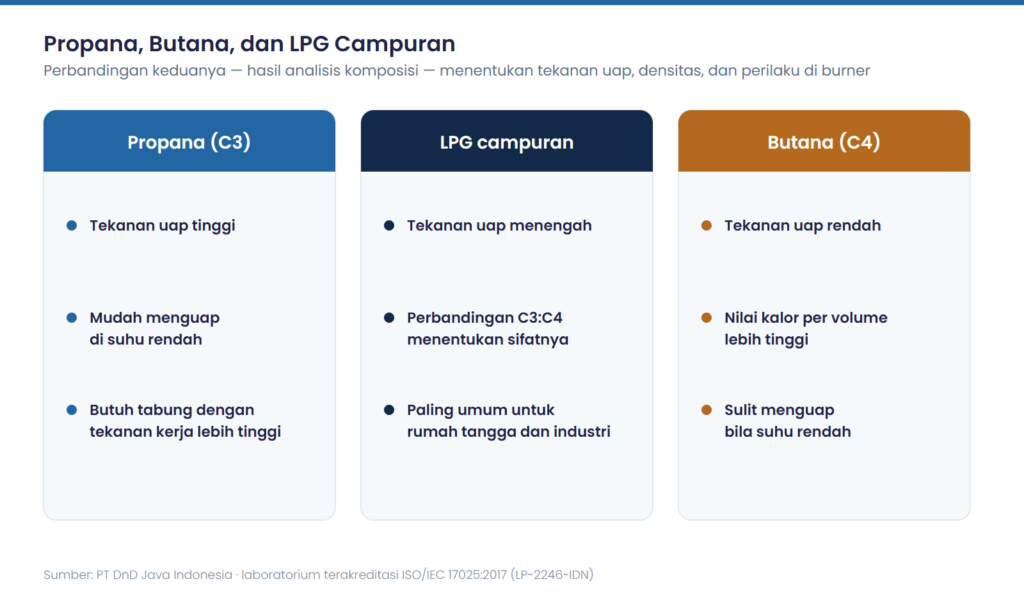
LPG sold in Indonesia is generally a mixture of propane and butane. Their ratio is the most important result of LPG analysis, as it determines almost every property of the product.
| Property | More propane | More butane |
|---|---|---|
| Vapour pressure | Rises | Falls |
| Vaporisation at low temperature | Easier | Harder |
| Liquid density | Lower | Higher |
| Heating value per gas volume | Lower | Higher |
| Cylinder requirements | Higher working pressure | Lower working pressure |
So small changes in refinery feed gas, such as a new well or changed fractionation conditions, can shift the propane-butane ratio. Periodic LPG analysis catches this shift before the product is shipped to customers. For industrial users the change is felt directly: a burner tuned for one composition can produce a different flame when the supply changes, so composition data from each supplier helps production teams keep combustion efficient and safe. In procurement, LPG analysis results from several suppliers can also be compared fairly because they are measured with the same method and units.
How to Sample LPG Correctly
LPG is a liquid that boils at room temperature when its pressure is released. If sampled incorrectly, the light components evaporate first and what remains in the cylinder no longer represents the product. That is why sampling follows ASTM D1265 or the floating-piston cylinder method of ASTM D3700.
| Step | Purpose |
|---|---|
| Use a clean, dry sample cylinder | Prevents contamination from previous samples |
| Purge the cylinder with LPG from the sampling point | Makes the cylinder contents match the product |
| Take the sample in the liquid phase | The vapour phase does not represent the overall composition |
| Leave a controlled outage | Prevents over-pressure when temperature rises |
| Label point, time, temperature, and pressure | Keeps results traceable |
| Send to the laboratory promptly | Reduces the risk of leakage and sample change |
A laboratory that also samples on site can ensure all these steps are done correctly, so LPG analysis results are defensible at custody transfer.
Where LPG Analysis Is Carried Out
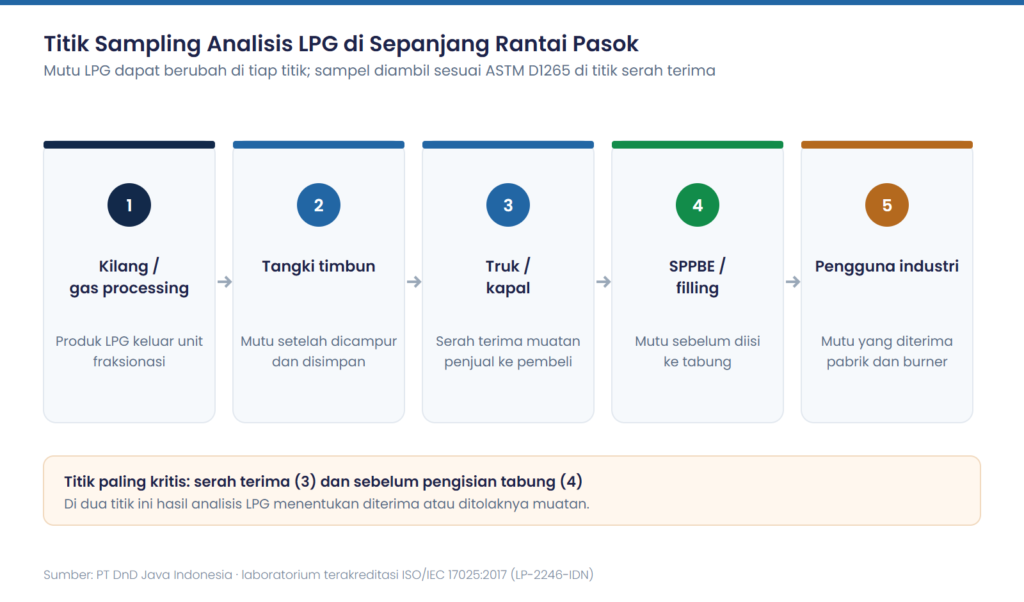
Refineries and gas processing units
At LPG plants and small to medium gas processing units, LPG analysis monitors fractionation column performance. High ethane indicates a sub-optimal de-ethaniser, while high pentane means debutaniser separation needs retuning.
Storage tanks and terminals
After several production batches are blended in a tank, LPG analysis confirms the combined product stays on specification before it is sold.
Truck and ship custody transfer
Samples are taken during loading or unloading. Composition and density results are the basis for the billed mass and for settlement if buyer and seller disagree.
LPG filling plants and stations
Before LPG is filled into cylinders, the quality of the product received must be confirmed. Vapour pressure and residue are the parameters most closely tied to end-user safety.
Industrial LPG users
Plants using LPG for heating, ovens, or combustion processes need a stable composition so burners work consistently and the energy purchased matches the contract.
How to Read an LPG Analysis Report
| Report section | What it means | What to check |
|---|---|---|
| Composition (mol %, liquid volume %, or mass %) | Content of each hydrocarbon | Units match the contract specification |
| Total C3 + C4 | Propane and butane share | Meets the minimum specification limit |
| C5+ (pentane and heavier) | Heavy fraction | Below the maximum specification limit |
| Vapour pressure | Cylinder safety | Measurement reference temperature is stated |
| Density | Volume-to-mass conversion | Reference temperature (usually 15 °C) is stated |
| Copper corrosion, residue, sulphur | Product cleanliness | Passes the set limits |
Watch the composition units. Mol percent, liquid volume percent, and mass percent give different figures for the same sample. A good report states units clearly and, on request, presents all three so they can be compared directly with the specification.
Common Mistakes in LPG Analysis
| Mistake | Consequence | Prevention |
|---|---|---|
| Sample taken from the vapour phase | Propane reads too high, butane too low | Sample from the liquid phase |
| Cylinder filled full with no outage | Dangerous pressure when temperature rises | Leave outage per ASTM D1265 |
| Cylinder leaks during shipment | Light components are lost | Leak test before and after sampling |
| Composition units not agreed | Figures appear off-specification | Agree on units from the start |
| Unsuitable calibration standard gas | Butylene and pentane levels are off | Use a traceable LPG standard gas |
Example: How Composition Affects Custody Transfer Tonnage
Suppose a tank truck carries 20 cubic metres of liquid LPG. If LPG analysis shows a butane-rich mixture, its liquid density is higher than a propane-rich mixture. For the same volume, the mass of LPG loaded differs by several hundred kilograms. Because LPG is traded by mass, this difference becomes a billing difference directly.
| Calculation step | Data required | Data source |
|---|---|---|
| 1. Measured liquid volume | Tank level or flow meter | On-site instruments |
| 2. Volume correction to reference temperature | Liquid temperature and correction factor | Thermometer, correction tables |
| 3. Density at reference temperature | Composition or direct measurement | Laboratory LPG analysis |
| 4. Massa = volume terkoreksi x densitas | Results of steps 2 and 3 | Calculation |
The third step is the only one that depends on the laboratory, but its effect on the final figure is large. That is why LPG contracts usually name the analysis method, the agreed laboratory, and the procedure if both parties' results differ.
LPG Analysis for Monitoring Plant Performance
For LPG plants and gas processing units, LPG analysis is not only product quality control but also a tool for reading process performance. Product composition points directly to which column needs tuning.
| Finding in the LPG analysis | Possible cause | Typical action |
|---|---|---|
| Ethane above limit | De-ethaniser not separating light fractions enough | Review de-ethaniser column temperature and pressure |
| High pentane and C5+ | Debutaniser separation not sharp enough | Review reflux and column bottom temperature |
| Unexpected olefins | Mixed with streams from other units | Check blending lines and valves |
| Copper corrosion fails | Reactive sulphur compounds slipping past the treating unit | Check the sulphur removal unit |
| High residue | Carry-over of lube oil or heavy fractions | Check compressors and separators |
With periodic analysis, composition trends can be compared week by week. Gradual changes are often an early sign of process problems, long before the product actually goes off specification. For small gas processing units without their own laboratory, a periodic programme from an accredited laboratory near the site is the most efficient way to get this data.
LPG Analysis vs Natural Gas Analysis
Both use gas chromatography, but the sample, instrument configuration, and purpose differ. Understanding the difference helps you choose the right service.
| Aspect | LPG analysis | Natural gas analysis |
|---|---|---|
| Sample state | Pressurised liquid | Gas |
| Main components | Propane and butane | Methane |
| Composition standard | ASTM D2163 | GPA 2261, ASTM D1945, ISO 6974 |
| Calculated properties | Vapour pressure, liquid density | Heating value, Wobbe index, relative density |
| Sampling method | ASTM D1265, cylinder with outage | GPA 2166, gas cylinder |
| Transaction basis | Mass (tonnes) | Energy (MMBTU) |
Facilities that process natural gas into LPG and sales gas usually need both: analysis of feed and sales gas by natural gas methods, and analysis of the LPG product per ASTM D2163.
Recommended LPG Analysis Schedule
- Every batch or shipment — for custody transfer at refineries, terminals, and trucks.
- Weekly or monthly — monitoring fractionation unit performance and storage tank quality.
- When the source changes — new feed gas, new supplier, or changes in plant operation.
- At commissioning — new gas processing units or storage facilities.
- When there are complaints — cylinders running out fast with liquid left, unstable flames, or regulator corrosion.
Safety When Handling LPG Samples
LPG samples are flammable pressurised liquids. Safe handling protects staff and keeps samples intact until analysis.
- Certified cylinders — sample cylinders have the right working pressure and are tested periodically.
- Mandatory outage — cylinders must never be completely full of liquid, as expansion can rupture them.
- No ignition sources — sampling is done away from heat and sparks, with personal protective equipment.
- Leak testing — connections and valves are checked before and after sampling.
- Safe transport — cylinders are secured upright, shielded from direct sun, and labelled as hazardous.
These procedures also protect data quality. Cylinders exposed to excessive sun or slowly leaking lose light components, and the LPG analysis no longer represents the product.
Choosing an LPG Analysis Laboratory
| Question | Why it matters |
|---|---|
| Is ASTM D2163 within the laboratory's ISO/IEC 17025 accreditation scope? | Accreditation applies per method |
| Does the laboratory supply clean LPG sample cylinders? | Dirty cylinders contaminate results |
| Can laboratory staff take samples on site? | Most errors happen during sampling |
| How far and how long is the trip to the laboratory? | The sooner it is analysed, the lower the leak risk |
| Does the report present units matching the contract specification? | Avoids misreading results |
For facilities in East Java and Central Java, a nearby laboratory offers real advantages: samples can be analysed the same or next day, and staff can attend custody transfer sampling.
Key LPG Analysis Terms
| Term | Short meaning |
|---|---|
| LPG (liquefied petroleum gas) | A mixture of light hydrocarbons, mainly propane and butane, liquefied under pressure |
| Commercial propane | Propane-dominated LPG, high vapour pressure |
| Commercial butane | Butane-dominated LPG, low vapour pressure |
| Olefins | Unsaturated hydrocarbons such as propylene and butylene, usually from refinery cracking units |
| Vapour pressure | The pressure LPG produces in a closed container at a given temperature |
| Weathering | Evaporation test to see the heavy fraction remaining |
| Outage | Empty space left in the sample cylinder for liquid expansion |
| Odorant | A smelling agent, usually a mercaptan, so LPG leaks are easy to detect |
Preparing to Order LPG Analysis
The following information helps the laboratory prepare the right cylinders, methods, and report format from the start, so LPG analysis results are usable without retesting:
- Product type — commercial propane, commercial butane, or LPG mixture, and whether it contains olefins from cracking units.
- Sampling points and number of samples — column outlet, storage tank, truck, ship, or filling plant tank.
- Reference specification — government specification, buyer specification, or company internal limits.
- Parameters required — composition only, or complete with vapour pressure, density, residue, corrosion, and sulphur.
- Reporting units — mol percent, liquid volume percent, or mass percent.
- Frequency — one-off, per shipment, or a periodic monitoring programme.
With this data, the sampling schedule can follow loading or production schedules, so staff are present when samples best represent the product being transferred.
DND Java LPG Analysis Services in East Java and Central Java
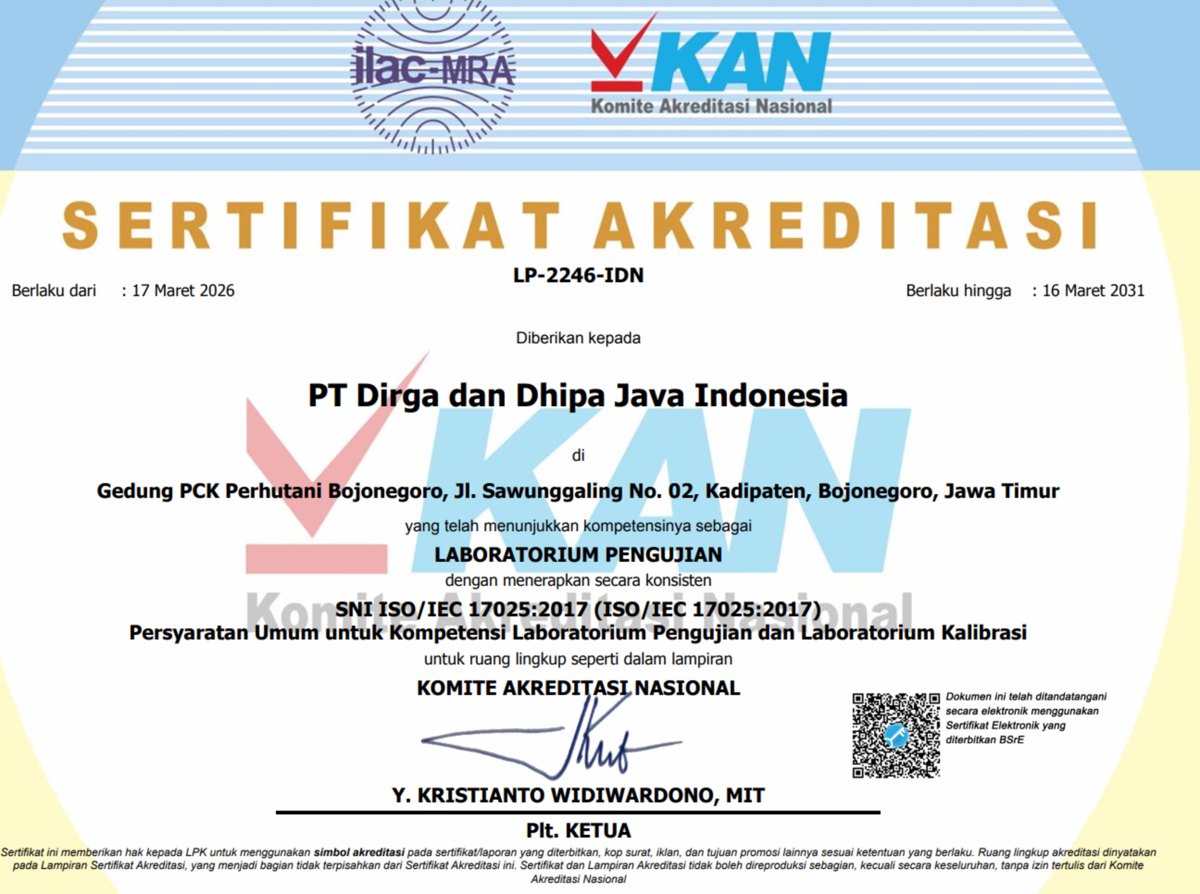
PT DnD Java Indonesia operates a KAN-accredited ISO/IEC 17025:2017 laboratory (LP-2246-IDN) in Bojonegoro, close to LPG plants and gas processing facilities in Tuban, Bojonegoro, Gresik, and Cepu. We provide LPG analysis from on-site sampling with cylinders we prepare, to composition analysis by gas chromatography, to reports formatted to your specification. Full parameter details are on the page gas composition services.
For plants and filling stations that need routine data, we set up periodic analysis programmes with fixed sampling schedules and trend reports. Our main service area covers East Java and Central Java, and our team can be mobilised anywhere in Indonesia. Every report states the method, units, reference conditions, and sampling data, so it can be attached directly to custody transfer documents, quality audits, or buyer and regulator inspections without further explanation.
Frequently Asked Questions about LPG Analysis
What is LPG analysis?
LPG analysis is laboratory testing to confirm LPG meets its specification. Its core is the composition of propane, butane, and other components by gas chromatography per ASTM D2163, plus vapour pressure, density, residue, copper corrosion, and sulphur.
Which standard is used for LPG composition?
LPG composition is generally tested per ASTM D2163 by gas chromatography. Vapour pressure and density can be calculated from composition per ASTM D2598 or measured directly per ASTM D1267 and D1657. Samples are taken per ASTM D1265.
Why must LPG samples be taken in the liquid phase?
Light components such as propane evaporate more easily, so the vapour phase above the liquid contains more propane than the actual product. A liquid-phase sample represents the composition of the LPG being sold and transferred.
How often should LPG be analysed?
For custody transfer, analysis is done for every batch or shipment. For monitoring plants and storage tanks, usually weekly or monthly, plus whenever the feed gas source or operating conditions change.
Related Articles
- gas chromatography — how it works, detectors, and gas composition analysis standards
- automated sampling system — how it works, components, and automated sampling standards
- automated sampling systems — 5 reasons industries need automated sampling
Need LPG analysis for your plant, filling station, or factory?
Tell us the sampling points, number of samples, and reference specification; we will prepare the cylinders, method, and schedule. Choose your sector — the WhatsApp message is pre-filled, just send it.
WhatsApp — LNGWhatsApp — CNGWhatsApp — LPGWhatsApp — Natural Gas / Pipeline
Or call (0353) 8940000 · [email protected]