

Gas chromatography is a laboratory method that separates a gas mixture into its components and measures the content of each one. In the natural gas, LNG, CNG, and LPG industries, this is the method that produces gas composition figures: what percentage of methane, ethane, propane, nitrogen, and CO2 is in the gas. The heating value that forms the basis of gas trading is calculated from those figures.
This article covers how gas chromatography works, the detectors used, GPA, ASTM, and ISO method standards, its application across each part of the gas industry, how to read test reports, and what makes analysis results trustworthy for contracts and audits.
What Is Gas Chromatography
Gas chromatography works on a simple principle: each compound moves at a different speed when pushed by a carrier gas through a column containing a retaining material. Light compounds such as methane come out first, while heavier compounds such as butane and pentane are held back longer. The exit time identifies the compound, and the size of its signal shows its concentration.
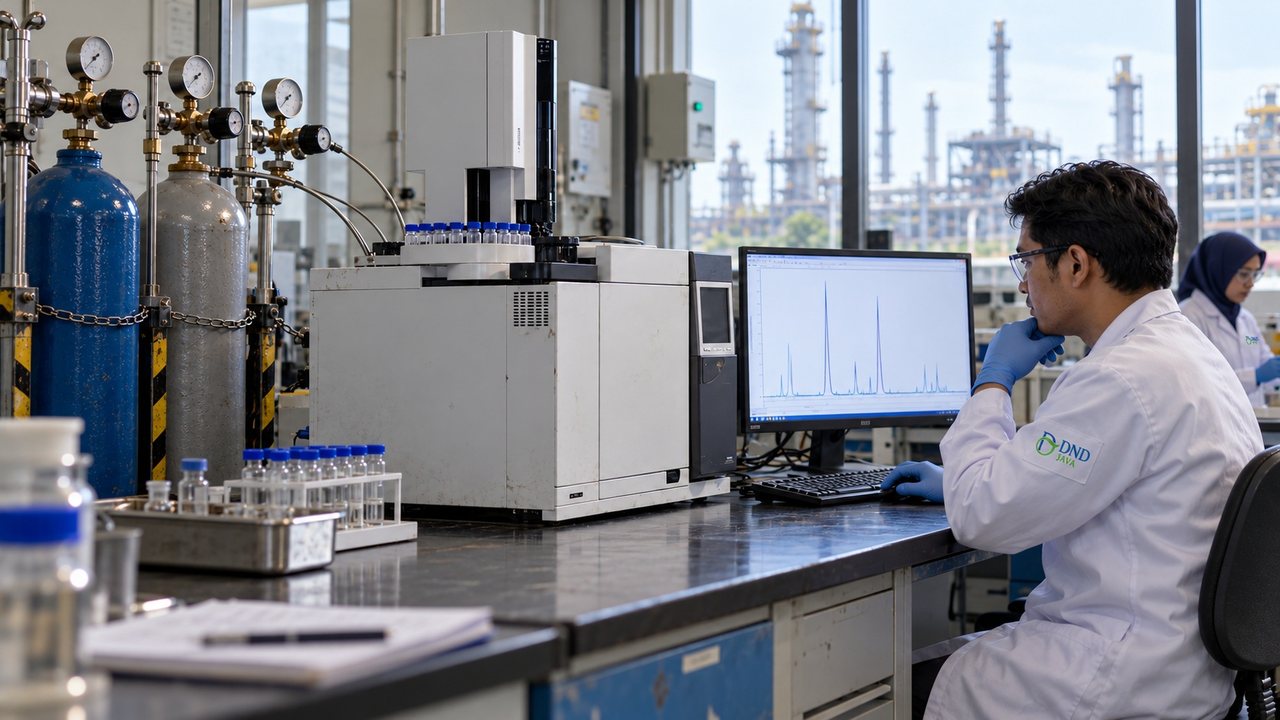
The instrument that runs this method is called a gas chromatograph, or GC. For natural gas analysis, a GC is usually specially configured with several columns and automatic valves so all key components are measured in a single sample injection.
The method is widely used because it provides detail no other instrument can. A single gas chromatography analysis produces a dozen or more component figures, from which heating value, density, Wobbe index, compressibility factor, and even hydrocarbon dew point can be calculated. All these properties are used in facility design, daily operations, and gas transaction calculations. In Indonesia, gas chromatography data is routine at gas fields, pipeline distribution networks, large and small-scale LNG facilities, CNG stations, and LPG plants.
How Gas Chromatography Works Step by Step
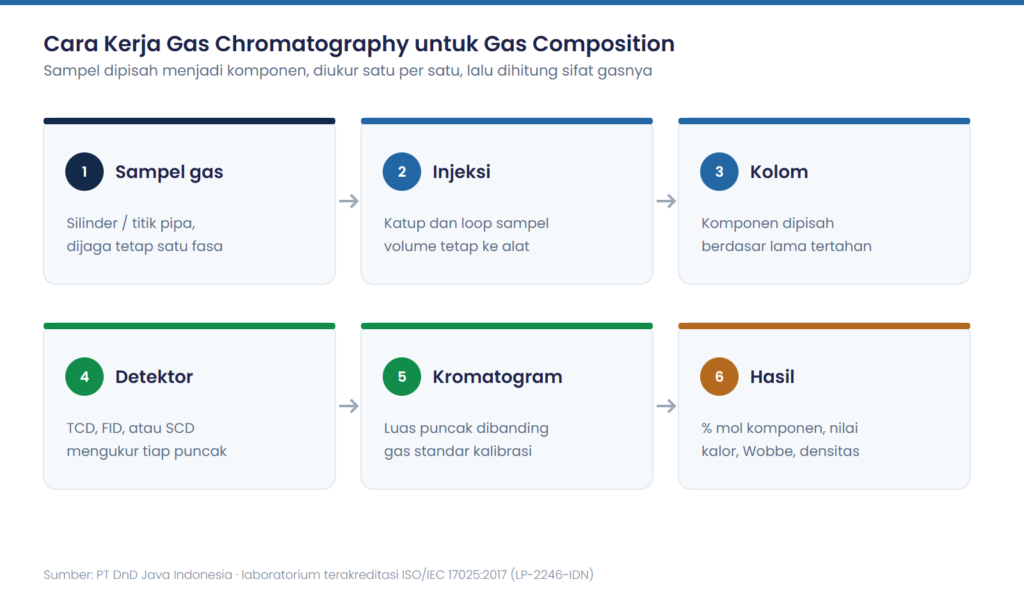
| Step | What happens | What must be controlled |
|---|---|---|
| 1. Gas sample | Gas is taken from a pipeline, tank, or cylinder | The sample represents the flow and does not condense |
| 2. Injection | A valve introduces a fixed sample volume | Stable sample loop pressure and temperature |
| 3. Column | Components separate by retention time | Column type suited to the target components |
| 4. Detector | Each eluting component produces a signal peak | Detector suited to the components measured |
| 5. Chromatogram | Peak areas are compared with the calibration standard gas | Traceable standard gas that is still valid |
| 6. Result | Component mol %, then heating value, Wobbe, density | Calculations follow ISO 6976 or GPA 2172 |
Calibration is key. A gas chromatograph does not measure concentration directly; it compares the sample signal with the signal of a standard gas of known composition. The quality and traceability of the standard gas therefore determine the quality of the results.
Four Detector Types and What They Do
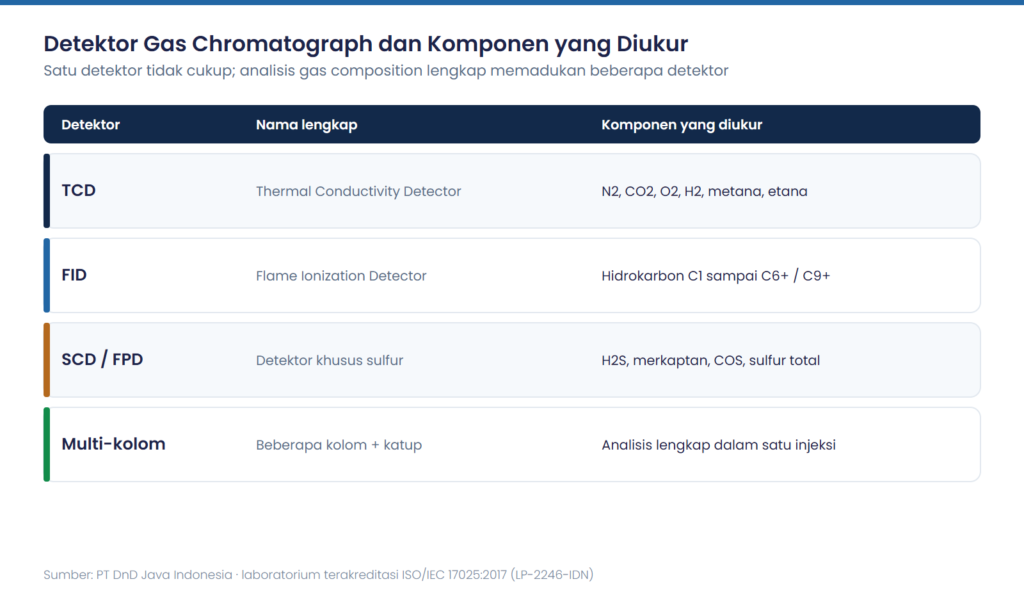
TCD (Thermal Conductivity Detector)
A TCD measures changes in the thermal conductivity of the gas. It responds to almost every component, so it is used for non-hydrocarbon gases such as nitrogen, CO2, oxygen, and hydrogen, as well as methane and ethane at high concentrations.
FID (Flame Ionization Detector)
An FID burns components in a hydrogen flame and measures the ions formed. It is highly sensitive to hydrocarbons, so it is used for propane, butane, pentane, and the heavy C6+ or C9+ fractions that determine hydrocarbon dew point.
SCD and FPD for sulphur compounds
Sulphur compounds such as H2S, mercaptans, and COS occur at ppm or even ppb levels and are corrosive and toxic. Sulphur-specific detectors are used per ASTM D5504 or ISO 19739 to measure them separately.
Multi-column systems
Modern natural gas GCs combine several columns and detectors with switching valves, so a complete C1 to C6+ analysis plus N2 and CO2 is done in a single injection. This is the configuration referred to by GPA 2261 and ISO 6974.
Gas Chromatography Method Standards for the Gas Industry
| Standard | For | Notes |
|---|---|---|
| GPA 2261 / ASTM D1945 | Natural gas | C1–C6+, N2, CO2 composition |
| ISO 6974 | Natural gas | Composition with defined uncertainty |
| GPA 2286 / ISO 6975 | Natural gas, LNG | Extended analysis to C9+ for hydrocarbon dew point |
| GPA 2172 / ISO 6976 | All natural gas | Calculation of heating value, density, Wobbe from composition |
| ASTM D2163 | LPG | C2–C5 hydrocarbon and olefin composition |
| ASTM D5504 | Natural gas | Sulphur compounds with an SCD detector |
| GPA 2166 / ASTM D1265 | Sampling | How to take representative gas and LPG samples |
The standard used is usually set by the gas sales contract or the buyer's specification. Reports that state the standard clearly are more readily accepted when seller and buyer figures differ.
Applying Gas Chromatography to LNG, CNG, LPG, and Natural Gas
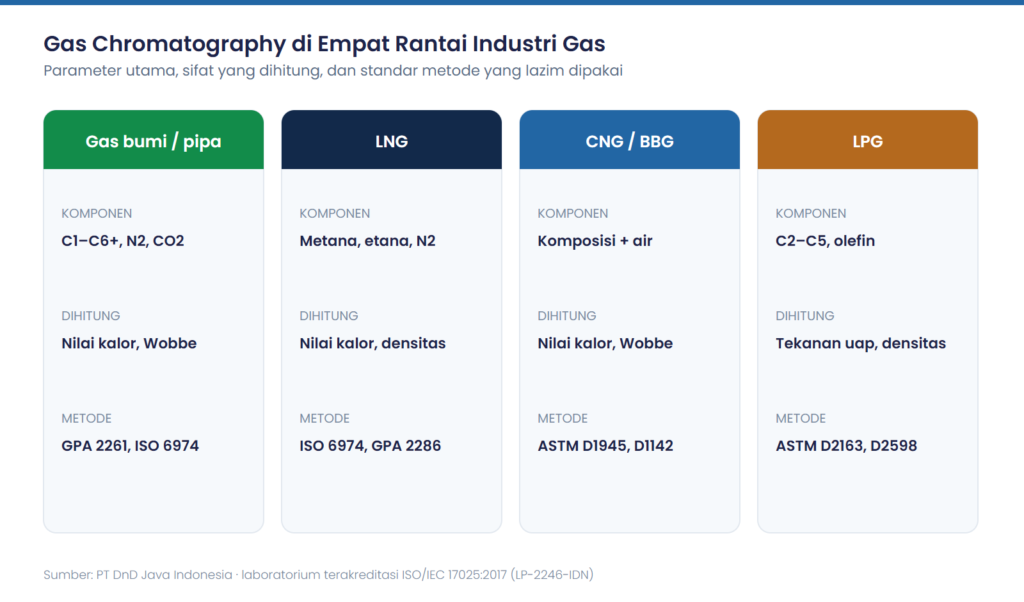
Natural gas and pipeline networks
Pipeline gas composition determines the heating value billed per MMBTU. A small difference in nitrogen or CO2 content directly changes the transaction value, so many contracts require periodic analysis by an independent laboratory.
LNG and mini LNG
Before liquefaction, gas must be free of CO2, H2S, and water that can freeze in the cold box. Gas chromatography is used to check feed gas, purification unit outlet, and LNG product to calculate heating value and density.
CNG and CNG stations
Gas compressed to high pressure must be dry and of stable composition to be safe for vehicle tanks and industrial customers. Composition analysis is combined with moisture testing per ASTM D1142.
LPG and gas processing plants
For LPG, gas chromatography measures the ratio of propane, butane, and pentane that determines the product's vapour pressure and density. In processing plants, this data also shows how efficiently propane and butane are separated from the feed gas. LPG parameters and sampling are covered in detail in the article LPG analysis.
How to Read a Gas Chromatography Report
| Report section | What it means | What to check |
|---|---|---|
| Composition, mol % | Content of each component | Total close to 100% before normalisation |
| Heating value (GHV / NHV) | Energy per volume of gas | Reference temperature and pressure conditions used |
| Wobbe index | Interchangeability of gases in burners | Within the buyer's specification range |
| Relative density | Weight of the gas compared with air | Used for flow meter correction |
| Uncertainty | Confidence range of the result | Stated for contract parameters |
A pre-normalisation total far from 100% indicates a sampling or calibration problem. A good report states this figure, not only the normalised results.
What Makes Gas Chromatography Results Trustworthy
- Correct sampling — clean cylinders, adequate purging, and no condensation in transit.
- Traceable standard gas — composition close to the sample and a valid certificate.
- Method matching the contract — the same GPA, ASTM, or ISO standard agreed with the buyer.
- Accredited laboratory — ISO/IEC 17025 accreditation proves competence and measurement traceability.
- Short time from sampling to analysis — the faster a sample is analysed, the lower the risk of composition change.
Example: From Composition to Heating Value
A gas chromatograph does not measure heating value directly; it is calculated from composition. Each component has an ideal heating value tabulated in ISO 6976 or GPA 2145. The heating value of the mixture is the sum of each component's concentration multiplied by its heating value, then corrected for real-gas behaviour.
| Component | Content (mol %) | Effect on heating value |
|---|---|---|
| Methane (C1) | 85–95 | Largest energy contributor |
| Ethane (C2) | 2–8 | Raises heating value per volume |
| Propane and butane (C3–C4) | 0,5–4 | Raises heating value sharply |
| Nitrogen (N2) | 0,2–5 | Non-combustible, lowers heating value |
| CO2 | 0,5–5 | Non-combustible, lowers heating value and is corrosive when wet |
A simple example: if nitrogen rises from 1% to 3% and methane falls by the same amount, the gas heating value drops by about 2%. For large supplies, a 2% difference means a significant billing amount every month. That is why gas buyers and sellers both depend on accurate gas chromatography recognised by both parties. The same applies to LNG sold on an energy basis, and to LPG whose price and specification depend on the propane-butane ratio. Accurate figures from an accredited laboratory make energy calculations traceable and defensible when checked by auditors, regulators, or buyers.
Laboratory Gas Chromatography and Online GC in the Field
Many gas metering stations install online GCs that analyse gas automatically every few minutes. They are very useful for continuous monitoring but still need verification. Laboratory gas chromatography serves as an independent comparison and covers parameters online GCs do not measure.
| Aspect | Online GC | Laboratory GC |
|---|---|---|
| Frequency | Every few minutes | Periodically per sampling schedule |
| Component coverage | Usually C1–C6+, N2, CO2 | Can be extended to C9+ and sulphur |
| Calibration | On-site standard gas | Traceable standard gas and laboratory quality control |
| Main role | Daily monitoring and energy calculation | Verification, disputes, audits, and full analysis |
| Risk | Undetected calibration drift | Sampling quality at collection |
Good practice is to compare online GC results with laboratory results from samples taken at the same time. A difference beyond the agreed limit signals that the online GC needs recalibration.
Gas Chromatography Compared with Other Methods
Besides gas chromatography, there are other ways to determine gas properties. Each has its place, but only gas chromatography gives a component-by-component breakdown.
| Method | What is measured | Limitations |
|---|---|---|
| Gas chromatography | Content of each component, then gas properties are calculated | Requires a representative sample and standard gas |
| Calorimeter | Heating value directly | No component breakdown |
| Single-parameter analyser | For example only CO2, H2S, or water | No complete composition picture |
| Detector tube | Quick estimate of one compound | Limited accuracy, not for transactions |
Common Mistakes That Skew Gas Composition Results
| Mistake | Consequence | Prevention |
|---|---|---|
| Cylinder not purged enough | Residual old gas mixes with the sample | Repeated purging per GPA 2166 |
| Sample cooled below its dew point | Heavy fractions condense, C6+ reads low | Keep cylinder temperature above the dew point |
| Sampling point at the bottom of the pipe | Liquid is drawn in | Sampling probe in the centre of the flow |
| Expired standard gas | Calibration drifts | Check certificate and validity |
| LPG sample partially vaporised | Light components are lost | Cylinder with controlled outage (ASTM D1265) |
Most differences between laboratories come from sampling, not from the gas chromatograph itself. A laboratory that also handles on-site sampling can therefore control the whole chain from pipeline point to report.
Extended Gas Chromatography: Hydrocarbon Dew Point and Sulphur
A standard C1 to C6+ analysis is enough to calculate heating value, but not for two important issues in gas networks: liquid condensation and corrosion. Both require extended gas chromatography analysis.
Hydrocarbon dew point (HCDP)
Hydrocarbon dew point is the temperature at which heavy fractions in the gas start to condense into liquid at a given pressure. Liquid in pipelines disrupts flow meters, damages compressors, and lowers the quality of gas delivered to customers. HCDP is strongly affected by C7, C8, and C9+ components at very low concentrations, so gas chromatography must be extended per GPA 2286 or ISO 6975. From that detailed composition, HCDP is calculated with an equation of state and compared with the pipeline specification.
Sulphur compounds
H2S is toxic and, together with water, causes corrosion of steel pipes. Mercaptans are deliberately added to city gas as an odorant, so their level also needs confirming. For LNG, sulphur must be very low before liquefaction. Gas chromatography with a sulphur-specific detector measures each sulphur compound separately at ppm to ppb levels, far more detailed than detector tubes or single-parameter analysers.
Key Gas Chromatography Terms
| Term | Short meaning |
|---|---|
| Carrier gas | An inert gas such as helium or argon that pushes the sample through the column |
| Column | A tube containing retaining material where gas components are separated |
| Retention time | The time a component takes to leave the column; identifies it |
| Chromatogram | A graph of detector signal versus time; each peak represents one component |
| Peak area | Size of a component's signal; proportional to its concentration |
| Calibration standard gas | A gas mixture of certified composition used to compare sample signals |
| Normalisation | Adjusting results so the total composition is exactly 100% |
| C6+ | All hydrocarbons with six or more carbon atoms combined |
| Gross heating value (GHV) | Combustion energy including the heat of condensation of water vapour |
| Wobbe index | Heating value divided by the square root of relative density; shows whether two gases are interchangeable in a burner |
Understanding these terms helps operations, procurement, and finance teams read gas chromatography reports correctly, especially when comparing results from several laboratories or from an online GC.
When Gas Chromatography Analysis Is Needed
- Periodically per contract — monthly or quarterly as the basis for energy billing.
- When the gas source changes — new wells, new suppliers, or blending gas from several sources.
- Facility commissioning — new mini LNG, CNG stations, or purification units before full operation.
- Online GC verification — independent comparison for analysers at metering stations.
- When there are complaints — unstable burners, disputed heating value, or corrosion in pipelines.
Choosing a Gas Chromatography Laboratory
Gas composition results are often used for high-value decisions: energy billing, cargo acceptance, or dispute resolution. So a laboratory should not be chosen on price alone.
| Question | Why it matters |
|---|---|
| Is the requested gas chromatography method within the laboratory's ISO/IEC 17025 accreditation scope? | Accreditation applies per method, not to the laboratory in general |
| Which standard is used: GPA, ASTM, or ISO? | It must match what is written in the contract or specification |
| Can the laboratory take samples on site itself? | Most errors happen during sampling |
| How long does it take for samples to reach the laboratory? | Short distances reduce the risk of sample change |
| Does the report state the pre-normalisation total and uncertainty? | A sign of a transparent report |
| Does the laboratory supply and clean sample cylinders? | Dirty cylinders contaminate results |
Preparing for Gas Chromatography Analysis
To make the analysis run smoothly and the results immediately usable, prepare the following information before contacting the laboratory:
- Gas type and sampling point — feed gas, sales gas, LNG, CNG, or LPG, with operating pressure and temperature.
- Reference standard — the method named in the contract, for example GPA 2261, ISO 6974, or ASTM D2163.
- Additional parameters — whether heating value, Wobbe, HCDP, sulphur, or moisture is needed.
- Calculation reference conditions — the reference temperature and pressure used for heating value in your contract.
- Schedule and frequency — one-off, monthly, or a periodic monitoring programme.
With this information the laboratory can prepare suitable cylinders, choose the right gas chromatography configuration, and produce a report formatted to your contract requirements.
DND Java Gas Chromatography Services in East Java and Central Java
PT DnD Java Indonesia operates a KAN-accredited ISO/IEC 17025:2017 laboratory (LP-2246-IDN) in Bojonegoro, at the heart of the Tuban, Bojonegoro, Cepu, and Gresik oil and gas region. We provide gas composition analysis for natural gas, LNG, CNG, and LPG, including on-site sampling with cylinders we prepare. Parameter and package details are on the page gas composition services.
For facilities that need routine data, such as mini LNG plants, CNG mother stations, and LPG plants, we set up periodic monitoring programmes: a fixed sampling schedule per point, prepared cylinders, and reports showing composition and heating value trends over time. This trend data helps operations teams detect changes in gas source or declining purification unit performance before they become problems.
Our main service area covers East Java and Central Java, and our team can be mobilised anywhere in Indonesia for projects that need it.
Frequently Asked Questions about Gas Chromatography
What is gas chromatography?
Gas chromatography is a laboratory method that separates a gas mixture into its components in a column, then measures the content of each component with a detector. In the gas industry, this method produces gas composition and heating value data.
What is the difference between gas chromatography and gas composition?
Gas composition is the result: a list of component concentrations such as methane, ethane, nitrogen, and CO2. Gas chromatography is the method and instrument used to obtain that composition data.
Which detectors are used for natural gas analysis?
Natural gas analysis usually combines a TCD for nitrogen, CO2, and methane with an FID for hydrocarbons from propane to C6+ or C9+. Sulphur compounds such as H2S are measured separately with a sulphur-specific detector such as an SCD.
Which standard is used for LPG gas chromatography?
LPG composition is generally analysed per ASTM D2163 for C2 to C5 hydrocarbons and olefins. The results are used to calculate vapour pressure and density. LPG sampling follows ASTM D1265.
Related Articles
- automated sampling system — how it works, components, and automated sampling standards
- automated sampling systems — 5 reasons industries need automated sampling
- pressure dew point — keeping compressed air dry
Need gas chromatography analysis for your facility?
Tell us the gas type, sampling point, and your contract standard; we will prepare the method, sample cylinders, and schedule. Choose your sector — the WhatsApp message is pre-filled, just send it.
WhatsApp — LNGWhatsApp — CNGWhatsApp — LPGWhatsApp — Natural Gas / Pipeline
Or call (0353) 8940000 · [email protected]