Genset diesel testing is laboratory testing of the diesel in standby genset tanks to make sure the fuel is still fit for use when the power goes out. Gensets in malls, office buildings, hotels, hospitals, and data centres can go months running only for routine tests, while the diesel in their tanks keeps absorbing water, forming sediment, and oxidising. Genset diesel testing finds these problems before the genset fails when it is needed most.
This page explains why genset diesel deteriorates quickly, the parameters in the Healthy Genset package, the recommended testing schedule, how to sample from genset tanks, and how to send samples to our laboratory from anywhere in Indonesia.
Why Diesel in Genset Tanks Is Most at Risk
Standby genset tanks are filled up and rarely turned over. Day and night temperature swings draw humid air in through the vent, where it condenses into water at the bottom of the tank. Water becomes a breeding ground for bacteria and fungi that form slime. Since diesel on the market contains about 40% biodiesel (B40), this happens faster, because biodiesel absorbs water and oxidises more easily during long storage.
The consequences appear when the genset is really needed: filters clog within minutes, the engine stutters or stops, and injectors are damaged. Such damage is barely visible in short weekly test runs, so laboratory genset diesel testing is the only way to confirm the fuel's condition.
Genset Failure Risk by Building Type
| Building type | Consequence if the genset fails | Why genset diesel testing matters |
|---|---|---|
| Malls and shopping centres | Tenants stop trading, escalators and lifts stop, visitor safety risk | Large gensets with large tanks that are rarely turned over |
| Hotels and resorts | Guest complaints, kitchens and cooling stop, bad reviews | High occupancy demands uninterrupted power |
| Hospitals | Operating theatres, ICU, and medical equipment depend on emergency power | The genset is a safety system, not just a backup |
| Data centres and telecom towers | Customer services drop, contract penalties | Many remote sites with diesel from different suppliers |
| Office buildings and apartments | Lifts stop, water pumps fail, building security is disrupted | Building managers are accountable to owners and occupants |
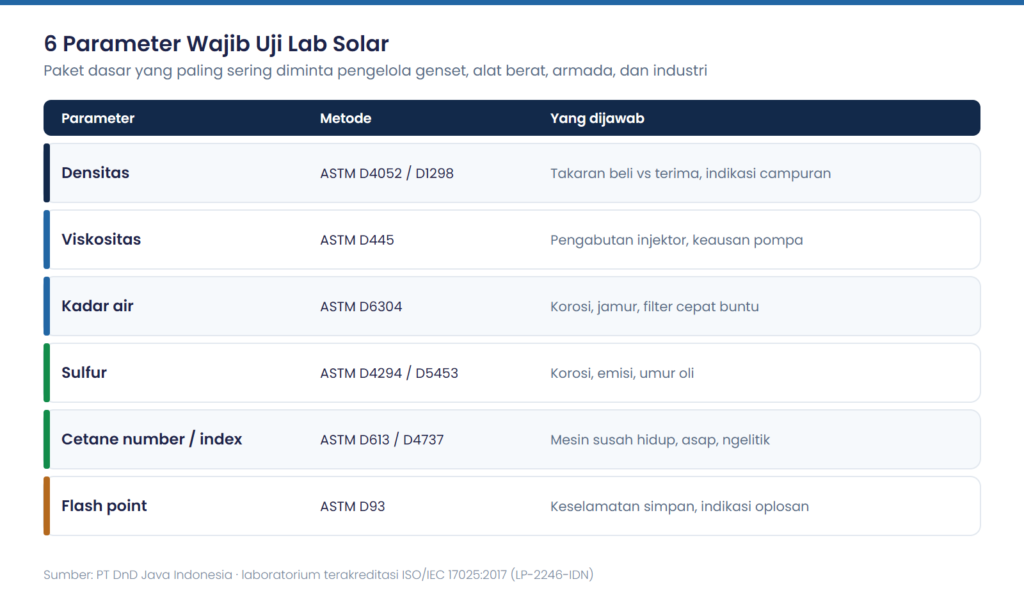
Healthy Genset Package: Genset Diesel Test Parameters
| Parameter | Method | What it answers for gensets |
|---|---|---|
| Moisture content | ASTM D6304 | Whether water has built up and risks clogging filters |
| Water and sediment | ASTM D2709 | Sediment and free water at the bottom of the tank |
| Density | ASTM D4052 | Whether the diesel matches the type purchased, signs of blending |
| Viscosity | ASTM D445 | Injector atomisation and pump lubrication |
| Cetane number / index | ASTM D613 / D4737 | How easily the genset starts when needed |
| Flash point | ASTM D93 | Storage safety, signs of adulteration |
| Oxidation stability (biodiesel blend) | EN 15751 | Whether long-stored diesel is starting to form deposits |
| Genset oil analysis (optional) | Viscosity, contamination, wear metals | Engine condition and fuel contamination of the oil |
The basic package can be extended with oil analysis of the genset engine and other tests as needed. Each diesel parameter is explained in plain language in the guide diesel fuel lab testing, and the wider list of fuel parameters is in fuel analysis services.
Signs of Problem Diesel in Gensets
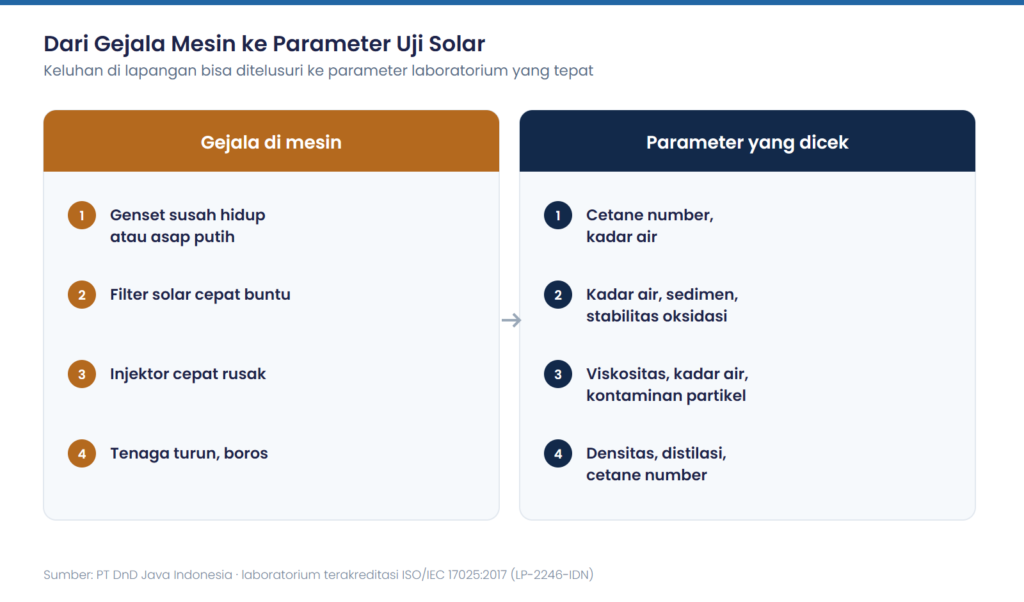
- Genset hard to start or needing several start attempts during weekly testing.
- White or black smoke in excess after the genset starts.
- Fuel filters replaced often even though the genset has few running hours.
- Water or slime visible when the tank is drained from the bottom.
- Power loss when the genset carries full load.
- Diesel dark or hazy compared with when it was first filled.
A single sign is reason enough to test genset diesel before damage spreads to injectors and pumps, which cost far more to repair.
Recommended Genset Diesel Testing Schedule
| Genset condition | Test frequency | Notes |
|---|---|---|
| Standby genset, rarely used | Every 6 months | Tank rarely turned over, highest risk of water and oxidation |
| Genset used regularly at peak load | Every 3 months | Diesel turns over faster, supplier risk is more prominent |
| After filling from a new supplier | Every delivery | Make sure the diesel received matches what was paid for |
| After the tank is cleaned | Once after refilling | Confirms there is no residual contamination |
| Signs of trouble | Immediately | Before replacing expensive components |
How to Sample from a Genset Tank
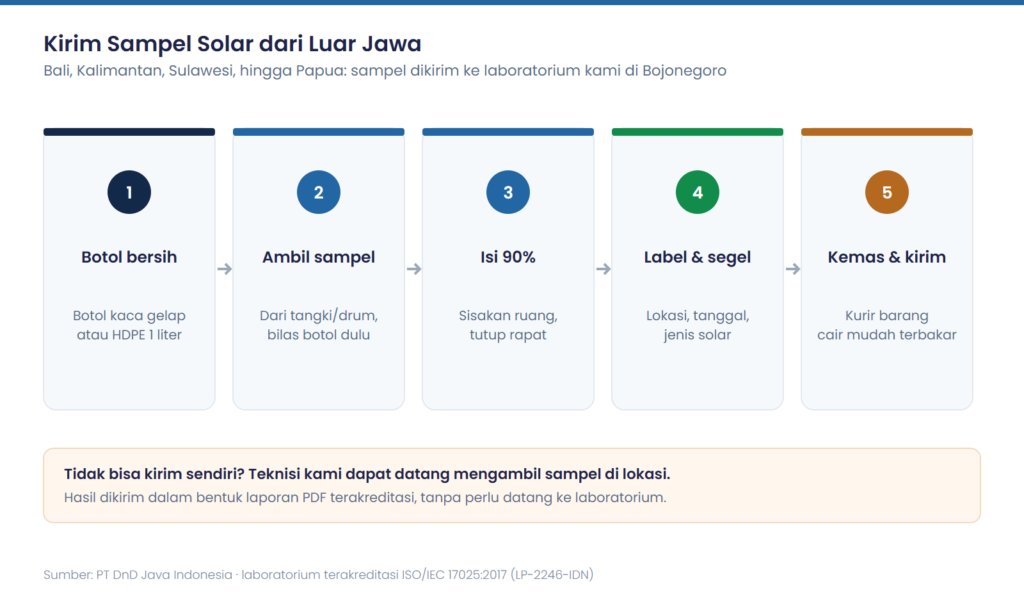
For genset diesel testing, take two samples where possible: one from the bottom of the main tank, where water and sediment collect, and one from the day tank or the point before the genset filter. Use a clean bottle of about 1 litre per sample, fill to about 90%, close tightly, then label it with the building name, tank location, date, and sampling point.
| Sampling point | What it reveals |
|---|---|
| Bottom of the main tank | Water, sediment, and microbial growth |
| Day tank | The diesel that actually enters the engine |
| During filling from the supplier's truck | Supplier diesel quality, for claims if it does not conform |
Samples can be sent to our laboratory in Bojonegoro, East Java, via a courier that accepts flammable liquids. For buildings with many gensets or many sites, our technicians can be scheduled to collect samples directly.
Genset Tank Care Beyond Diesel Testing
- Drain water from the tank bottom regularly via the drain tap.
- Keep the tank filled to reduce the air space where condensation forms.
- Replace filters on schedule and note when replacement intervals get shorter.
- Rotate diesel stock where possible, so diesel is not stored too long.
- Clean the tank when testing shows high water, sediment, or microbes.
Genset diesel testing provides the basis for these maintenance decisions. Without data, tanks are often only cleaned after the genset fails.
Common Mistakes in Looking After Genset Diesel
| Mistake | Consequence | What to do instead |
|---|---|---|
| Assuming weekly test runs are enough | Diesel problems only show when the genset runs under load for long | Add periodic laboratory genset diesel testing |
| Never draining water from the tank bottom | Water and microbes keep increasing | Drain regularly and record how much water comes out |
| Buying diesel from the cheapest supplier without proof of quality | Adulterated or off-grade diesel enters the tank | Test every delivery from a new supplier |
| Sampling only from the top of the tank | Water and sediment at the bottom go undetected | Sample from the bottom drain tap |
| Replacing injectors without checking the diesel | Damage recurs because the cause remains | Test diesel and oil before replacing components |
Periodic Programme for Managers of Many Buildings
Property managers, hotel groups, hospital groups, and telecom tower operators usually have dozens of gensets across many sites. For them we set up periodic genset diesel testing programmes: a fixed schedule per site, sample kits sent ahead of each round, and trend reports comparing every genset in one view. Head office can then see which sites' tanks are starting to have problems without waiting for fault reports from the field.
Periodic programmes also help assess diesel suppliers. If several sites supplied by the same supplier show deviating water content or density, the decision to change supplier can be based on recorded data rather than individual complaints.
Cost of Testing vs Cost of Genset Failure
Laboratory genset diesel testing costs far less than a single injection system failure, emergency rental of a replacement genset, or operating losses during a power cut without backup. For hospitals and data centres, genset failure even affects safety and service contracts. That is why many building managers include genset diesel testing in the annual maintenance budget, alongside engine servicing and genset load testing.
Reports for Management, Audits, and Insurance
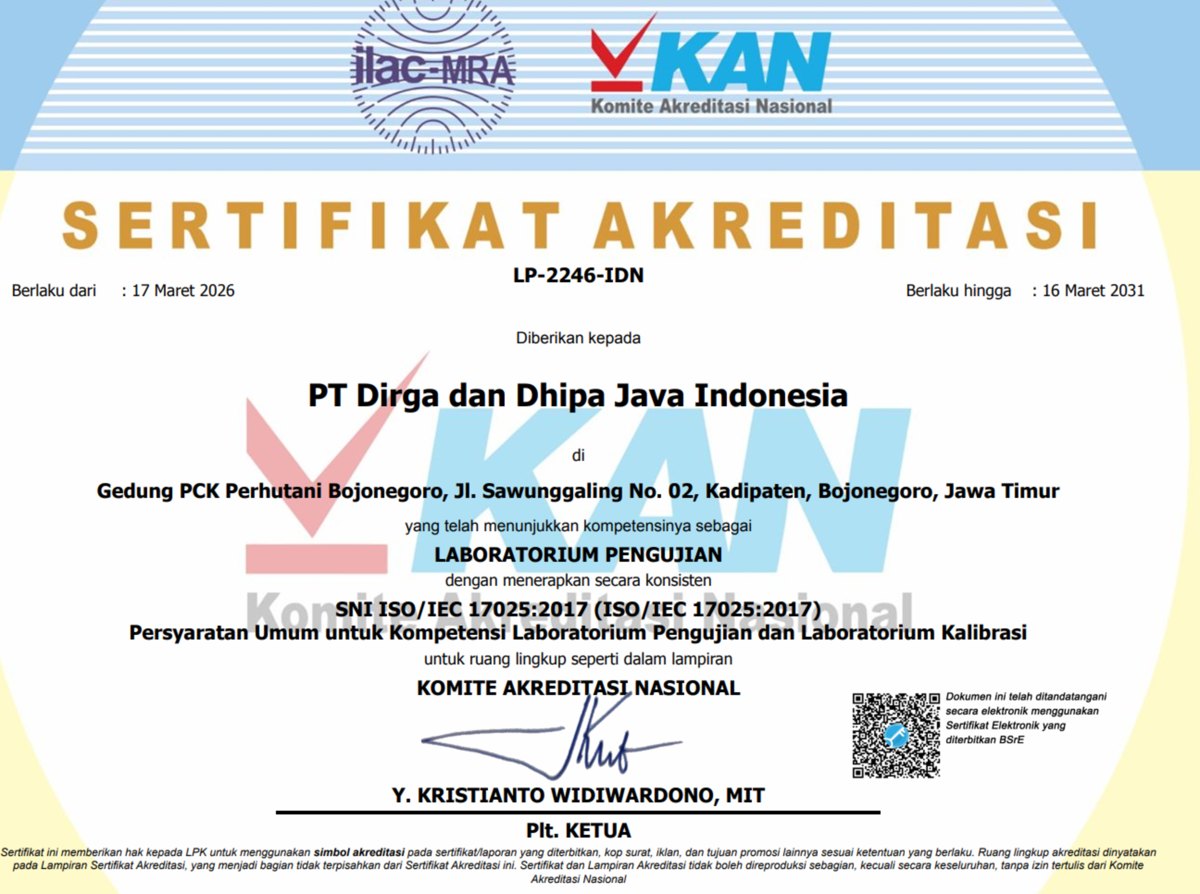
Genset diesel test reports from a KAN-accredited ISO/IEC 17025:2017 laboratory (LP-2246-IDN) show the result of each parameter, the test method, specification limits, and conforming or non-conforming status. They can be attached to building maintenance records, reports to owners or operators, facility inspections, and claims to diesel suppliers when quality does not conform.
Genset Diesel Testing for All of Indonesia
Our laboratory serves building managers across Indonesia. Outside East Java, samples are sent with sample kits and couriers, and technician visits can be scheduled for managers with many gensets. See also our services for Bali and Kalimantan, and the list of service areas us.
Frequently Asked Questions about Genset Diesel Testing
How often should genset diesel be tested?
For standby gensets that are rarely used, genset diesel testing every 6 months is strongly recommended. Testing is also done whenever diesel is received from a new supplier, after the tank is cleaned, and when the genset shows signs of trouble.
Which parameters are tested on genset diesel?
The basic package covers water content, water and sediment, density, viscosity, cetane number or cetane index, and flash point. For long-stored biodiesel blends, oxidation stability is added, and genset oil analysis can be included.
Does the genset have to be shut down for sampling?
No. Samples are taken from the drain taps of the main tank and day tank without affecting genset readiness. Sampling at the filling point is done while the supplier's truck unloads.
Can genset diesel samples be sent from outside Java?
Yes. Samples in clean, tightly closed, labelled bottles are sent via couriers that accept flammable liquids. Accredited reports are sent as PDFs.
Make sure your genset is ready when the power goes out
Tell us the number of gensets, tank capacity, and your city; we will send a sampling guide or schedule a technician. Choose your sector — the WhatsApp message is pre-filled, just send it.
WhatsApp — Malls & BuildingsWhatsApp — Hotels & ResortsWhatsApp — HospitalsWhatsApp — Data Centres & Towers
Or call (0353) 8940000 · [email protected]