Gas Purity Testing
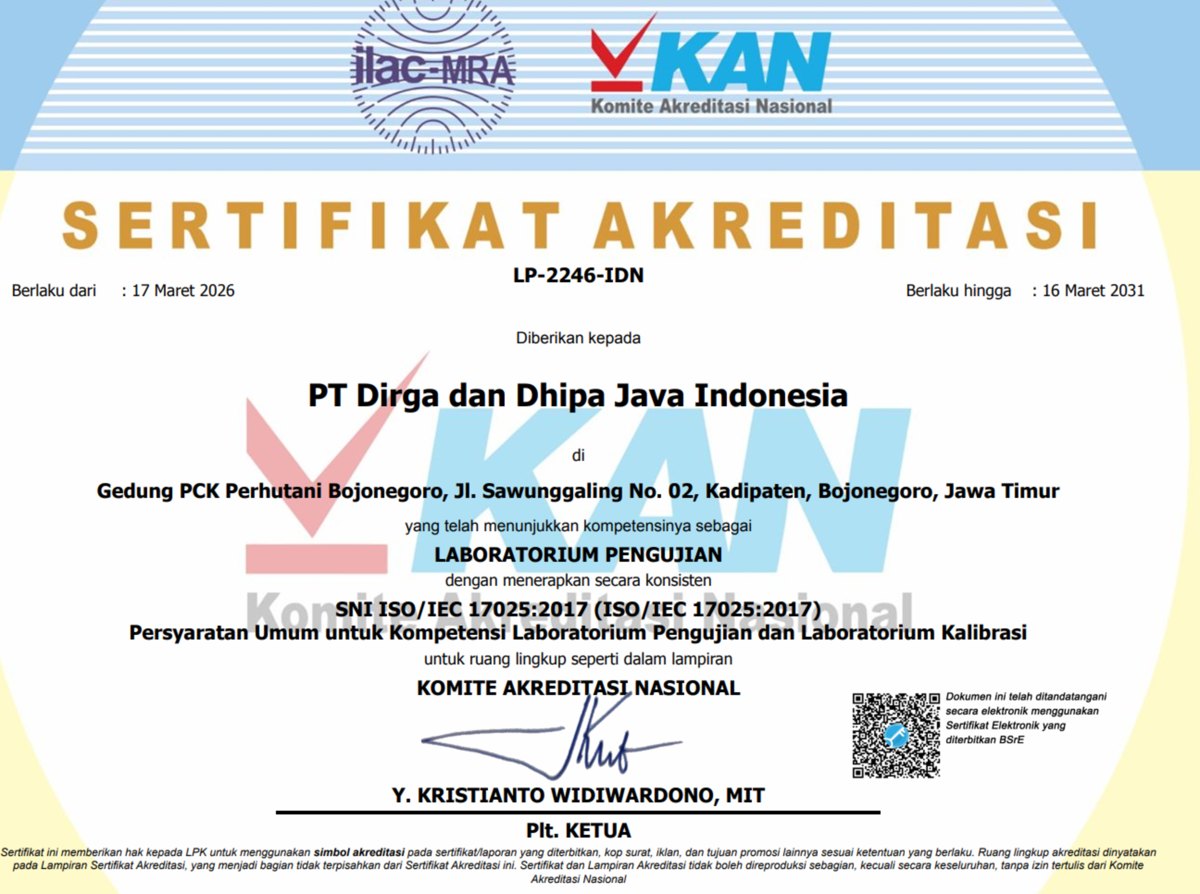
Gas purity testing (gas purity analysis) is laboratory testing that measures the content of the main gas, such as nitrogen, oxygen, CO2, argon, or hydrogen, while detecting impurities such as oxygen, water, CO, and hydrocarbons down to ppm levels. PT DnD Java Indonesia performs it in a KAN-accredited ISO/IEC 17025:2017 laboratory (LP-2246-IDN), with samples taken directly at the point of use. Gas purity determines product integrity, operational safety, and manufacturing efficiency. We provide accurate and traceable analysis to ensure your industrial gases meet the required purity specifications.
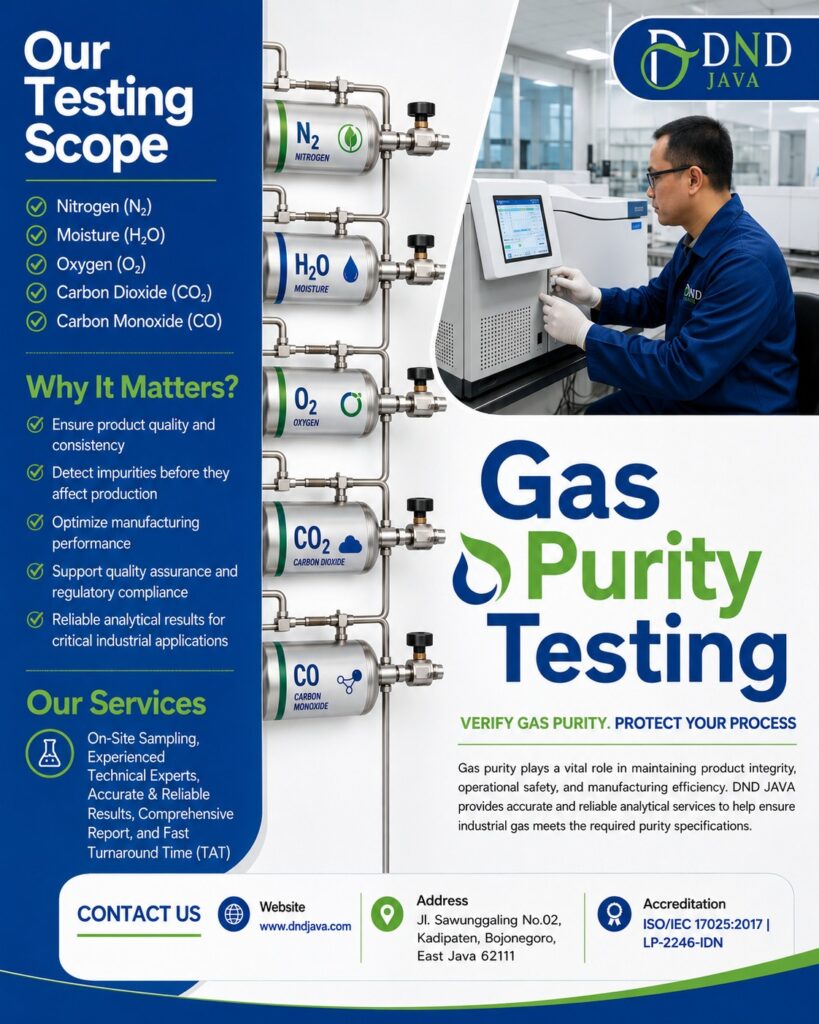
- Testing Scope
- Why It Matters
- Testing Workflow
- Services & Accreditation
Table of Contents
Gas Purity Testing Parameters
We analyse the purity of industrial gases and their main impurities using calibrated gas chromatography instruments and dedicated detectors.
| Parameter | Symbol | Purpose of Testing |
|---|---|---|
| Nitrogen | N2 | Ensures nitrogen content meets the specification for inert or process gas |
| Water Content / Moisture | H2O | Detects water vapour that causes corrosion, freezing, and catalyst damage |
| Oxygen | O2 | Controls the risk of product oxidation and fire hazards in flammable gases |
| Carbon Dioxide | CO2 | Identifies impurities that lower gas quality and form acid when they meet water |
| Carbon Monoxide | CO | Detects toxic contaminants that endanger workers and poison catalysts |
Industrial applications
Gas Purity Testing is needed in manufacturing, electronics, pharmaceuticals, food and beverage, petrochemicals, and facilities that use inert gas for blanketing and purging.
Why Gas Purity Testing Matters
- Maintains product quality and consistency — impure gas directly affects process results.
- Detects impurities before they affect production — problems are caught early, not after the product fails.
- Optimises manufacturing performance — process parameters can be tuned based on data, not guesswork.
- Supports quality assurance and regulatory compliance — test results become objective evidence during audits.
- Provides reliable analytical data for critical industrial applications.
Risks when gas purity is not monitored
Excess moisture causes pipe corrosion, oxygen breakthrough causes product oxidation, while carbon monoxide and carbon dioxide can poison catalysts and endanger workers. All of these lead to lower product quality and unnecessary repair costs.
Testing Workflow and Turnaround Time
The Gas Purity Testing process starts with a needs discussion: gas type, sampling point, requested parameters, and the specification limits to be met. Once the scope is agreed, our team prepares suitable sample containers so gas purity does not change during transport.
Sampling can be carried out by our team directly at your site or by your own staff following the procedure we provide. Samples arriving at the laboratory are logged, given a unique ID, and checked for condition before analysis. Analysis is run on calibrated instruments by analysts whose competence is maintained.
Results are issued in an official report containing sample identity, reference method, measured results with units, and notes on any deviation in sample condition. Routine testing is usually completed within a few working days, while urgent requests can be scheduled sooner once confirmed.
Frequently asked questions
How much sample is needed? The amount depends on the requested parameters; our team will calculate the required volume before sampling.
Can I test just one parameter? Yes. You can choose specific parameters only, for example moisture or oxygen, according to your quality control needs.
Can the results be used for audits? Yes. Reports are issued by an accredited laboratory, so they can be used as objective evidence in internal and third-party audits.
DnD Java Gas Purity Testing Services
- On-site sampling throughout Indonesia by trained staff
- Accurate and reliable results with calibrated equipment
- Experienced technical team in gas and oil & gas
- Fast turnaround time (TAT) for urgent needs
- Comprehensive reports complete with reference methods and interpretation of results
Accreditation
The PT DnD Java Indonesia laboratory is accredited to ISO/IEC 17025:2017 under number LP-2246-IDN, so test results can be used as a basis for commercial decisions and audits.
Consultation
Contact our team via contact page to discuss test parameters, sampling schedule, and estimated turnaround time.
Standards and references
Testing methods follow established analytical practice in the gas industry. Standard references can be read at ISO and ASTM International. This service complements Gas Composition as well as Sampling and Onsite Analysis for complete gas testing needs.
Main Gas Purity Testing Methods (Gas Purity Analysis)
Gas purity analysis cannot be done with a single instrument. The purity of the main gas and each type of impurity are measured by different methods, then combined into one report.
| Method | What is measured | Example uses |
|---|---|---|
| Gas chromatography (GC-TCD / FID) | Main gas purity, N2, O2, CO, CO2, methane, total hydrocarbons | Packaging nitrogen, beverage CO2, welding argon |
| Trace oxygen analyser | Residual oxygen down to ppm level | Nitrogen from PSA or membrane generators |
| Dew point hygrometer | Moisture content and dew point | Dry gas for packaging and hygroscopic materials |
| FTIR | Specific impurities such as CO, NOx, ammonia, and organic compounds | Food-grade CO2, process gases |
| Sulphur detector | H2S and total sulphur compounds | Beverage CO2, gas from natural sources |
The combination of methods is determined by the gas type, its source (cylinder, liquid tank, or on-site generator), and the specification your audit refers to. A deeper review of GC is in the guide gas chromatography.
Gas Purity Testing for Pharmaceutical, Food, and Cosmetics
Auditors treat nitrogen, carbon dioxide, and oxygen that touch the product as materials, not just utilities. Nitrogen is used to flush snack and milk powder packaging, blanket oil and API tanks, and protect cosmetic creams and serums from oxidation. CO2 goes directly into carbonated drinks. So the audit question is always the same: how do you know this gas is pure? A supplier certificate covers gas quality when it leaves the supplier's plant, but not gas quality at your point of use, especially when the gas is produced by an on-site nitrogen generator.
Gas purity testing from PT DnD Java Indonesia provides that independent evidence: samples are taken at the point of use, analysed by gas chromatography and calibrated dedicated detectors, then reported against the specification you use.
Need proof of gas purity for an audit or supply acceptance?
We sample from your cylinders, liquid tanks, or nitrogen generator, then report the results against the specification you use. Choose your sector — the WhatsApp message is pre-filled, just send it.
WhatsApp — PharmaceuticalWhatsApp — Food & BeverageWhatsApp — Cosmetics
Or call (0353) 8940000 · [email protected]
Gas Purity Testing Parameters by Gas Type
| Gas | Main parameters | Risk if not met |
|---|---|---|
| Nitrogen (N2) | Purity, residual oxygen, moisture, CO, CO2, hydrocarbons | Residual oxygen accelerates oxidation and rancidity; water promotes microbial growth |
| Carbon dioxide (CO2) | Purity, moisture, oxygen, CO, hydrocarbons, sulphur | Off-taste and odour in beverages; toxic impurities if limits are exceeded |
| Oxygen (O2) | Purity, CO, CO2, moisture | Does not meet the process gas or monograph specification |
| Gas mixtures (N2/CO2) for MAP packaging | Mixture composition, residual oxygen | Product shelf life is not achieved |
How each parameter is measured and read is explained in the article nitrogen gas purity testing, moisture content in gas, and industrial gas purity standards.
Gas Purity Testing for the Food and Beverage Industry
In the food industry, nitrogen and CO2 are classed as food additives (INS 941 and INS 290), so they fall within the scope of HACCP and FSSC 22000. The two points auditors ask about most often:
- Nitrogen for packaging flushing (MAP) — chips, nuts, coffee, milk powder, and baby food. Residual oxygen in the gas determines shelf life; moisture and oil impurities from the generator must be controlled.
- CO2 for carbonated drinks — the beverage industry generally refers to the beverage CO2 quality guidelines from ISBT/EIGA, which limit impurities such as hydrocarbons, sulphur compounds, and moisture because they directly affect taste and safety.
Because on-site nitrogen generators can lose performance without visible signs, testing at the point of use is far more meaningful than relying only on the certificate issued at installation.
A full discussion of impurities, specification references, and point-of-use testing is in the article food-grade gas: nitrogen and CO2 for packaging and beverages.
Gas Purity Testing for the Pharmaceutical Industry
In drug manufacturing, gas that contacts APIs, intermediates, or finished products must meet the specification set in quality documents, and for certain uses refers to pharmacopoeia monographs (Indonesian Pharmacopoeia, Ph. Eur., or USP) for nitrogen and oxygen. Typical applications:
- Blanketing and inerting of reactors and oxygen-sensitive API tanks.
- Nitrogen flushing during filling of vials, ampoules, and powder packaging.
- Process gas in clean areas within the scope of CPOB (GMP) utility qualification.
Our gas purity testing results are reported with reference methods and traceability, so they can be attached to qualification documents, supplier changes, and BPOM inspections.
A complete guide to contact points, pharmacopoeia grade, and the role of gas in CPOB qualification is in the article pharmaceutical gas: nitrogen and oxygen purity testing.
Gas Purity Testing for the Cosmetics Industry
Cosmetics plants use nitrogen to protect easily oxidised formulas, such as vitamin C serums, plant oils, and active creams, during both mixing and filling. Nitrogen purity and residual oxygen determine whether that protection really works. Under CPKB and ISO 22716, gas that contacts the product should be controlled like any other material: with a specification, testing, and records.
When Gas Purity Testing Is Needed
| Situation | What is tested | Evidence produced |
|---|---|---|
| HACCP, FSSC 22000, BRCGS, CPOB, or CPKB audit | Gas at product-contact points | Accredited report per point |
| New nitrogen generator or after maintenance | Purity, residual oxygen, moisture | Performance verification against specification |
| Change of gas supplier | Full specification package | Basis for supplier approval |
| Complaints about taste, odour, or product shelf life | Residual oxygen, hydrocarbons, sulphur | Data for root cause investigation |
| Periodic monitoring | Critical parameters per gas | Trends for management review |
Frequently Asked Questions about Gas Purity Testing
Is a gas supplier's certificate enough for an audit?
A supplier certificate shows gas quality when it leaves the supplier's plant. Auditors often ask for evidence of quality at the point of use, because gas can be contaminated in cylinders, regulators, or distribution pipes. For nitrogen from an on-site generator, independent testing is the only evidence.
What nitrogen purity is required for food packaging?
There is no single figure for all products. Plants set it based on the residual oxygen limit the product can tolerate, for example stricter for milk powder and oily foods. Gas purity testing measures purity and residual oxygen so you can compare them with that specification.
Can gas purity testing be done on an on-site nitrogen generator?
Yes. Samples are taken directly from the generator outlet or point of use with dedicated containers that preserve purity during transport. This is actually recommended, because generator performance can decline as membranes or adsorbents age.
Which parameters are tested on CO2 for beverages?
Usually CO2 purity, moisture, oxygen, carbon monoxide, hydrocarbons, and sulphur compounds, referring to the beverage CO2 quality guidelines used by the industry. The exact parameters are adjusted to your buyer's or brand owner's specification.
Discuss your gas type and specification with us
Tell us the gas type, supply source, point of use, and reference standard; we will prepare the parameters and sample containers. Choose your sector — the WhatsApp message is pre-filled, just send it.
WhatsApp — PharmaceuticalWhatsApp — Food & BeverageWhatsApp — Cosmetics
Or call (0353) 8940000 · [email protected]
PT DnD Java Indonesia Gas Purity Testing Services
- Accredited to ISO/IEC 17025:2017 (LP-2246-IDN) — reports accepted in food safety, CPOB, and CPKB audits
- Nitrogen, CO2, oxygen, and mixtures — from cylinders, liquid tanks, or on-site generators
- Sampling at the point of use — anywhere in Indonesia, with containers that preserve sample purity
- Reports against your specification — conforming or non-conforming status per parameter
- Related services — compressed air testing for compressed air and gas composition for natural gas
Standards and references
Food and beverage gas quality references are published by EIGA and ISBT; analytical methods refer to ASTM International and ISO. See also nitrogen gas purity.