Fuel Analysis
Fuel Analysis or fuel analysis is the process of evaluating various physical and chemical properties of fuel to determine quality, performance, and compliance with industry standards.
Fuel testing and analysis services support clients with quality control, specification requirements, troubleshooting, research and development for exploration, refining, production, storage and distribution operations.
Fuel Analysis Test
- API gravity, density, relative humidity
- Appearance
- Biodiesel Testing and biodiesel blending
- Cetane Index, Cetane Number
- Cloud point
- Color, ASTM
- Copper corrosion
- Distillation
- Flash point
- Lubricity, HFRR, BOCLE
- Metals
- Microbiological contamination of diesel fuel
- Fuel Test Kit for Microbe Detection (Diesel fuel)
- Pour point
- Sulfur content
- Sediment and water (S&W)
- BS EN 590 diesel fuel testing
- ULSD ultra low sulfur diesel testing
- and other tests to ASTM, ISO, and other recognized testing protocols
Why Fuel Analysis Determines Engine Life and Operating Costs
Fuel analysis answers one simple question with big consequences: does the fuel you buy, store, and burn really meet specification? Low-cetane diesel makes engines hard to start and wasteful; water and microbes clog filters and corrode tanks; sulphur above the limit damages after-treatment systems and breaks emission rules. Every deviation ends in maintenance costs, downtime, or disputes with suppliers.
The PT DnD Java Indonesia laboratory performs fuel analysis for diesel, biodiesel and blends, petrol, and industrial fuels, following ASTM and EN methods and the specifications in force in Indonesia. Results are used for incoming quality control, resolving engine complaints, and verifying supplier deliveries.
Fuel Analysis Parameters and Reference Methods
| Parameter | Reference method | What it answers |
|---|---|---|
| Density / API gravity | ASTM D4052, D1298 | Specification compliance, volume-to-mass conversion, indication of blending |
| Cetane index / cetane number | ASTM D4737 / ASTM D613 | Combustion quality, ease of starting, diesel engine noise |
| Distillation | ASTM D86 | Boiling range, indication of light or heavy fraction contamination |
| Flash point | ASTM D93 | Keselamatan penyimpanan; flash point rendah = kontaminasi bensin |
| Cloud point & pour point | ASTM D2500 / ASTM D97 | Low-temperature flow, risk of filters clogging with wax |
| Sulfur content | ASTM D4294, D5453 (ULSD) | Emission compliance, protection of catalysts and DPF |
| Water & sediment (S&W) | ASTM D2709 | Free water and solids that damage injectors and cause corrosion |
| Copper strip corrosion | ASTM D130 | Active sulphur that corrodes copper and brass components |
| Lubricity HFRR | ASTM D6079 | Injection pump protection, especially with ULSD and biodiesel blends |
| FAME content | EN 14078 / ASTM D7371 | Biodiesel ratio in the blend, verification of the blending programme |
| Color & appearance | ASTM D1500, D4176 | Indication of degradation, oxidation, and visual clarity |
| Microbial contamination | Diesel microbe detection kit, ASTM D6469 (guide) | Bacterial and fungal growth in storage tanks |
| Metals | ASTM D5185 / ICP | Wear metals from the distribution system, catalyst contaminants |
For gaseous fuels and condensate, see our service gas composition; for the engine oil used with these fuels, see lube oil analysis.
6-Parameter Diesel Fuel Lab Test Package for Gensets, Heavy Equipment, and Fleets
For diesel and biodiesel blend users, we offer the most requested basic fuel analysis package: density (ASTM D4052), viscosity (ASTM D445), Karl Fischer water content (ASTM D6304), sulphur (ASTM D4294/D5453), cetane number or cetane index (ASTM D613/D4737), and flash point (ASTM D93). This package suits new supplier checks, standby genset tanks in buildings, malls, hotels, and hospitals, and field tanks in mining and fleets.
For long-stored B40 biodiesel blends, the package can add FAME content, oxidation stability, and water and sediment. Each parameter in plain language, related engine symptoms, and how to take samples are explained in the guide diesel fuel lab testing.
Ship Diesel Samples from Anywhere in Indonesia
Pelanggan dari Bali, Kalimantan, Sulawesi, Sumatra, hingga Papua tidak perlu datang ke laboratorium. Ambil sekitar 1 liter solar per sampel ke dalam botol bersih yang tertutup rapat, isi sekitar 90%, beri label lokasi tangki dan tanggal, kemas berlapis, lalu kirim lewat kurir yang menerima barang cair mudah terbakar. Laporan terakreditasi dikirim dalam bentuk PDF. Bila pengiriman sendiri tidak memungkinkan, teknisi kami dapat dijadwalkan mengambil sampel di lokasi. Lihat paket khusus genset diesel testing untuk mal, hotel, dan rumah sakit, serta layanan untuk Bali, Kalimantan, and wilayah lain.
Need diesel fuel lab testing for your tanks?
Tell us the diesel type, number of tanks, and location; we will send a sampling guide or schedule a technician. Choose your sector — the WhatsApp message is pre-filled, just send it.
WhatsApp — Buildings & GensetsWhatsApp — Mining & Heavy EquipmentWhatsApp — Fleet & TransportWhatsApp — Industry & Diesel Power
Or call (0353) 8940000 · [email protected]
Fuel Analysis for Biodiesel and Blends
Indonesia's biodiesel blending programme means diesel on the market contains a significant share of FAME. FAME improves lubricity and cetane but absorbs water more easily, is more prone to oxidation, and is friendlier to microbial growth. Fuel analysis for biodiesel blends therefore adds FAME content, water content, oxidation stability, and microbial testing alongside conventional diesel parameters.
For fleet, genset, and heavy equipment operators, checking FAME content and water content at receipt is the cheapest way to prevent clogged filters and stuck injectors a few weeks later.
How to Read Fuel Analysis Results
Fuel analysis results are easiest to read in groups. The first group is product identity: density, distillation, and flash point tell you whether what is in the tank really is diesel, not diesel mixed with petrol, kerosene, or another product. A flash point below 52 °C almost always means light fractions have entered.
The second group is combustion quality: cetane, sulphur, and the end of distillation. Low cetane makes starting difficult and combustion rough; high sulphur damages after-treatment and raises emissions. The third group is storage cleanliness and health: water and sediment, microbes, colour, and appearance. This group changes most during storage, so it must be retested in tanks with slow turnover.
Our report shows all three groups side by side with the specification limits you use, with notes where a parameter passes but is close to the limit, because such values usually become a problem in the next delivery.
Common Mistakes That Make Fuel Analysis Misleading
- Sampling from the nozzle, not the tank — fuel in the hose always looks clean; water and microbes collect at the bottom of the tank.
- Used or clear containers — container residue changes appearance and colour; light accelerates degradation before the sample reaches the laboratory.
- Delaying shipment — microbes keep growing and light fractions evaporate; samples should be tested within a few days of collection.
- Comparing with the wrong specification — industrial diesel, automotive diesel, and biodiesel blends have different limits; make sure the reference matches the purchase contract.
When Fuel Analysis Is Needed
| Situation | Key parameters | Consequence if not tested |
|---|---|---|
| Receiving deliveries from a new supplier | Density, distillation, flash point, sulphur, S&W, FAME | Blended or off-spec fuel accepted without evidence |
| Hard starting, smoke, power loss | Cetane, distillation, water, microbes | Repeated engine repairs without fixing the root cause |
| Filters clogging quickly | Microbes, S&W, cloud point, appearance | Rising filter and downtime costs |
| Fuel stored long in the tank | Water, microbes, oxidation stability, colour | Degradation goes undetected until the engine fails |
| Claims to the supplier or insurer | Full specification package from an accredited lab | Claim rejected for lack of independent evidence |
| Environmental or emissions audit | Sulphur, metals | Non-compliance penalties |
Fuel Analysis Workflow at DND Java
- Defining the scope — fuel type, purpose (routine receipt, investigation, claim), and the reference specification used.
- Sampling — from tanks, trucks, or nozzles per ASTM D4057 and D4177, or through our sampling service ; for microbial tests, samples are taken from the tank bottom where water collects.
- Receipt — chain of custody recording, seal check, and initial appearance check.
- Testing — each parameter is run by its reference method with recorded quality control.
- Report — results are compared directly with the agreed specification limits, so pass/fail status is clear at a glance.
Test certificate contents
- Sample identity, source, sampling date, and sampler
- Result per parameter, reference method, units, and comparison specification limits
- Conformity status per parameter and interpretation notes for values near the limit
- Signature of the technical manager and the laboratory accreditation number
Fuel Analysis for Every Type of User
- Power plants and industrial gensets — routine fuel analysis of day tanks and reserve tanks; focus on water and sediment, microbes, and cetane because fuel is often stored for long periods.
- Mining and heavy equipment — verification of every diesel delivery from suppliers, especially density, flash point, and sulphur, to protect high-value engines and meet manufacturer warranties.
- Transport and logistics fleets — quick investigation when vehicles show similar symptoms close together; usually traced to one fuel batch.
- Oil and gas operators — fuel analysis for rig fuel, support vessels, and production facilities, plus crude analysis for the feedstock.
- Distributors and industrial fuel stations — quality certificates from an independent laboratory as proof to customers that delivered product meets specification.
For users with many storage points, we set up periodic fuel analysis programmes with labelled bottles, sampling schedules, and reports comparing results across tanks and over time, so problem tanks show up before the engines using them fail.
Frequently Asked Questions about Fuel Analysis
Which fuel analysis parameters matter most for fleet diesel?
For routine quality control, prioritise water and sediment, microbial contamination, FAME content, and flash point, because these four most often cause clogged filters and damaged injectors. Cetane, sulphur, and distillation are added when receiving deliveries from a new supplier.
How long do fuel analysis results take?
Physical parameters such as density, flash point, distillation, and S&W can be completed in one to two working days. Microbial tests need several days of incubation, and cetane number by test engine is scheduled separately. The exact schedule is given in the quotation.
How do I take a fuel sample correctly?
Use a clean, dark container, fill it almost full, label it with source and date, then seal it. If water or microbes are suspected, sample from the lowest point of the tank. If in doubt, our technicians can take samples at your site.
PT DnD Java Indonesia Fuel Analysis Services
PT DnD Java Indonesia is an oil and gas testing laboratory in Bojonegoro, East Java, serving oil and gas operators, power plants, mining, transport, manufacturing, and fuel distributors across Indonesia since 2022. Our fuel analysis is used both for daily quality control and as independent evidence in supplier claims.
- Accredited to ISO/IEC 17025:2017 — fuel analysis results accepted for audits, claims, and tenders
- Full coverage — diesel, biodiesel and blends, petrol, industrial fuels, and other derived products
- On-site sampling — trained technicians sample from tanks, trucks, and vessels
- Decision-ready reports — every result compared with the specification limits you use
- Related services — crude oil analysis for feedstock and chemical screening for additives
Accreditation
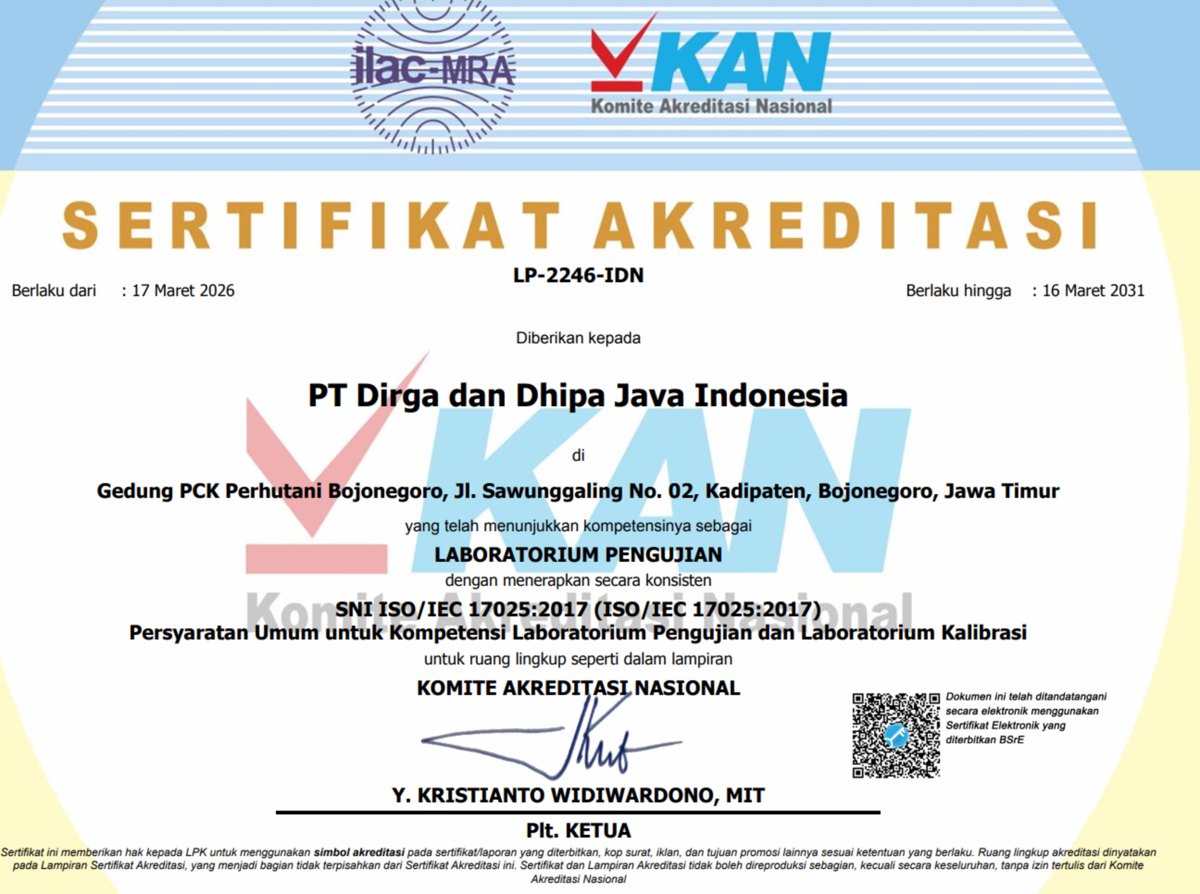
The PT DnD Java Indonesia laboratory is accredited to ISO/IEC 17025:2017 by the National Accreditation Committee (KAN) under number LP-2246-IDN. The fuel analysis certificates we issue state the reference method for each parameter and are traceable.
Consultation
Free consultation: contact our team via WhatsApp 0888-9507-534, phone (0353) 8940000, or contact page. Include the sample type, quantity, and parameters needed so a quotation can be prepared right away.
Standards and references
Test methods refer to ASTM International and the European EN 590 standard for diesel; microbial control guidance follows ASTM D6469. See also pour point and viscosity and a range of laboratory services us.