Compressed Air Testing
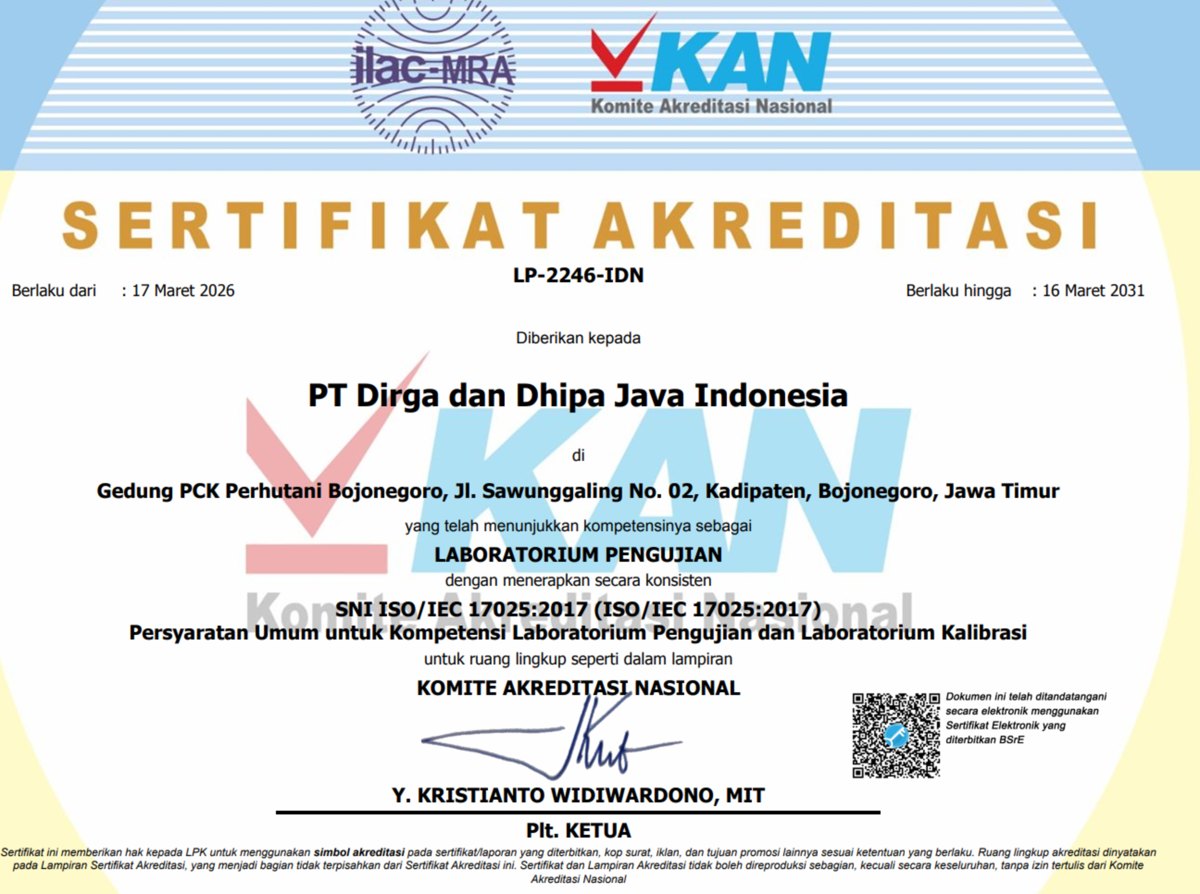
Compressed air testing is the quality testing of air from compressors to measure solid particles, water (pressure dew point), oil, and microorganisms, and assess them against the ISO 8573-1 purity classes. PT DnD Java Indonesia performs it directly at your plant with a KAN-accredited ISO/IEC 17025:2017 laboratory (LP-2246-IDN). Compressed air in direct contact with products in the pharmaceutical, food, and cosmetics industries must be monitored to keep contamination risk under control and protect product quality.
- Testing Scope
- Why It Matters
- Testing Workflow
- Services & Accreditation
Table of Contents
Compressed Air Testing Parameters
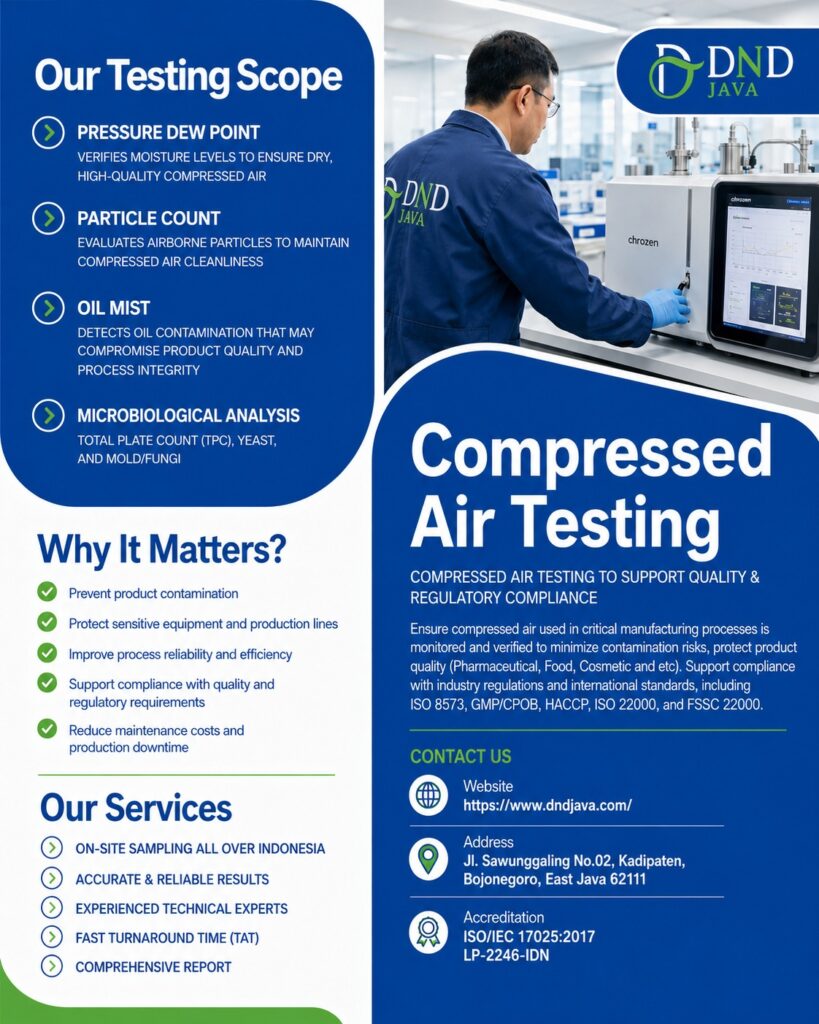
Testing covers the main contaminants in compressed air under the framework of the standard ISO 8573.
| Parameter | What Is Tested |
|---|---|
| Pressure Dew Point | Verifies moisture content to ensure the compressed air is truly dry and of high quality |
| Particle Count | Evaluates airborne particles to keep compressed air clean |
| Oil Mist | Detects oil contamination that can damage product quality and process integrity |
| Microbiological Analysis | Total Plate Count (TPC), yeast, and mould |
Reference standards
Testing supports compliance with ISO 8573, GMP/CPOB, HACCP, ISO 22000, and FSSC 22000.
Why Compressed Air Testing Matters
- Prevents product contamination — compressed air often comes into direct contact with the product.
- Protects sensitive equipment and production lines from oil, particles, and moisture.
- Improves process reliability and efficiency because unexpected disruptions are reduced.
- Supports compliance with quality and regulatory requirements.
- Reduces maintenance costs and production downtime through early detection.
Industries that need it
Pharmaceuticals, food and beverage, cosmetics, and general manufacturing that use compressed air for filling, packaging, drying, or direct product contact.
Testing Workflow and Turnaround Time
Compressed Air Testing starts by selecting the sampling points. The chosen points are usually the compressed air locations closest to the product, for example before the filling machine or on lines in direct contact with packaging. The choice of point determines how relevant the test results are to the real contamination risk.
Sampling uses dedicated equipment for each parameter: a dew point meter for moisture, a particle counter for air cleanliness, absorbent media for oil content, and sterile media for microbiological testing. All equipment is calibrated regularly.
Once analysis is complete, results are compared against the quality class you target under the ISO 8573 framework. The report includes the sampling point identity, reference method, measured results, and notes on conditions at the time of sampling. Routine testing is usually completed within a few working days.
Frequently asked questions
How often should testing be carried out? Frequency depends on how critical the process is. Production lines in direct contact with the product are usually monitored more closely than supporting utilities.
Does production have to stop? No. Sampling is carried out under normal operating conditions so the results reflect actual conditions.
What if the results do not meet the target? Our team helps interpret the results and shows which parameters deviate, so repairs to the filtration or drying system can be targeted precisely.
DnD Java Compressed Air Testing Services
- On-site sampling throughout Indonesia
- Accurate and reliable results using validated methods
- Experienced technical team for compressed air sampling
- Fast turnaround time (TAT)
- Comprehensive reports ready to use during audits
Accreditation
The PT DnD Java Indonesia laboratory is accredited to ISO/IEC 17025:2017 under number LP-2246-IDN.
Consultation
Please contact our team via contact page to determine sampling points, test parameters, and the work schedule.
Standards and references
Testing follows the framework of ISO 8573 for compressed air quality. Standard references can be read at ISO and ASTM International. This service complements Environmental Monitoring as well as Chemical Screening for quality control of the production environment.
Compressed Air Testing Methods According to ISO 8573
ISO 8573-1 sets the compressed air purity classes, while the other parts of the ISO 8573 series define how each contaminant is measured. Complete compressed air testing uses the following five methods.
| Contaminant | Test method | Standard |
|---|---|---|
| Solid particles | Laser particle counter by particle size | ISO 8573-4 |
| Water / water vapour | Pressure dew point hygrometer | ISO 8573-3 |
| Oil aerosol and liquid oil | Membrane filtration followed by laboratory analysis | ISO 8573-2 |
| Oil vapour | Activated carbon adsorption followed by analysis | ISO 8573-5 |
| Microorganisms | Air impaction onto agar media, incubation, colony count | ISO 8573-7 |
The result of each method is compared with your target ISO 8573-1 class, for example class 1.2.1 for air in direct contact with the product. How to read the classes is explained in the article ISO 8573.
Compressed Air Testing for Audited Industries: Pharmaceutical, Food, and Cosmetics
In these three industries, compressed air is more than a utility. It blows bottles before filling, pushes powders along transfer lines, dries packaging, and drives valves that touch the product. That is why CPOB/GMP, HACCP, FSSC 22000, BRCGS, and CPKB auditors almost always ask the same question: prove that your compressed air is clean. Compressed air testing reported by an accredited laboratory is the evidence they ask for.
PT DnD Java Indonesia performs compressed air testing directly at your plant: samples are taken at the points closest to the product, while production runs normally, then analysed under the ISO 8573 framework and reported against your target quality class.
Audit coming up soon?
We sample at your plant without stopping production, and the accredited report is ready to attach to your audit documents. Choose your sector — the WhatsApp message is pre-filled, just send it.
WhatsApp — PharmaceuticalWhatsApp — Food & BeverageWhatsApp — Cosmetics
Or call (0353) 8940000 · [email protected]
What Is Tested in ISO 8573 Compressed Air Testing
| Contaminant | Standard part | Why auditors care |
|---|---|---|
| Solid particles | ISO 8573-4 | Particles from rusty pipes or failed filters can enter the product or packaging |
| Water / pressure dew point | ISO 8573-3 | Humid air lets microbes grow and damages hygroscopic products |
| Oil (aerosol, liquid, vapour) | ISO 8573-2 and ISO 8573-5 | Compressor oil is a chemical contaminant that must not be present on products |
| Microorganisms | ISO 8573-7 | Bacteria, mould, and yeast in product-contact air are a critical audit finding |
Results are expressed as an ISO 8573-1 class in the format [particles : water : oil], for example class 2:2:1, so they can be compared directly with the specification in your quality documents. Each class is explained in the article ISO 8573: how to read compressed air purity classes.
Compressed Air Testing for the Pharmaceutical Industry (CPOB / BPOM)
In drug manufacturing, compressed air that contacts products, starting materials, or product-contact surfaces is treated as a critical utility. CPOB (Indonesian GMP) guidelines require such utilities to be qualified and monitored, and the most common inspection finding is missing microbiological and particle data at points of use in clean areas.
- Typical test points: air to liquid and powder filling machines, ampoule and vial blowing, pneumatic material transfer, granule dryers, and points of use in clean rooms.
- Parameters usually requested: particles, pressure dew point, total oil, and microbiology (ISO 8573-7).
- Target class: set by the plant based on the risk assessment in the URS/qualification documents; we report results against that class.
- When to test: during qualification (IQ/OQ/PQ) of the air system, after changes or repairs, and during periodic monitoring according to the set schedule.
The full CPOB perspective is covered in the article compressed air testing for the pharmaceutical industry.
Compressed Air Testing for the Food and Beverage Industry (HACCP, FSSC 22000, BRCGS)
Food safety schemes treat compressed air that contacts food as a potential physical, chemical, and biological hazard. FSSC 22000 and BRCGS auditors generally ask for evidence that this air is monitored against a documented specification. A widely referenced industry guide, BCAS Food Grade Compressed Air Code of Practice, recommends ISO 8573-1 class 2:2:1 for air in direct contact with food and 2:4:2 for indirect contact, plus microbiological monitoring.
| Contact type | Plant examples | Common reference class (BCAS) |
|---|---|---|
| Direct contact with food | Blowing bottles and packaging before filling, drying products, pneumatic transfer of powders and flour | 2:2:1 + microbiology |
| Indirect contact | Pneumatic cylinders and valves in open areas near the product | 2:4:2 |
| No contact | Instrument air and workshop tools outside production areas | As required by the equipment |
How the critical points are mapped in a HACCP plan is covered in the article compressed air in the food and beverage industry.
Compressed Air Testing for the Cosmetics Industry (CPKB / ISO 22716)
Cosmetics plants applying BPOM CPKB or ISO 22716 face a similar question: air used to blow bottles, fill creams, lotions, and serums, and push product along filling lines must be proven free of oil, particles, and microbes. Water-based products such as lotions, toners, and serums are highly susceptible to microbial contamination, and one contaminated batch means a product recall.
- Typical test points: blowing bottles and tubes before filling, filling machine nozzles, pressurised mixers, and packaging lines.
- Recommended parameters: oil, particles, and microbiology; pressure dew point for powder products such as face powder and decorative cosmetics.
- Reference class: many cosmetics plants use the same class approach as the food industry for direct-contact air, then adjust it through risk assessment.
The full guide, including contaminants by product type and the CPKB audit file, is in the article compressed air for cosmetics.
From Auditor Findings to Test Parameters
| Auditor finding or question | Compressed air testing parameters | Evidence you provide |
|---|---|---|
| “There is no compressed air quality data at the point of use.” | Particles, dew point, oil, microbiology at product-contact points | Accredited test report per point |
| “How do you know the filter still works?” | Particles and oil before and after the filter | Two-point comparison report |
| “The compressor still uses lubricant; what is the risk?” | Total oil (aerosol, liquid, vapour) | Results against the target oil class |
| “Is there a microbial risk from the air?” | Microbiology ISO 8573-7 | Colony count per volume of air |
| “How often is monitoring carried out?” | Periodic testing programme | Schedule and trend reports |
Compressed Air Testing Workflow at Your Plant
- Point mapping — together with your QA/engineering team, we mark direct-contact, indirect-contact, and before/after-filter points.
- Setting the target class — taken from your URS, HACCP specification, or risk assessment.
- Sampling while production runs — equipment is connected to the point of use without stopping the line.
- Laboratory analysis — particles, dew point, oil, and microbiology are analysed by reference methods.
- Audit-ready reports — results per point, class achieved, conforming/non-conforming status, and corrective notes.
Frequently Asked Questions about Compressed Air Testing
Which ISO 8573 class is required for air in direct contact with food?
The BCAS Food Grade Compressed Air Code of Practice recommends class 2:2:1 for air in direct contact with food and 2:4:2 for indirect contact, plus microbiological monitoring. The final class is still set by the plant through its HACCP risk assessment.
Is compressed air testing mandatory for CPOB and CPKB audits?
CPOB and CPKB guidelines require utilities that contact the product to be controlled and monitored. Compressed air is included, so auditors generally ask for periodic test data at points of use as evidence of that control.
Does production have to stop during sampling?
No. Compressed air testing should be done while the system operates normally so the results represent the conditions assessed by the auditor. Sampling equipment is connected to the point of use without disrupting the production line.
How often should compressed air testing be done?
Usually at initial qualification, after changes or repairs to the air system, and then periodically according to the plant's risk assessment, for example every six or twelve months for product-contact points. Points with past problems are usually monitored more closely.
Discuss your sampling points and target class with us
Tell us the number of points, type of product contact, and audit date; we will put together the parameter package. Choose your sector — the WhatsApp message is pre-filled, just send it.
WhatsApp — PharmaceuticalWhatsApp — Food & BeverageWhatsApp — Cosmetics
Or call (0353) 8940000 · [email protected]
PT DnD Java Indonesia Compressed Air Testing Services
- Accredited to ISO/IEC 17025:2017 (LP-2246-IDN) — reports accepted as evidence in CPOB, HACCP, FSSC 22000, BRCGS, and CPKB audits
- Sampling at your plant — anywhere in Indonesia, without stopping production
- All four ISO 8573 contaminants — particles, water, oil, and microbiology in one visit
- Per-point reports against your target class — showing conforming or non-conforming at a glance
- Related services — gas purity testing for nitrogen and CO2 process gases, as well as environmental monitoring
Standards and references
Testing refers to the ISO 8573 series and the BCAS guide for food-grade compressed air. See also pressure dew point and compressed air testing.