Gas Composition
Gas Composition is a term that refers to the measurement and determination of the types and proportions of various gases contained in a gas mixture. Gas composition is very important in various industries, including oil and gas, chemical, environmental, and many others, because it can affect the production process, product quality, and safety and environmental aspects.
- Natural Gas
- Liquefied Natural Gas (LNG)
- LPG testing and inspection
DnD Java Laboratory provides quality and component analysis of natural gas. Natural gas testing includes analysis of conventional and shale gas, LNG, and condensate and other hydrocarbon components. The gases analyzed include hydrocarbons (C1 to C6+) such as methane, ethane, propane, iso-butane, n-butane, iso-pentane, n-pentane, and hexane, plus heavier molecules.
Natural gas laboratory tests for trace impurity detection levels. Trace impurities in natural gas include hydrogen, nitrogen, carbon monoxide, carbon dioxide, oxygen, mercury, sulfur, water, and other components.
| Natural Gas Tests | Natural Gas Test Methods |
|---|---|
|
Natural Gas Composition Analysis |
ASTM D1945, GPA 2261, ISO 6974, UOP 539,GC-MS, etc. |
|
Methane |
mol % |
|
Ethane C2 |
mol % |
|
Propane C3 |
mol % |
|
Iso Butane C4 |
mol % |
|
Normal Butane |
mol % |
|
Iso Pentane C5 |
mol % |
|
Normal Pentane |
mol % |
|
Hexane plus Heavier |
mol % |
|
Total C6 carbon |
Total C6 carbon |
|
Total C7 carbon |
mol % |
|
Nitrogen |
mol % |
|
Carbon Dioxide |
mol % |
|
Oxygen |
mol % |
|
Total Sulfur |
ASTM D5504, ISO 6326, etc. |
|
Hydrogen Sulfide |
ASTM D5504, ISO 6326, etc. |
|
Water |
KF |
|
Energy Calculations |
ASTM D3588, GPA 2172, ISO 6976 |
|
Vapor Density |
Calculated |
|
Relative Density |
Calculated |
|
Molecular Weight |
Calculated |
|
Gross Heating Value (GHV) |
Calculated |
|
Net Heating Value (NHV) |
Calculated |
Liquefied natural gas (LNG) is transported by LNG tankers serving markets around the world. DnD Java supports production, transportation and storage.
LNG Test
LNG Composition and Impurity Testing
Regulatory Testing for Environmental Compliance
Determination of Mercury based on ISO 6978-2:2003
On-site Laboratory Services (including equipment and/or manpower according to ISO 17025 standards)
LPG testing and inspection is provided for Liquefied (Liquefied) Petroleum Gas (LPG) products at refineries, pipelines, and marine and coastal tank cargo storage facilities.
DnD Java supports clients involved with LPG production, distribution, and terminal storage locations. LPG analytical testing, traceability analysis, loss control, and quality control are available during production and storage. LPG testing is performed as per ASTM and other accepted industry standards.
LPG Test
- Ammonia, Arsine
- Carbonyl, Chloride
- Composition of Gases
- Contamination to trace ppm, ppb, and ppt levels
- Corrosion
- Density
- Hydrogen Sulfide, Sulfur
- Mercaptans, Mercury
- Moisture
- Non-condensable Gases
- Organic content
- Oxygen
- Phosphine
- Sulfur
- Total Inhibitor content
- Volatility
- Vapor Pressure
- Water
- and more.
Gas Composition for the LNG, CNG, LPG, and Pipeline Gas Industries
In gas trading, composition is money. The heating value the buyer pays for, whether gas can enter a transmission pipeline, vehicle fuel safety, and LPG quality in cylinders are all calculated from one basic dataset: gas composition, the fraction of each component in the gas. This data is produced with gas chromatography (GC), an instrument that separates methane, ethane, propane, butane, pentane, hexane, nitrogen, and carbon dioxide and measures each one. How it works and its detectors are explained in our guide gas chromatography.
PT DnD Java Indonesia performs gas composition analysis for natural gas producers and transporters, LNG terminals and plants, CNG operators, the LPG industry, and power plants and factories that use gas. Samples are taken at your site following GPA and ASTM procedures, then analysed in our ISO/IEC 17025:2017 accredited laboratory in Bojonegoro, East Java.
Need gas composition data for custody transfer, pipeline specifications, or calibration?
We sample at your site with suitable cylinders, then analyse them by calibrated gas chromatography. Choose your sector — the WhatsApp message is pre-filled, just send it.
WhatsApp — LNGWhatsApp — CNGWhatsApp — LPGWhatsApp — Natural Gas / Pipeline
Or call (0353) 8940000 · [email protected]
What Gas Composition Analysis Delivers
| Result | Reference method | Used for |
|---|---|---|
| C1–C6+ composition, N2, CO2 | GPA 2261, ASTM D1945, ISO 6974 | Basis for all calculations; contract specification verification |
| Extended composition (C6–C9+) | GPA 2286, ISO 6975 | Hydrocarbon dew point calculation and condensate-rich gas |
| Heating value (GHV/NHV), relative density, Wobbe index | GPA 2172, ISO 6976 | Energy billing (MMBTU), fuel suitability for burners and turbines |
| H2S and sulphur compounds | ASTM D5504, ASTM D6228 | Pipeline specification limits, safety, corrosion |
| Moisture content | ASTM D1142 (dew point), analyser | Preventing hydrates and corrosion in pipelines |
| Hydrocarbon dew point | Calculated from extended composition, ASTM D1142 | Risk of liquid condensation in pipelines |
| Mercury | ISO 6978 | Protecting aluminium heat exchangers in LNG facilities |
A technical discussion of hydrocarbon dew point is in the article gas composition analysis for HCDP calculation, and moisture content in moisture content in gas.
Gas Composition for Natural Gas and Pipeline Gas
Gas entering transmission and distribution pipelines must meet the specification in the gas sales agreement or the pipeline operator's requirements. Parameters almost always requested: heating value, CO2 and inerts, H2S and total sulphur, moisture, and hydrocarbon dew point. All of these are derived from, or run alongside, gas composition analysis.
- Gas producers and PSC contractors — monitor gas quality from each well and after processing facilities, before the gas is delivered.
- Transporters and distributors — verify gas received at the delivery point and calculate the energy delivered.
- Industrial buyers and power plants — ensure the billed heating value is correct and the gas suits turbines or burners.
Cases of off-spec gas are covered in the article identifying off-spec natural gas.
Gas Composition for LNG
For LNG, composition determines the energy value of the cargo. Samples are taken from the liquid stream with a controlled vaporiser so light and heavy fractions do not separate, then the vaporised gas is analysed by gas chromatography. The LNG heating value and density used in custody transfer are calculated from that composition.
- Composition and heating value for cargo custody transfer and sales of regasified gas.
- Nitrogen and heavy hydrocarbons that affect weathering and quality during storage.
- Mercury (ISO 6978) to protect aluminium heat exchangers.
- On-site service at terminals and regasification facilities, with equipment and personnel in line with ISO/IEC 17025.
More details are in the article LNG analysis services.
Gas Composition for CNG
CNG (compressed natural gas) is used as vehicle fuel and to supply industries not yet reached by pipelines. Gas composition determines the heating value and Wobbe index, which affect engine performance. Moisture and sulphur must be controlled because the gas is compressed to high pressure: water can condense and form hydrates in cylinders and regulators, while H2S accelerates corrosion.
- CNG stations and industrial CNG suppliers — verify gas quality at the compressor and dryer outlet.
- Industrial users — ensure the gas received matches the energy contract and suits their burners.
Gas Composition for LPG
LPG is a mixture of propane and butane with small amounts of ethane and pentane. Its composition determines vapour pressure, heating value, and how LPG behaves in cylinders. A complete guide to sampling and reading the results is in the article LPG analysis. LPG analyses commonly requested by refineries, terminals, and filling stations:
| Parameter | Reference method | Why it matters |
|---|---|---|
| C2–C5 hydrocarbon composition | ASTM D2163 | Determines the propane/butane ratio and specification compliance |
| Vapour pressure | ASTM D1267 / D6897 | Cylinder safety and performance in use |
| Evaporation residue | ASTM D2158 | Deposits that clog regulators and stoves |
| Copper strip corrosion | ASTM D1838 | Active sulphur compounds that damage metal components |
| Total sulphur | ASTM D6667 | Product specification and emissions |
| Free water content | Visual inspection / specification method | Freezing in valves and regulators |
Gas Composition for Mini LNG, CNG Stations, and Small-Scale Gas Processing
Natural gas growth in East and Central Java is largely driven by small and medium-scale facilities: mini LNG plants that liquefy gas for customers beyond the pipeline network, CNG mother stations and filling stations, and gas processing plants that produce LPG and condensate from associated gas. These facilities need gas composition data routinely but rarely have their own laboratory gas chromatograph. The analysis points are detailed in the article mini LNG and CNG.
| Facility type | Points usually analysed | Decision answered |
|---|---|---|
| Mini LNG plant | Feed gas, processing unit outlet, LNG product | CO2/H2S and water removal performance before liquefaction, heating value of LNG sold |
| CNG mother stations and filling stations | Inlet gas, dryer and compressor outlet | Safe moisture for high pressure, heating value for customer energy billing |
| LPG plants / gas processing | Feed gas, sales gas (lean gas), LPG, condensate | Propane-butane recovery efficiency, LPG specification, sales gas quality |
| Industrial gas users | Gas entering the plant | Billed heating value accuracy and burner suitability |
For these facilities we provide periodic monitoring programmes: a fixed sampling schedule per point, prepared sample cylinders, and reports showing composition and heating value trends month by month.
Service Area: East Java and Central Java
Our laboratory is in Bojonegoro, at the heart of the oil and gas region stretching from Tuban, Bojonegoro, and Cepu to Gresik, Sidoarjo, and Surabaya. This proximity means technicians can leave to take samples the same day, and gas cylinders reach the laboratory within hours, not days.
- East Java — Bojonegoro, Tuban, Lamongan, Gresik, Surabaya, Sidoarjo, Pasuruan, and surrounding industrial estates.
- Central Java — Blora and Cepu, Rembang, Semarang, Kendal, and industrial estates along the north coast corridor.
- All of Indonesia — for projects outside Java, sampling teams and equipment can be mobilised on an agreed schedule.
Sampling Determines Gas Composition Results
Even the most accurate gas chromatography cannot fix a bad sample. A cylinder that is not purged carries air, so nitrogen and oxygen read too high; rich gas sampled at too low a temperature loses heavy fractions, so the heating value reads too low; LPG sampled without the right outage can over-pressurise the cylinder. Our team samples following GPA 2166 for natural gas, ASTM D1265 for LPG, and controlled vaporisation procedures for LNG, recording pressure, temperature, and flow conditions. See also our service sampling and onsite analysis.
Gas Composition Analysis Workflow at DND Java
- Defining the objective — energy custody transfer, pipeline specification, fuel quality, or investigation of operating problems.
- Method selection — standard C6+ or extended composition, sulphur package, moisture, mercury.
- Sampling — cylinders suited to the gas type, purged and filled following GPA/ASTM procedures, with full chain of custody.
- Gas chromatography analysis — instruments are calibrated with certified standard gases before samples are analysed.
- Report — mol% composition, heating value, relative density, Wobbe index, and other parameters against your specification.
Frequently Asked Questions about Gas Composition
What is gas composition analysis?
Gas composition analysis is the measurement of the fraction of each component in a gas, such as methane, ethane, propane, butane, nitrogen, and carbon dioxide, using gas chromatography. The results are the basis for calculating heating value, density, Wobbe index, and compliance with gas sales specifications.
Which standards are used for natural gas composition analysis?
Common methods are GPA 2261, ASTM D1945, and ISO 6974 for composition, GPA 2286 or ISO 6975 for extended composition, and GPA 2172 or ISO 6976 for calculating heating value and Wobbe index from the composition results.
Does DND Java offer LPG and LNG analysis?
Yes. For LPG we analyse hydrocarbon composition per ASTM D2163 together with vapour pressure, residue, copper corrosion, and sulphur. For LNG we analyse composition after controlled vaporisation, heating value, and mercury, including on-site service at terminals.
How long do gas composition results take?
Standard composition and heating value calculations are usually completed within one to a few working days after the sample is received. Extended, sulphur, and mercury packages take extra time. For urgent custody transfer needs, the schedule can be expedited once confirmed.
Discuss your gas composition analysis with us
Tell us the gas type, sampling point, pressure, and testing purpose (custody transfer, specification, or operations); we will prepare the method and schedule. Choose your sector — the WhatsApp message is pre-filled, just send it.
WhatsApp — LNGWhatsApp — CNGWhatsApp — LPGWhatsApp — Natural Gas / Pipeline
Or call (0353) 8940000 · [email protected]
Why Choose DND Java for Gas Composition
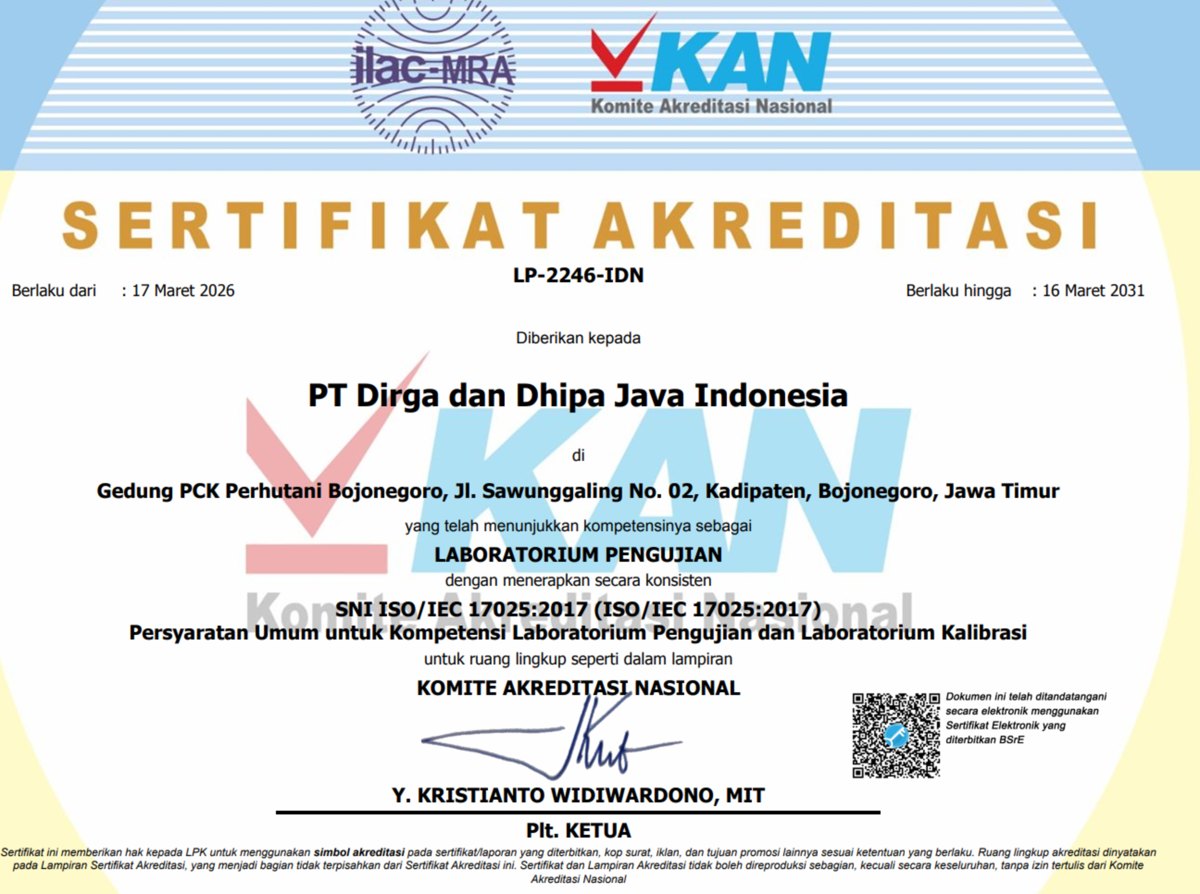
- Accredited to ISO/IEC 17025:2017 (LP-2246-IDN) — results accepted for custody transfer, contract specifications, and audits
- Based in Bojonegoro, East Java — close to the Cepu Block oil and gas fields and East Java pipelines; samples arrive the same day
- One laboratory for all gas types — natural gas, LNG, CNG, and LPG
- Sampling by trained technicians — GPA 2166, ASTM D1265, and controlled LNG vaporisation
- Related services — gas purity testing for nitrogen and CO2 process, crude oil analysis for condensate
Standards and references
Methods refer to GPA Midstream, ASTM International, and the ISO 6974/6976 series. A basic explanation of natural gas composition is in the article natural gas composition analysis and why accurate natural gas composition analysis matters.