Marine fuel testing is laboratory testing of the diesel and biodiesel blends used by ferries, tugboats, barges, fishing vessels, tourist boats, and supply vessels to make sure the fuel is clean, safe, and on specification. Vessels refuel at many ports with varying quality, while an engine failing at sea is a safety risk and a major loss.
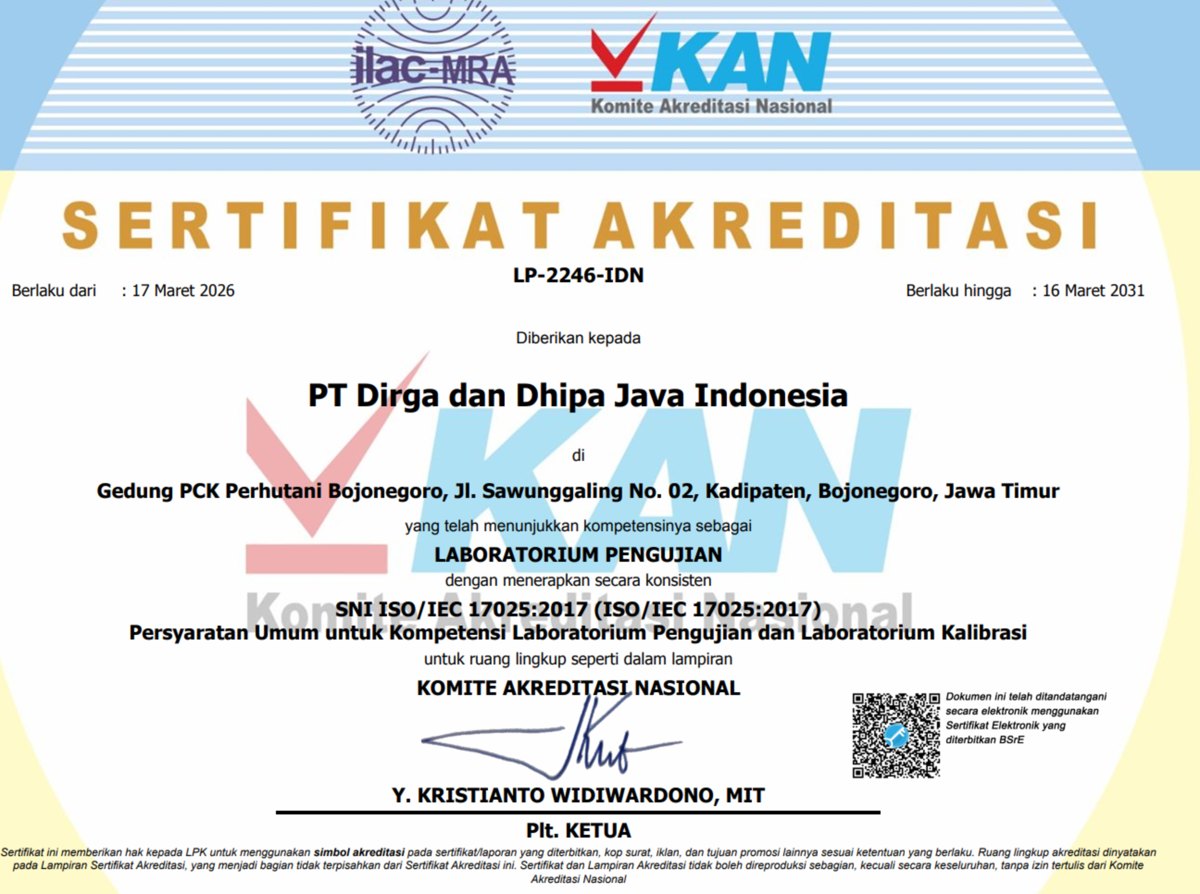
This page explains marine fuel test parameters, sampling points on board, engine symptoms linked to fuel quality, and how to send samples to the KAN ISO/IEC 17025:2017 accredited laboratory of PT DnD Java Indonesia.
Why Marine Fuel Testing Matters
Marine fuel is most vulnerable to water. Condensation in tanks, seawater entering through vents or tank caps, and water from the supplier's shore tanks all end up in the fuel system. The B40 biodiesel blend now on the market absorbs water more easily and supports microbial growth, so separators and filters fill quickly. Marine fuel testing provides proof of quality at bunkering and helps find the source of problems before the engine is damaged.
For safety, the international ship safety convention (SOLAS) generally requires marine fuel to have a flash point of at least 60 °C, and ships subject to IMO rules also face sulphur limits. Flash point and sulphur testing confirm the fuel received meets those limits.
Marine Fuel Test Parameters
| Parameter | Method | What it answers |
|---|---|---|
| Moisture content | ASTM D6304 | Dissolved water that damages injectors and causes corrosion |
| Water and sediment | ASTM D2709 | Free water and dirt that clog filters and separators |
| Density | ASTM D4052 | Fuel type conformity, volume-to-mass conversion at bunkering |
| Viscosity | ASTM D445 | Injector atomisation and pump lubrication |
| Flash point | ASTM D93 | Storage safety on board, signs of blending with lighter fuels |
| Sulfur | ASTM D4294 / D5453 | Sulphur limit compliance and corrosion risk |
| Cetane index / number | ASTM D4737 / D613 | Ease of starting and combustion quality |
| FAME content | EN 14078 / ASTM D7371 | Biodiesel percentage in the blend |
Sampling Points on Board
| Point | Purpose |
|---|---|
| During bunkering from a truck or shore tank | Proof of the fuel quality purchased, basis for supplier claims |
| Vessel storage tank, bottom | Accumulated water and sediment |
| Day tank | The fuel that actually enters the engine |
| Before and after the separator or filter | Effectiveness of fuel cleaning |
During bunkering, sample while pumping is under way and keep one sealed backup bottle signed by both parties. This bottle becomes the reference if a quality dispute arises.
Marine Engine Symptoms Linked to Fuel
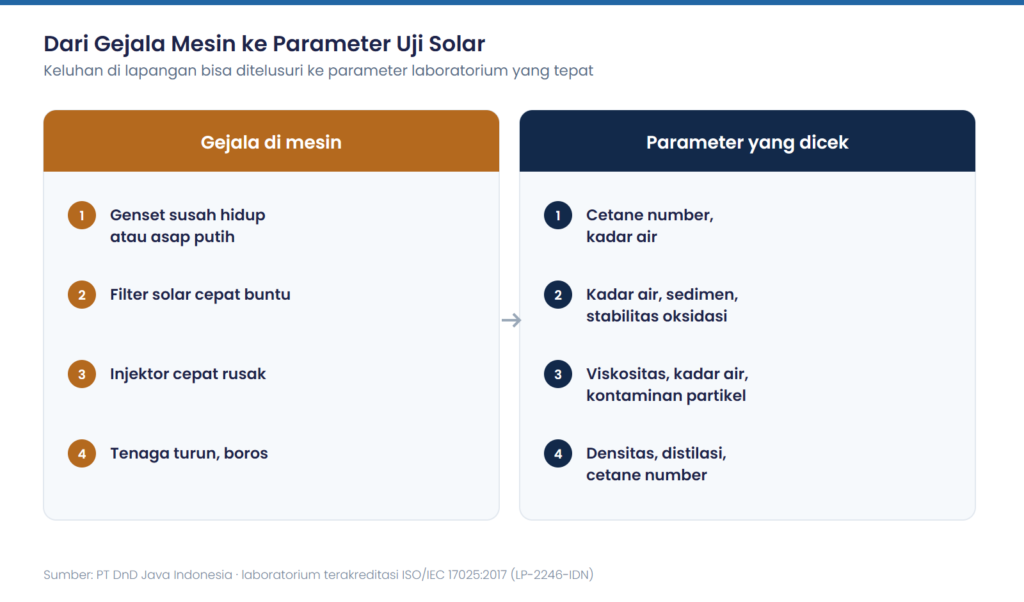
| Symptom | Parameters tested |
|---|---|
| Engine stutters after refuelling at a new port | Water content, density, flash point |
| Separator or filter fills quickly | Water and sediment, water content, FAME content |
| Black smoke, power loss, higher consumption | Cetane, viscosity, density |
| Injectors and pumps wear quickly | Viscosity, water content, cleanliness |
Marine fuel testing should be combined with marine engine oil analysis. Oil contaminated with fuel or water is often the first sign of a fuel system problem.
Who Needs Marine Fuel Testing
| Operator | Need |
|---|---|
| Ferries and passenger vessels | Passenger safety, schedules must not be disrupted |
| Tugboats and barges | Shipping schedules, engines working hard on rivers and coasts |
| Fishing vessels | Long trips, fuel stored at sea for long periods |
| Tourist boats and fast boats | Refuelling at many points, reputation of tourism services |
| Oil and gas supply vessels | Oil and gas operator safety standards |
| Port fuel suppliers | Proof of quality for vessel customers |
How to Send Marine Fuel Samples
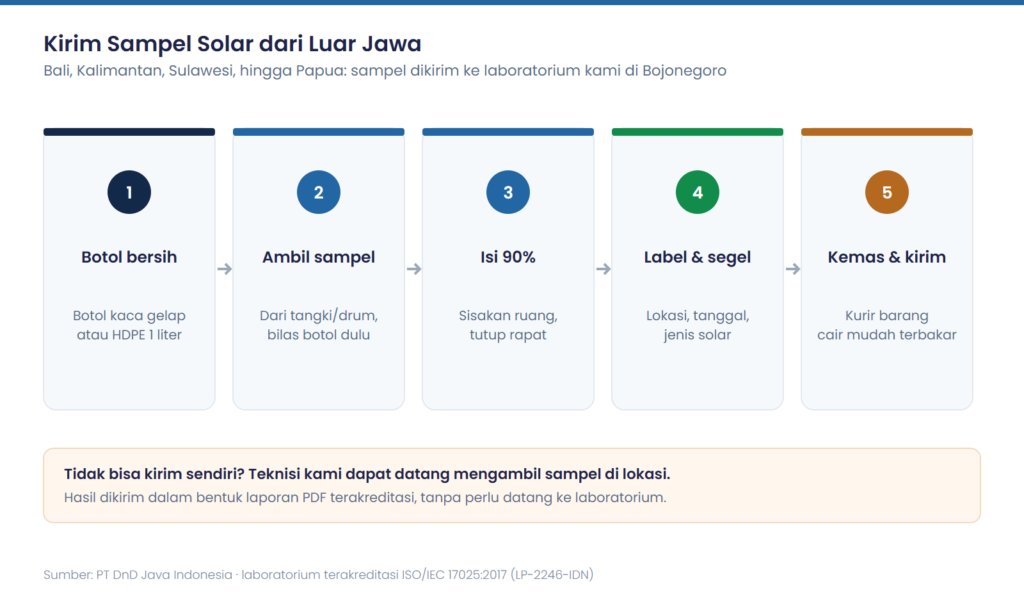
Use a clean bottle of about 1 litre per sample, fill to about 90%, close tightly, label it with the vessel name, sampling point, bunkering port, and date, then pack in layers and ship via a courier that accepts flammable liquids. We accept samples from all of Indonesia, including East Java, Central Java, Bali, Lombok and NTB, Kalimantan, and Sulawesi. Samples are sent with our kit, or taken by technicians for programmes with many points.
Recommended Marine Fuel Testing Schedule
- Every bunkering from a new supplier or at a port not used before.
- Monthly on storage tanks and day tanks for vessels in regular operation.
- Before long voyages for fishing and supply vessels.
- Immediately when the engine shows signs of trouble.
Frequently Asked Questions about Marine Fuel Testing
Which parameters are tested on marine fuel?
Usually water content, water and sediment, density, viscosity, flash point, sulphur, cetane index, and FAME content for biodiesel blends. The package is tailored to the vessel type and engine complaints.
When should marine fuel samples be taken?
During bunkering from the supplier, with one sealed backup bottle, and periodically from storage tanks and day tanks. If the engine has problems, also sample before and after the separator.
Why is marine fuel easily contaminated with water?
Condensation in tanks, seawater entering through vents or tank caps, and water from the supplier's shore tanks. Biodiesel blends also absorb water more easily than pure diesel.
Can samples be sent from ports outside Java?
Yes. Samples are sent with our kit via couriers that accept flammable liquids, and accredited reports are sent as PDFs.
Need marine fuel testing?
Tell us the vessel type, number of vessels, and your port; we will send a sample kit or technician schedule. Choose your sector — the WhatsApp message is pre-filled, just send it.
WhatsApp — Ferries & Passenger VesselsWhatsApp — Tugboats & BargesWhatsApp — Fishing VesselsWhatsApp — Tourist Boats & Fast Boats
Or call (0353) 8940000 · [email protected]