Heavy equipment oil analysis is laboratory testing of engine, transmission, hydraulic, and final drive oil in excavators, dump trucks, dozers, graders, and gensets to detect component wear, contamination, and oil degradation before major failures. With periodic analysis, maintenance teams can plan repairs, extend oil drain intervals when safe, and avoid sudden unit stoppages.
This page explains heavy equipment oil analysis parameters, what the detected wear metals mean, the compartments tested, sampling schedules, and monthly programmes for mining, contractors, plantations, and construction projects.
What Heavy Equipment Oil Analysis Finds
| Finding | Possible source | Typical action |
|---|---|---|
| Iron (Fe) rising | Cylinder liners, gears, shafts, bearings | Compare with operating hours, check filters |
| Copper (Cu) and lead (Pb) rising | Plain bearings, bushings, oil cooler | Check bearing clearance and oil cooler leaks |
| Aluminium (Al) and silicon (Si) rising together | Dust entering through a leaking air filter | Check air intake ducts and seals |
| Chromium (Cr) rising | Piston rings, valve stems | Check blow-by and compression |
| Sodium (Na), potassium (K), boron (B) | Coolant entering the oil | Pressure-test the cooling system, check gaskets |
| Viscosity and flash point falling | Oil contaminated with fuel | Check injectors and diesel testing |
Heavy Equipment Oil Analysis Parameters
| Parameter | Method | Purpose |
|---|---|---|
| Viscosity at 40 and 100 °C | ASTM D445 | Oxidation, soot, or fuel dilution |
| Wear metals and additives | ASTM D5185 (ICP) | Worn components and additive package condition |
| Moisture content | ASTM D6304 | Coolant leaks or condensation |
| Base number (TBN) | ASTM D2896 / D4739 | Remaining capacity of the oil to neutralise acids |
| Acid number (TAN) | ASTM D664 | Oil oxidation, especially hydraulic and transmission |
| Oxidation, nitration, soot | ASTM E2412 (FTIR) | Oil degradation and combustion load |
| Flash point | ASTM D92 / D93 | Dilution by fuel |
The full list of lubricant parameters is on the page lube oil analysis.
Compartments Tested and Sampling Schedule
| Compartment | Typical schedule | Focus |
|---|---|---|
| Engine | At each oil change or about every 250 operating hours, as recommended by the manufacturer | Wear metals, fuel, coolant, soot, TBN |
| Transmission | Every 500 operating hours or as per the manufacturer | Gear and clutch wear metals |
| Hydraulic | Every 500 operating hours or as per the manufacturer | Water, oxidation, cleanliness |
| Final drive and swing | Every 500 operating hours or as per the manufacturer | Iron and gear particles |
Record the unit's operating hours and oil hours on every sample label. Without this data, wear metal figures are hard to compare over time. Consistent sampling points and timing ensure heavy equipment oil analysis results truly reflect component condition, not differences in sampling method.
Monthly Heavy Equipment Oil Analysis Programme
For sites with dozens of units, we set up monthly programmes: bottles and labels are sent to the site, mechanics take samples on the service schedule, samples are shipped to the laboratory, and per-unit reports are sent with trend notes. The programme works best combined with diesel fuel lab testing on tanks and fuel trucks, because contaminated fuel is one of the main causes of engine wear.
| Benefit | Explanation |
|---|---|
| Prevents sudden breakdowns | Wear shows up in the oil weeks before a component fails |
| The right oil drain interval | Change when the oil has actually degraded, not too early or too late |
| Evidence for warranty claims | Oil condition history from an accredited laboratory |
| Spare parts planning | Components starting to wear can be ordered before they fail |
How to Take and Send Oil Samples
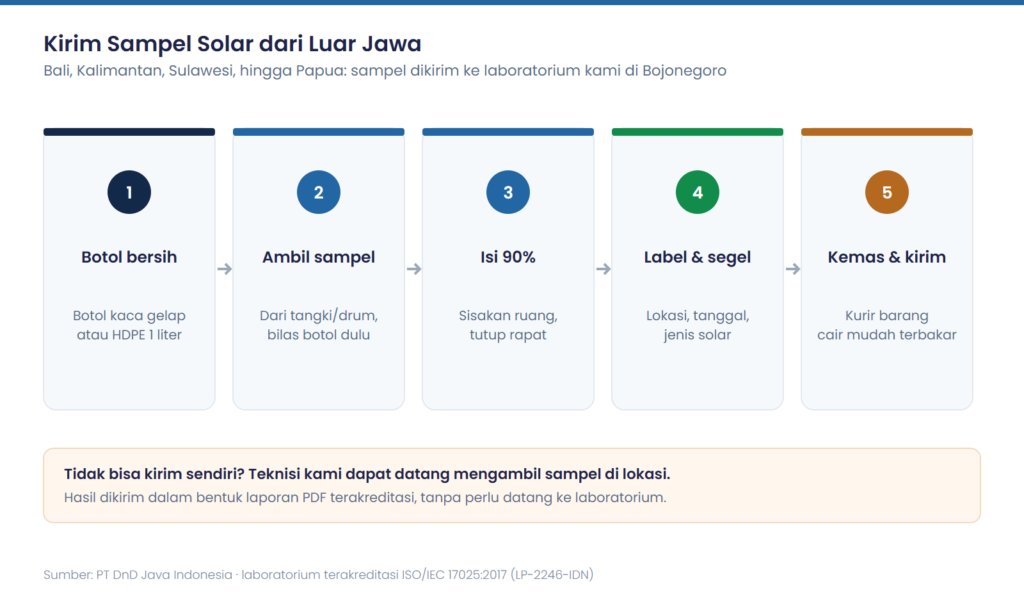
Take samples while the oil is still warm after operation, from the sampling point or with a vacuum pump through the dipstick tube, not from used oil in a drain pan. Fill a clean bottle with about 100–200 ml, close tightly, and label it with the unit number, compartment, operating hours, oil hours, oil type, and date. We accept samples from all of Indonesia, including East Java, Central Java, Bali, Lombok and NTB, Kalimantan, and Sulawesi. Samples are sent with our kit, or taken by technicians for programmes with many points.
Frequently Asked Questions about Heavy Equipment Oil Analysis
What are the benefits of heavy equipment oil analysis?
Heavy equipment oil analysis detects component wear, the entry of dust, water, coolant, and fuel into the oil, and the condition of the oil itself. Results are used to prevent sudden breakdowns and set the right oil drain interval.
How often should heavy equipment oil be analysed?
For engines usually at each oil change or about every 250 operating hours, and for transmissions, hydraulics, and final drives about every 500 operating hours, following the unit manufacturer's recommendation.
Which metals indicate dust entering the engine?
Silicon rising together with aluminium usually indicates dust entering through a leaking air filter or intake. This accelerates piston and liner wear.
How much oil sample should be sent?
About 100 to 200 ml per compartment in a clean, tightly closed bottle, labelled with the unit number, compartment, and operating hours.
Set up an oil analysis programme for your fleet
Tell us the number of units, type of heavy equipment, and site location; we will draw up a sampling schedule and send sample bottles. Choose your sector — the WhatsApp message is pre-filled, just send it.
WhatsApp — Mining & ContractorsWhatsApp — Construction & ProjectsWhatsApp — Plantations & ForestryWhatsApp — Heavy Equipment Rental
Or call (0353) 8940000 · [email protected]