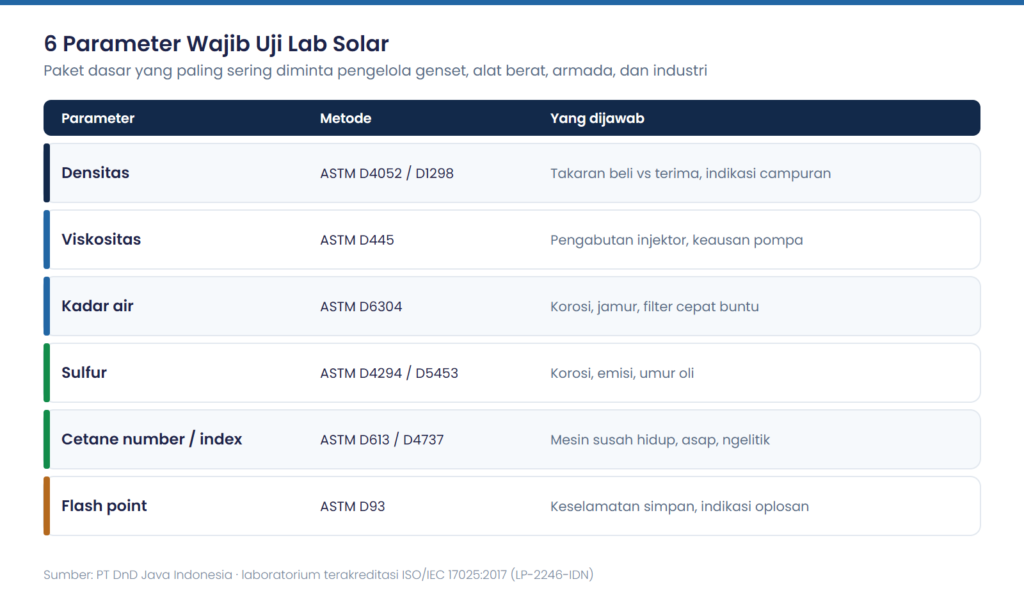
Diesel fuel lab testing is laboratory testing of diesel or biodiesel blend quality to ensure the fuel you buy and store meets specification, is safe, and will not damage engines. The most requested package has six parameters: density, viscosity, water content, sulphur, cetane number, and flash point. Results are used by building genset managers, mining contractors, fleet operators, and industry to check suppliers, resolve engine complaints, and pass audits.
This article covers why diesel fuel lab testing is needed, what each parameter means in plain language, the method standards used, how to read the results, engine symptoms that point to bad fuel, and how to send samples to the laboratory from anywhere in Indonesia, including outside Java.
Why Diesel Fuel Lab Testing Is Needed
Diesel is often assumed to be the same from every supplier. In reality, its quality varies with the source, the biodiesel blending process, transport, and storage time. Diesel contaminated with water, too viscous, or with a low cetane number cannot be spotted by eye, but the effects show in the engine: gensets that fail to start when needed, filters that clog quickly, damaged injectors, and higher fuel consumption.
| Situation | Risk without diesel lab testing |
|---|---|
| Buying diesel from a new supplier | No proof the quality matches what was promised |
| Diesel stored long in a genset tank | Water and sediment build up, microbes grow, the genset fails in an emergency |
| Recurring engine complaints | Injector and pump repair costs keep coming without knowing the cause |
| Volume or quality differences at delivery | Hard to prove your case in a dispute with the supplier |
| Company or building owner audit | No fuel quality control records |
With periodic diesel fuel lab testing, decisions to buy, reject, or change suppliers can be based on data, not guesswork. The cost of testing is usually far lower than a single repair of a diesel engine injection system.
6 Essential Diesel Fuel Lab Test Parameters
1. Density (ASTM D4052 or D1298)
Density is the weight of diesel per volume at the 15 °C reference temperature. It is used to convert volume to mass at delivery and gives an early indication of blending with other fuels. Density outside the specification range suggests a blend or a product different from the one ordered.
2. Viscosity (ASTM D445)
Kinematic viscosity at 40 °C shows how thick the diesel is. Diesel that is too thin reduces injection pump lubrication, while diesel that is too thick causes poor injector atomisation, incomplete combustion, and more smoke.
3. Water content (ASTM D6304)
Water content is measured by the Karl Fischer method. Water in diesel causes corrosion, accelerates the growth of microbes that form slime in tanks, and makes filters clog quickly. Biodiesel blends containing FAME absorb water more easily, so this parameter matters more as biodiesel blending increases.
4. Sulphur (ASTM D4294 or D5453)
Sulphur content affects corrosion, emissions, and engine oil life. Modern diesel engines with common rail systems and exhaust after-treatment are more sensitive to high sulphur, so the diesel grade should follow the engine manufacturer's recommendation.
5. Cetane number or cetane index (ASTM D613 or D4737)
Cetane number shows how quickly diesel ignites after being injected into the combustion chamber. A low value makes engines hard to start, especially when cold, causes white smoke, and makes the engine run rough. In Indonesia, diesel is sold in different cetane grades, such as CN48 and CN51, so this test also confirms the grade received matches the grade purchased. Cetane index is calculated from density and distillation, while cetane number is measured directly with a test engine.
6. Flash point (ASTM D93)
Flash point is the lowest temperature at which diesel vapour can ignite. It matters for storage safety. A flash point that is too low is often a sign that the diesel is contaminated with a lighter fuel, such as petrol or kerosene.
Additional Parameters for B40 Biodiesel Blends
Since the mandatory biodiesel blend rose to B40, diesel on the market contains about 40% FAME (fatty acid methyl ester). FAME makes the fuel more environmentally friendly, but it also absorbs water more easily, oxidises faster in long storage, and can form deposits at low temperatures. For biodiesel blends stored in genset or project tanks, several additional parameters are strongly recommended.
| Additional parameters | Method | Why it matters for biodiesel blends |
|---|---|---|
| FAME content | EN 14078 / ASTM D7371 | Confirms the biodiesel percentage matches the B grade purchased |
| Oxidation stability | EN 15751 | Diesel stored for long periods forms gum and deposits |
| Water and sediment | ASTM D2709 | Deposits and free water that clog filters |
| Distillation | ASTM D86 | Indicates blending and is the basis for calculating cetane index |
| Copper strip corrosion | ASTM D130 | Compounds corrosive to metal components |
| Pour point / cloud point | ASTM D97 / D2500 | Risk of waxing in cold areas or highlands |
Biodiesel for mining heavy equipment is covered in the article biodiesel analysis for heavy equipment. The full list of fuel parameters we test is on the page fuel analysis services.
From Engine Symptoms to Diesel Lab Test Parameters
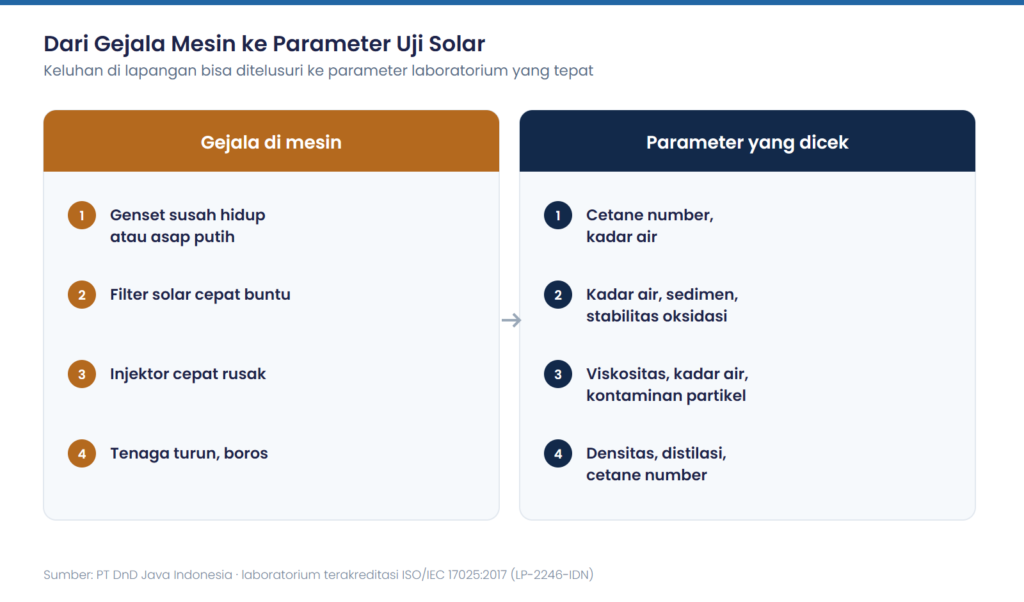
Many diesel fuel lab testing requests start with a complaint in the field. The table below helps choose the most relevant parameters so testing costs are well targeted.
| Symptom | Possible cause in the diesel | Parameters tested |
|---|---|---|
| Genset hard to start or white smoke at start-up | Low cetane, water present | Cetane number, water content |
| Fuel filter clogs quickly | Water, sediment, microbes, biodiesel oxidation | Water content, water and sediment, oxidation stability |
| Injectors and pumps wear quickly | Wrong viscosity, particles, water | Viscosity, water content, cleanliness |
| Power loss and higher consumption | Wrong diesel grade, contamination | Density, distillation, cetane number |
| Strong odour or colour change | Mixed with other fuel, oxidation | Flash point, density, distillation |
If engine damage has already occurred, diesel fuel lab testing should be combined with lube oil analysis of the engine oil, because fuel contamination of the oil is often part of the same problem.
Why Diesel in Genset Tanks Deteriorates Quickly
Standby genset tanks are where problem diesel most often sits unnoticed. The tank is filled up, then left for months because the genset only runs during weekly tests or power cuts. Meanwhile, day and night temperature swings draw humid air in through the tank vent, where it condenses into water at the bottom. This water becomes a breeding ground for bacteria and fungi that form a slime layer at the water-diesel interface.
Biodiesel blends with high FAME content speed this up because they absorb water and oxidise more easily. The result: when the genset is really needed, the filter clogs within minutes and the engine stops. Periodic diesel fuel lab testing of genset tanks, plus draining water from the tank bottom, is a low-cost way to prevent genset failure at the most critical moment.
How to Read Diesel Fuel Lab Test Results
| Report section | What it means | What to check |
|---|---|---|
| Result per parameter | Measured value with units | Units and reference temperature are stated |
| Specification limit | Required range | The specification used is stated |
| Conforming / non-conforming status | Comparison of results with limits | Which parameters deviate |
| Test method | ASTM or EN method used | Matches what the contract or manufacturer requires |
| Sample data | Origin, date, and sample condition | Matches the tank or delivery in question |
If one parameter deviates, do not immediately conclude from the diesel lab test that all the fuel is bad. High water content in a sample from the tank bottom, for example, may mean water has settled at the bottom while the diesel above is still good. That is why the sampling point is always recorded in the report.
Diesel Fuel Lab Testing for Every Type of User
Buildings, malls, hotels, hospitals, and data centres
Standby gensets can sit unused for months while the diesel in their tanks keeps ageing. When the power goes out, the genset must start immediately. Periodic diesel fuel lab testing, for example every six months, confirms the diesel in the tank is still fit for use and gives time to clean the tank before a failure occurs.
Mining and heavy equipment
Excavators, dump trucks, and other heavy equipment consume large amounts of diesel at dusty, humid sites. Diesel lab testing at delivery points and field tanks helps control contamination and protects expensive injection components.
Fleets and transport
Logistics companies, buses, and ships use diesel from many suppliers in many locations. Periodic testing per supplier provides a basis for choosing the suppliers with the most consistent quality.
Industry and diesel power plants
Boilers, burners, and diesel power plants buy diesel in large volumes under contract. Testing every delivery protects the contract value and provides evidence in a quality dispute.
How to Take and Ship Diesel Samples from Outside Java
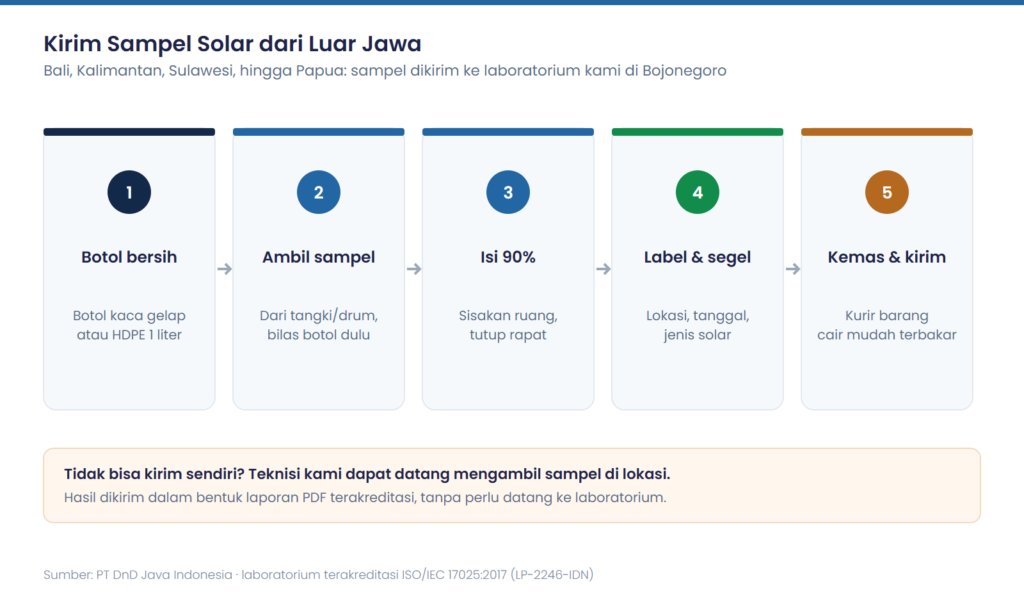
Our laboratory is in Bojonegoro, East Java, but customers in Bali, Kalimantan, Sulawesi, Sumatra, and Papua can send samples without visiting. Follow these steps so the sample still represents the diesel in your tank.
| Step | What to do | Why |
|---|---|---|
| 1. Prepare the bottle | Clean, dry amber glass or HDPE bottle, 1 litre per sample | Dirty bottles contaminate results |
| 2. Take the sample | From the tank tap, drum, or nozzle; rinse the bottle once with the same diesel | Bottle contents represent the diesel in the tank |
| 3. Fill to about 90% | Leave headspace, close tightly | Prevents spills when temperature changes |
| 4. Label it | Company name, tank location, date, diesel type, sampling point | Report traceability |
| 5. Pack and ship | Wrap in layers, put in a box, ship via a courier that accepts flammable liquids | Safe and compliant with shipping rules |
For engine complaints, take two samples: one from the storage tank and one from the point before the engine filter. For supplier deliveries, sample during unloading and keep one sealed backup bottle for comparison. If shipping yourself is not possible, our technicians can be scheduled to sample on site.
Common Mistakes That Make Diesel Lab Test Results Misleading
| Mistake | Consequence | Prevention |
|---|---|---|
| Sampling only from the top of the tank | Water and sediment at the bottom go undetected | Also sample from the bottom of the tank |
| Using old drink bottles | Residual liquid and dissolved plastic contaminate the sample | Use clean dedicated sample bottles |
| Clear bottles exposed to sunlight | Diesel oxidises during shipment | Dark bottles, store in the shade |
| No sampling point label | Results are hard to link to a specific tank | Label fully before shipping |
| Sample kept too long before shipping | Water content and stability change | Ship within a few days of sampling |
Reference Specifications in Diesel Fuel Lab Testing
Diesel fuel lab test results only mean something when compared with the right reference. In Indonesia, the quality of diesel on the market follows specifications set by the Directorate General of Oil and Gas for each diesel type, including the CN48 and CN51 grades and the applicable biodiesel blend. Many companies also use engine manufacturer specifications or stricter internal limits for critical equipment.
| Reference type | When used | Notes |
|---|---|---|
| Government diesel specification | Checking whether supplier diesel is fit for sale | The most common basis for supplier claims |
| Engine manufacturer recommendation | Gensets, heavy equipment, and common rail engines | Often stricter on sulphur and cleanliness |
| Purchase contract specification | Large-volume purchases by industry and mining | Methods and limits should be written into the contract |
| Company internal limits | Maintenance programmes and internal audits | Built from problem history and risk assessment |
When requesting diesel fuel lab testing, state the reference to use. The laboratory then reports each result against those limits, so conforming or non-conforming status is clear without interpreting the figures yourself.
Diesel Fuel Lab Testing vs Simple Field Checks
Some users rely on simple checks such as looking at the colour, smelling it, or using water-finding paste at the tank bottom. These are useful as quick checks but do not replace diesel fuel lab testing.
| Method | What it reveals | Limitations |
|---|---|---|
| Checking colour and clarity | Haze, visible free water | Dissolved water and combustion quality cannot be seen |
| Water-finding paste | Presence of free water at the tank bottom | Does not measure water content in the diesel |
| Field hydrometer | Approximate density | Limited accuracy, not for claims |
| Accredited diesel fuel lab testing | Measured values for every parameter | Requires shipping a sample and waiting for results |
Good practice is to use field checks for daily inspection, then diesel fuel lab testing for important decisions such as accepting a delivery, changing suppliers, or filing a claim. Only reports from an accredited laboratory carry weight as evidence.
Diesel Fuel Lab Test Packages and Turnaround Time
| Package | Parameter | Suitable for |
|---|---|---|
| Basic 6-parameter package | Density, viscosity, water content, sulphur, cetane, flash point | Supplier checks and building gensets |
| Biodiesel blend package | Basic package + FAME, oxidation stability, water and sediment | Long-stored tanks and B40 biodiesel blends |
| Investigation package | Tailored to the engine symptoms | Injector, filter, or power complaints |
| Periodic programme | Fixed parameters on a schedule | Many tanks or many sites |
Routine testing is usually completed within a few working days after the sample is received. Certain parameters, such as cetane number by test engine or oxidation stability, take longer. Exact schedule and cost are given in the quotation once the diesel type, number of samples, and location are known.
Recommended Diesel Fuel Lab Testing Schedule
- Every receipt from a new supplier — as the basis for supplier approval.
- Every six months for standby genset tanks — confirming the diesel is still fit for emergencies.
- Monthly or per delivery for large consumers — mining, diesel power plants, and industry with volume contracts.
- After tanks are cleaned or refilled — confirming there is no residual contamination.
- When engines show problems — before replacing expensive components.
Key Terms in Diesel Fuel Lab Testing
| Term | Short meaning |
|---|---|
| Diesel / HSD | Fuel for diesel engines; HSD stands for high speed diesel |
| B40 biodiesel blend | Diesel blended with about 40% biodiesel (FAME) |
| FAME | Fatty acid methyl ester, biodiesel made from vegetable oil |
| Cetane number | A measure of how quickly diesel ignites in the combustion chamber |
| CN48 / CN51 | Diesel grades based on minimum cetane number |
| Flash point | The lowest temperature at which diesel vapour can ignite |
| Karl Fischer | A titration method for measuring very small amounts of water |
| Oxidation stability | Resistance of the fuel to degradation during storage |
DND Java Diesel Fuel Lab Testing Services for All of Indonesia
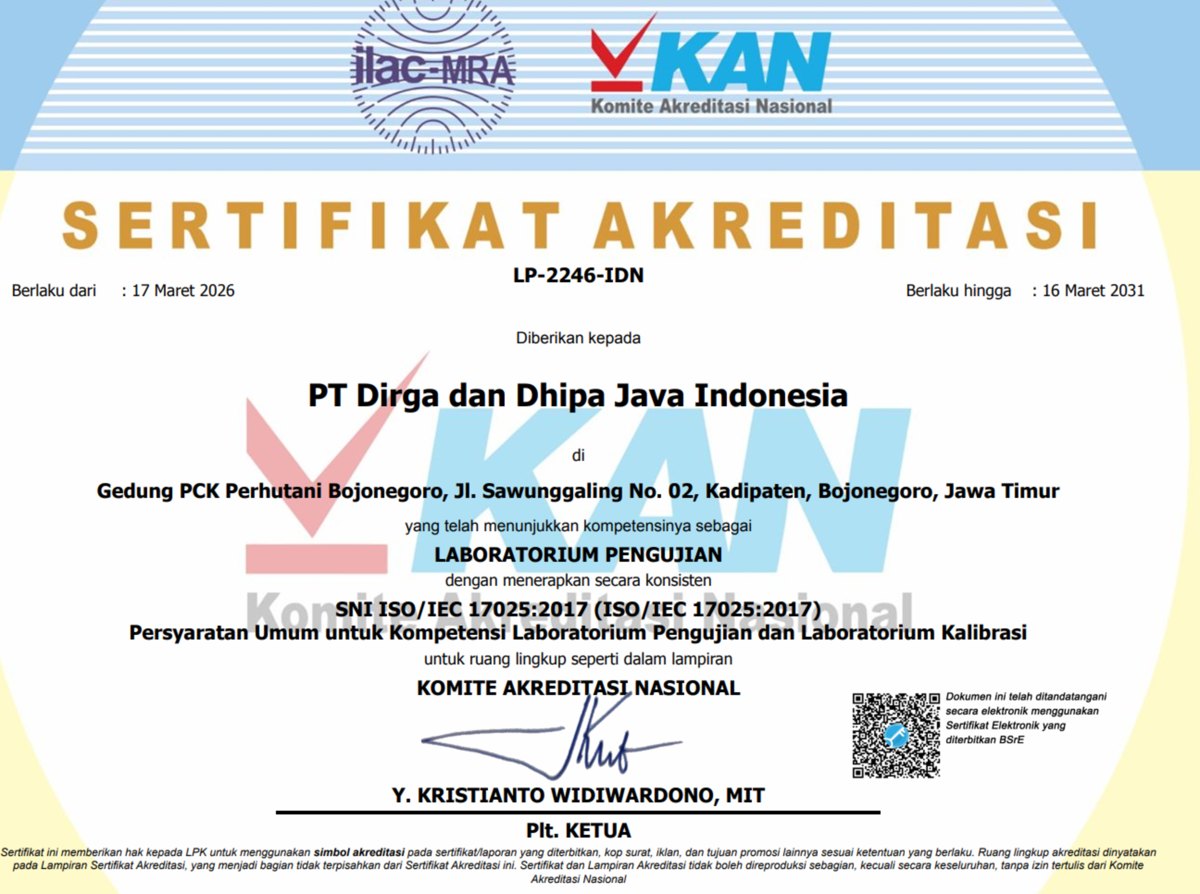
PT DnD Java Indonesia operates a KAN-accredited ISO/IEC 17025:2017 laboratory (LP-2246-IDN) in Bojonegoro, East Java. We provide diesel and biodiesel blend lab testing for buildings, malls, hotels, hospitals, mining, fleets, and industry, from the basic 6-parameter package to full testing against specification. Samples can be shipped from anywhere in Indonesia or collected on site by our technicians. Reports are sent as accredited PDFs, ready to attach to audits, supplier claims, or maintenance records.
For customers with many tanks or sites, we set up periodic testing programmes with a fixed schedule and trend reports, so changes in diesel quality over time can be tracked.
Frequently Asked Questions about Diesel Fuel Lab Testing
Which diesel fuel lab test parameters matter most?
The basic diesel fuel lab test package has six parameters: density, viscosity, water content, sulphur, cetane number or cetane index, and flash point. For B40 biodiesel blends, FAME content, oxidation stability, and water and sediment are usually added.
How much diesel sample needs to be sent?
Usually about 1 litre per sample for the 6-parameter package. Cetane number testing by test engine needs a larger volume, so we confirm the exact amount in the quotation.
Can diesel samples be sent from outside Java?
Yes. Samples in clean, tightly closed, labelled bottles packed in layers can be sent via couriers that accept flammable liquids. Customers in Bali, Kalimantan, Sulawesi, and other regions already use this method.
How often should diesel in a genset tank be tested?
For standby gensets that are rarely used, testing every six months is strongly recommended because biodiesel blends absorb water and oxidise during storage. Testing is also done whenever the supplier changes or the genset shows problems.
Related Articles
- automated sampling system — how it works, components, and automated sampling standards
- automated sampling systems — 5 reasons industries need automated sampling
- pressure dew point — keeping compressed air dry
Need diesel fuel lab testing for your genset, heavy equipment, or fleet?
Tell us the diesel type, number of samples, and your location; we will send a sampling guide or schedule a technician to your site. Choose your sector — the WhatsApp message is pre-filled, just send it.
WhatsApp — Buildings & GensetsWhatsApp — Mining & Heavy EquipmentWhatsApp — Fleet & TransportWhatsApp — Industry & Diesel Power
Or call (0353) 8940000 · [email protected]