

Summary
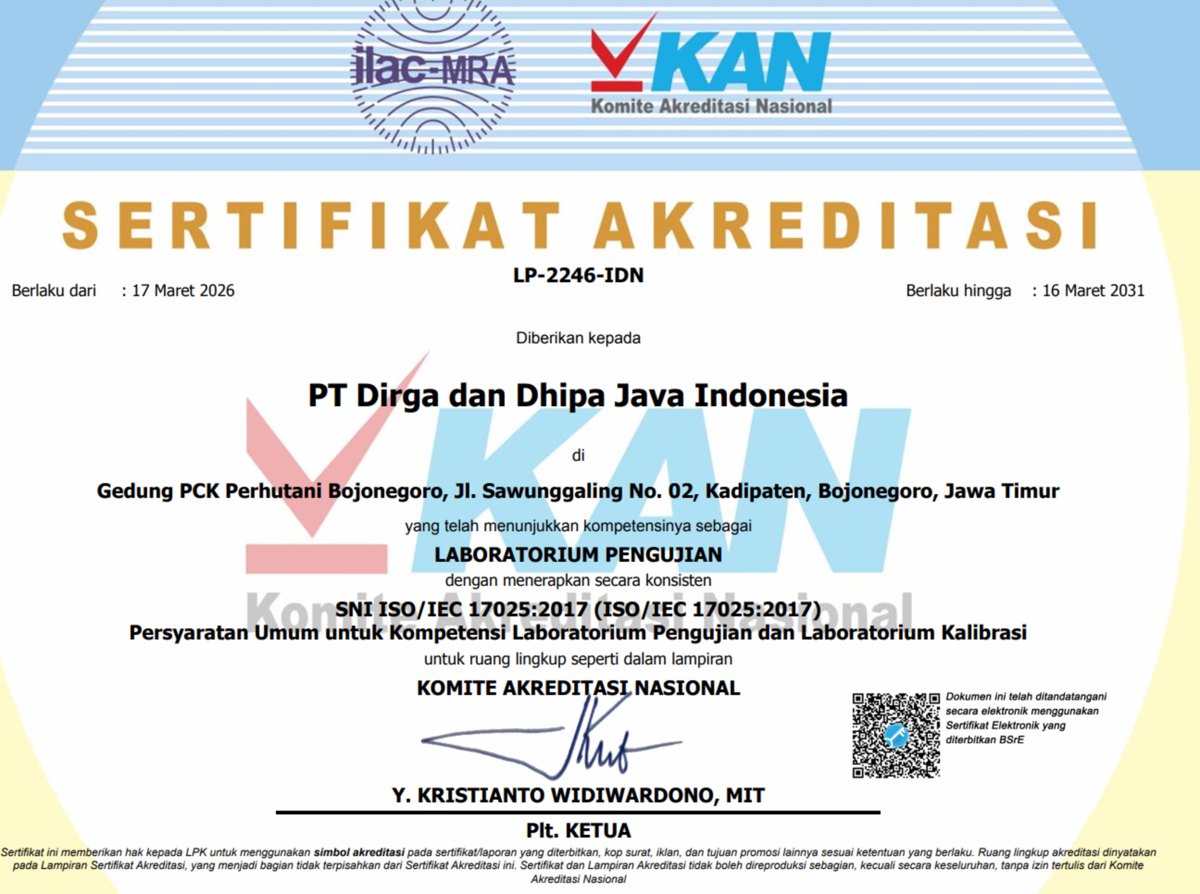
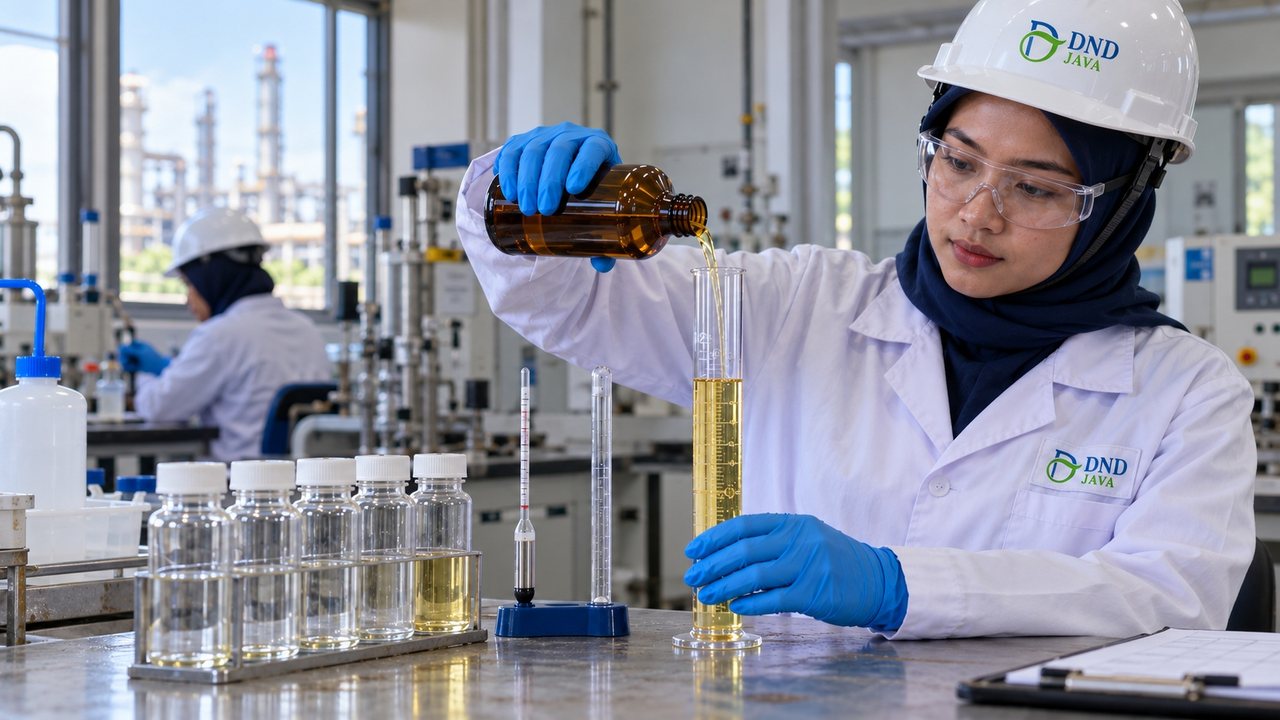
B40 biodiesel blend testing is laboratory testing to confirm that the diesel fuel blended with 40% biodiesel (FAME) you buy and store meets the specification set by decree of the Director General of Oil and Gas, from FAME content and water content to oxidation stability. The PT DnD Java Indonesia laboratory (KAN ISO/IEC 17025:2017, LP-2246-IDN) compares every result against the applicable specification annex, so the report can be used for supply acceptance, claims against suppliers, and B50 preparation.
Since 1 January 2025, diesel fuel sold in Indonesia must be blended with 40% biodiesel. For managers of mine sites, building gensets, fleets, vessels, diesel power plants (PLTD), and industrial fuel distributors, this change raises the same questions: does the biodiesel blend in our tanks really meet specification, and is it safe to store for long periods?
B40 biodiesel blend testing answers those questions with measured data, not estimates. This page explains the applicable specification parameters, the parameters already available in our laboratory, the most common field problems, package options, how to take samples, and the steps to prepare for B50.
Table of Contents
What B40 Biodiesel Blend Testing Is and Why It Is Needed
A B40 biodiesel blend is diesel fuel mixed with 40% biodiesel in the form of FAME (fatty acid methyl ester) made from vegetable oils. The government has mandated this blend since 1 January 2025 as a continuation of earlier biodiesel blending programmes.
A higher FAME share brings benefits, but it also changes how the fuel behaves. FAME absorbs water more readily, oxidises faster in storage, and can form deposits when temperatures drop. As a result, diesel fuel that passed on receipt can deteriorate after a few weeks or months in the tank.
B40 biodiesel blend testing is a laboratory check of those specification parameters. It has three purposes: confirming that supplies meet specification on receipt, monitoring quality during storage, and providing written evidence if a dispute arises with a supplier.
This page focuses on biodiesel blend specification compliance. If you only need a basic six-parameter diesel fuel check, our guide on diesel fuel lab testing is more concise and goes straight to how to ship samples.
Directorate General of Oil and Gas (Ditjen Migas) Specifications for Biodiesel-Blended Diesel Fuel
The quality of diesel fuel marketed domestically, including diesel fuel already blended with biodiesel, is set by decree of the Director General of Oil and Gas. The specification differs by diesel fuel type; for biodiesel-blended diesel fuel there is a cetane number 48 grade and a cetane number 51 grade.
Each type has a list of parameters and limits stated in the annex of the applicable Directorate General of Oil and Gas (Ditjen Migas) decree. These limits may be updated when blending policy changes, for example in preparation for B50.
That is why we do not list limit values on this page. Our B40 biodiesel blend test reports always compare each result with the annex in force at the time of testing, so you do not need to match the numbers yourself.
Official information on fuel policy and specifications can be followed on the websites of the Directorate General of Oil and Gas and the Ministry of Energy and Mineral Resources (ESDM). When requesting a quotation, state the diesel fuel grade you buy so that the correct reference is used in the report.
19 Specification Parameters in B40 Biodiesel Blend Testing
The following table summarises the specification parameters for biodiesel-blended diesel fuel, what each parameter tells you, and its availability in our laboratory. Parameters marked Confirm first are not yet listed in our service list; contact us to confirm availability before sending samples.
| Specification parameter | What it tells you about the biodiesel blend | Availability at DND |
|---|---|---|
| Cetane number or cetane index | Ignition quality, ease of starting, and smooth engine running | Available |
| Density at 15 °C | Product identity, volume-to-mass conversion, indication of blending | Available |
| Viscosity at 40 °C | Injector atomisation and injection pump lubrication | Available |
| Sulphur content | Corrosion, emissions, and the service life of the oil and exhaust system | Available |
| Distillation (T90) | Boiling range, indication of contamination with heavy or light fractions | Available |
| Flash point | Storage safety, indication of contamination with light fractions | Available |
| Cloud point or pour point | Risk of thickening and forming deposits when temperatures drop | Available |
| Carbon residue | Tendency to form deposits in the combustion chamber and injectors | Confirm first |
| Water content | Corrosion, microbial growth, clogged filters | Available |
| FAME content | Confirms the biodiesel share matches B40 | Available |
| Copper strip corrosion | Compounds corrosive to copper and brass components | Available |
| Ash content | Inorganic solids that cause component wear | Confirm first |
| Sediment content | Solid particles that clog filters and injectors | Confirm first (water and sediment test available) |
| Strong acid number | Strong mineral acids that are highly corrosive | Confirm first |
| Total acid number | Acidity level, partly from FAME oxidation | Confirm first |
| Lubricity (HFRR) | Protection of the injection pump against wear | Available |
| Visual appearance | Clarity, free water, and visible particles | Available |
| Colour | Indication of degradation or blending | Available |
| Oxidation stability | How well the biodiesel blend holds up in storage | Available |
Beyond the specification list, we also provide a microbial contamination detection kit for diesel fuels as well as metals analysis. Both are useful for investigating problem tanks, although they are not part of the specification parameter list.

All parameters are performed using recognised ASTM and EN methods. The full list of fuel parameters we offer can be found on our page for the fuel analysis services.
FAME Content: Confirming the Blend Is Truly B40
FAME content is the most distinctive parameter in B40 biodiesel blend testing. It shows what percentage of biodiesel is actually present in the diesel fuel you receive.
FAME content can deviate from 40% for several common reasons: uneven blending, tanks still holding old stock with a different blend ratio, or mixing with other diesel fuel along the distribution chain. Deviations in either direction are equally important to know about.
Too high a FAME share increases the risk of water uptake, deposits, and oxidation. Too low a share means the product does not match what is mandated and paid for. In both cases, figures from an accredited laboratory form the basis for discussions with the supplier.
FAME content tolerance follows the annex of the applicable Directorate General of Oil and Gas (Ditjen Migas) decree. For equipment with manufacturer fuel recommendations, FAME content data also helps maintenance teams adjust filter replacement intervals and injection system inspections.
Five Field Problems with Biodiesel Blends and the Parameters That Test Them
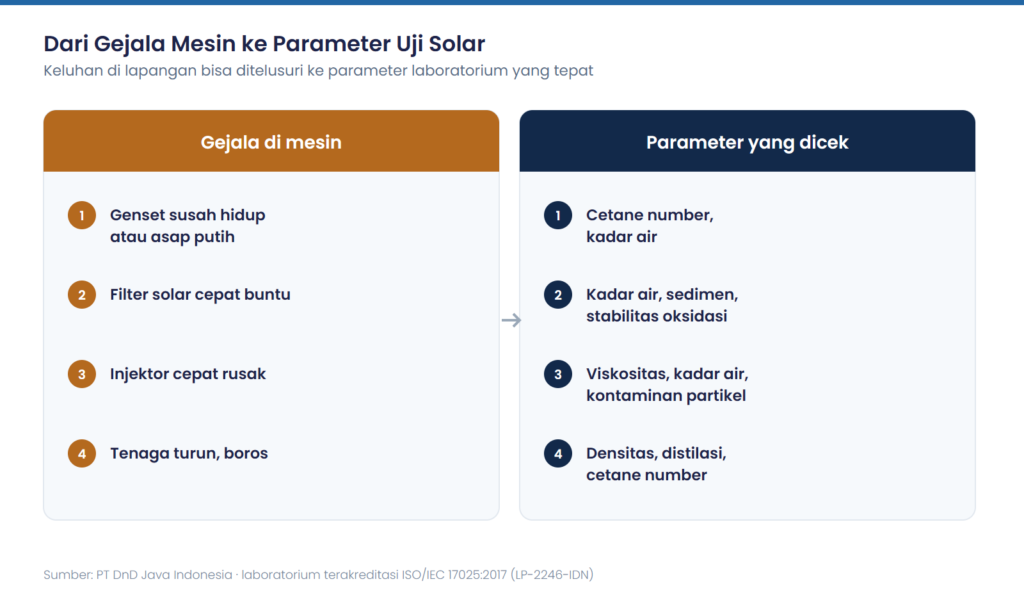
Most requests for B40 biodiesel blend testing start with a complaint from the field. Below are the five problems we encounter most often and the parameters that help trace them.
1. Clogged filters and monoglyceride deposits
Biodiesel carries residual monoglycerides from its production process. Saturated monoglycerides can crystallise and settle out when temperatures drop or when the biodiesel blend is stored for a long time, then stick to filters as a wax-like layer.
A common pattern: genset or heavy equipment filters clog even though the diesel fuel looks clear. The parameters that help trace this are cloud point or pour point, visual appearance, water and sediment, and oxidation stability.
Monoglyceride content itself is usually checked on pure biodiesel at the producer's end. If you need monoglyceride measurement, contact us to confirm parameter availability.
2. Water and microbial growth in tanks
FAME is more hygroscopic than pure diesel fuel, so the biodiesel blend more readily draws moisture from the air in the tank headspace. Water collecting at the tank bottom becomes a breeding ground for bacteria and fungi that form slime and clog filters.
Water content is measured by the Karl Fischer method, while the presence of microbes can be checked with a microbial detection kit for diesel fuels. Samples from the tank bottom give the most honest picture of this condition.
3. Oxidation stability during storage
FAME reacts with oxygen, especially when exposed to heat and light. Oxidation produces acids, gums, and deposits that accelerate pump wear and clog injectors.
The oxidation stability parameter shows how well the biodiesel blend withstands storage. For standby genset tanks or emergency stock with low turnover, this parameter should be tested periodically together with colour and visual appearance.
4. Doubts about whether FAME content matches B40
Buyers often receive only the supplier's documents with no data to compare against. Independent B40 biodiesel blend testing of FAME content, density, and distillation provides a defensible point of comparison.
5. Quality disputes with suppliers
When filters clog en masse or engines run into problems after a particular delivery, the first question is whether the fuel meets specification. Sealed retained samples and reports from an accredited laboratory provide a strong basis for resolving disputes.
The per-batch certificate workflow for distributors, transporters, and industrial buyers is covered on our page on diesel fuel test certificates.
Unsure about the quality of the biodiesel blend in your tanks?
Tell us the symptoms in the field and the number of tanks; we will help you choose the right test parameters. Contact us via WhatsApp or email us at [email protected].
Biodiesel Blend Testing Needs by Sector
B40 biodiesel blend testing needs differ by sector, even though the fuel is the same. Below is the testing focus that is usually most useful for each type of user.
Mining and heavy equipment

Excavators, dump trucks, and support units at mine sites burn large volumes of biodiesel blend, often from humid and dusty field tanks. B40 biodiesel blend testing at the receiving point and in field tanks helps reduce cases of clogged filters and injector damage.
Technical guidance on biodiesel for heavy equipment fleets is in our article on biodiesel analysis for heavy equipment. If wear has already occurred, combine it with heavy equipment oil analysis to see the impact inside the engine.
Building, hospital, and hotel gensets
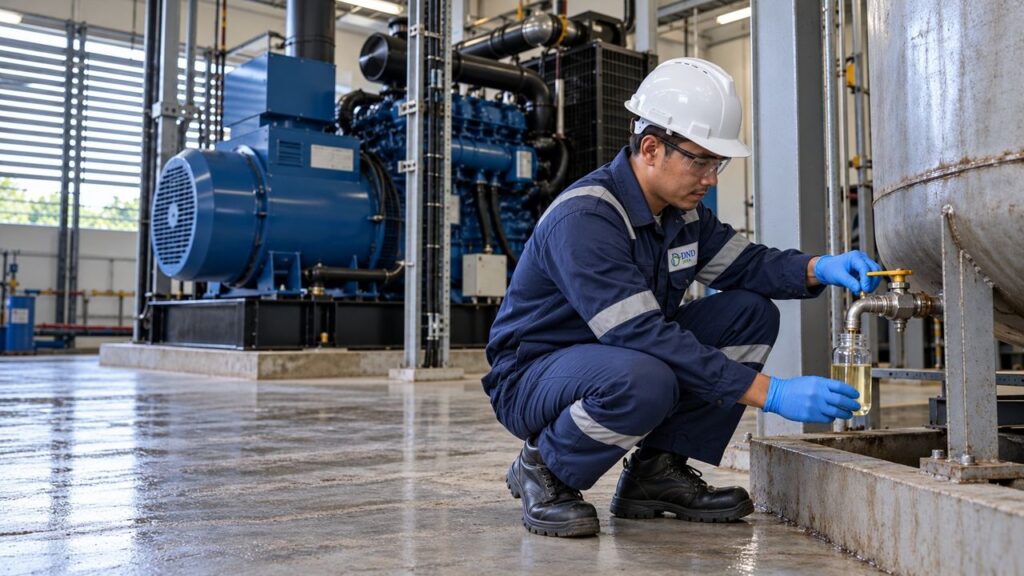
Standby gensets can sit idle for months while the biodiesel blend in their tanks keeps ageing. Hospitals, hotels, office buildings, and data centres suffer most if a genset fails during a power outage.
For genset tanks, storage parameters such as water content, oxidation stability, and visual appearance matter more than acceptance testing alone. A dedicated genset package is available on our page for genset diesel testing.
Land fleets and vessels
Truck, bus, and vessel operators refuel at many locations and from many suppliers. Periodic testing by supplier shows which supplier delivers the most consistent quality.
For vessels, sampling points and the risk of water ingress are covered on our page on marine fuel testing.
Industry and diesel power plants
Diesel power plants, boilers, and industrial burners buy biodiesel blend in contract volumes. Testing every delivery protects the contract value, and trend data helps decide when tanks need cleaning.
Distributors, industrial fuel agents, and transporters
For fuel suppliers, a per-batch B40 biodiesel blend test report is proof of quality for customers as well as protection if claims arise along the delivery chain. Transporters can use samples from the start and end of a trip to show that the cargo did not change in transit.
B40 Biodiesel Blend Testing Packages to Choose From
Not every situation requires the full set of specification parameters. Below are the package options we commonly put together with customers; the contents of each package can be adjusted.
| Package | Main parameters | Suitable for |
|---|---|---|
| Supply acceptance | FAME content, density, water content, flash point, visual appearance | Every delivery from a supplier |
| Storage and gensets | Water content, oxidation stability, colour, visual appearance, microbial detection kit | Standby tanks and old stock |
| Specification compliance | All parameters marked Available; other parameters confirmed first | Contracts, audits, and claims |
| Problem investigation | Tailored to engine symptoms and tank history | Clogged filters, damaged injectors, loss of power |
Costs and schedules are provided in the quotation once the diesel fuel type, number of samples, and location are known. We confirm the sample volume for the full package in advance because some parameters require larger volumes.
Need B40 biodiesel blend testing for your tanks or supplies?
State the diesel fuel grade, number of samples, and location; we will send a sampling guide or schedule a team to your site. Choose your sector — the WhatsApp message is pre-filled, just hit send.
WhatsApp — Buildings & GensetsWhatsApp — Mining & Heavy EquipmentWhatsApp — Fleet & TransportWhatsApp — Industry & Diesel Power
Or call (0353) 8940000 · [email protected]
When Biodiesel Blends Should Be Tested
B40 biodiesel blend testing frequency should follow risk, not just the calendar. The table below summarises the moments that matter most.
| Occasion | Reason | Parameter focus |
|---|---|---|
| New supplier | No quality history yet | Specification compliance package |
| Every large-volume delivery | Protects the contract value | FAME content, water, density, flash point |
| Low-turnover tanks | Biodiesel blend ages in storage | Oxidation stability, water, visual appearance |
| After tank cleaning | Confirms there is no residual contamination | Water, sediment, visual appearance |
| When engines show problems | Finds the root cause before components are replaced | Investigation package |
| Ahead of a blend change | Builds comparison data for B50 | FAME content, water, oxidation stability |
How to Take Biodiesel Blend Samples
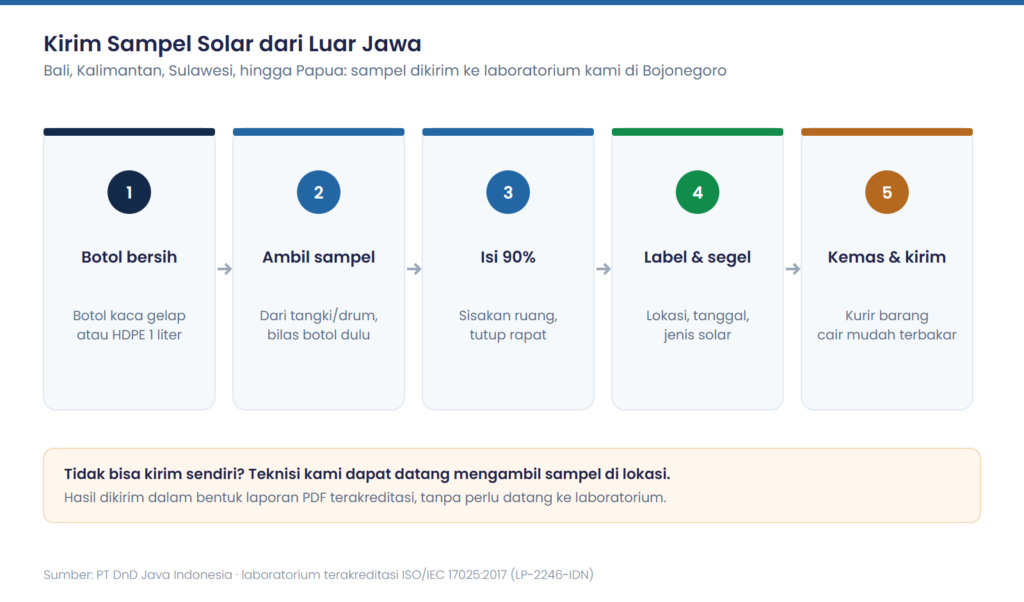
The basic steps for taking and shipping diesel fuel samples are already explained in our guide on diesel fuel lab testing. For B40 biodiesel blend testing, a few additional points make the results more representative of actual conditions.
- Use dark bottles. FAME oxidises faster when exposed to light, so clear bottles can affect oxidation stability and colour results.
- Take a separate tank-bottom sample. Water, sediment, and deposits collect at the bottom; a sample taken only from the surface looks clean.
- Keep a sealed retained sample. One retained bottle from each receipt serves as a reference if a dispute arises.
- Record the sampling point and time. B40 biodiesel blend test results are then easier to link to a specific tank or delivery.
- Ship promptly. Samples held for a long time can change in water content and stability.
If self-sampling is not possible, our team can be scheduled to your site via Sampling and Onsite Analysis.
How to Read a B40 Biodiesel Blend Test Report
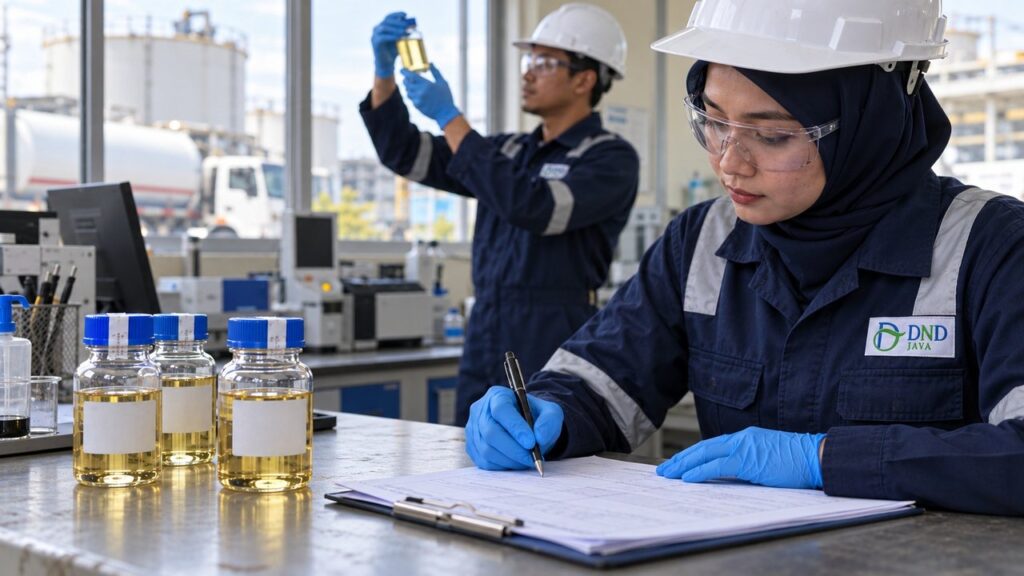
A good report supports decisions without you having to interpret the numbers yourself. Each parameter is listed with its result, unit, method, and limit from the annex of the applicable Directorate General of Oil and Gas (Ditjen Migas) decree.
| Report section | Contents | What you should check |
|---|---|---|
| Sample identity | Source tank, date, sampling point | Matches the tank or delivery in question |
| Specification reference | Diesel fuel type and annex used | Matches the diesel fuel grade purchased |
| Result per parameter | Measured values and their units | FAME content, water, and oxidation stability first |
| Status | Conforms or does not conform to the limit | Which parameters deviate |
| Notes | Results that pass but are close to the limit | Follow-up plan before the next delivery |
A single off-spec result does not always mean the entire tank contents are bad. High water content in a tank-bottom sample, for example, may mean that water has settled at the bottom while the biodiesel blend higher up is still good.
That is why the sampling point is always recorded, and B40 biodiesel blend test results are best read together with the tank history and engine maintenance records.
Common Mistakes in Biodiesel Blend Testing Programmes
Even an established testing programme can give a false sense of security. Below are the mistakes that most often mean biodiesel blend problems are only discovered after engines are affected.
| Mistake | Consequence | Fix |
|---|---|---|
| Testing only on receipt | Quality deterioration during storage goes unmonitored | Add periodic testing for low-turnover tanks |
| Comparing against the wrong diesel fuel grade | The conform or non-conform status becomes wrong | State the cetane number grade purchased when requesting testing |
| Judging by clarity alone | Deposits and dissolved water stay invisible until filters clog | Test water content, cloud point, and oxidation stability |
| Mixing new stock with old stock without data | The source of problems is hard to trace | Test the tank before refilling and keep a retained sample |
| Not keeping retained samples | Hard to prove your case in a dispute | One sealed bottle per receipt |
Preparing for B50: Steps You Can Start Now
The government is preparing to raise the blend towards B50. A larger FAME share means the traits already noticeable with B40, namely ready water uptake, easy oxidation, and a tendency to form deposits, are likely to become more pronounced.
Companies that start a B40 biodiesel blend testing programme now will have comparison data when B50 is implemented. With that data, changes in filter intervals, tank draining frequency, and engine problem patterns can be read clearly.
- Collect baseline data on FAME content, water, and oxidation stability for every main tank.
- Tidy up the schedules for draining tank-bottom water and maintaining tank vents.
- Review purchase contracts so that the specification reference and independent testing rights are clearly written.
- Set a periodic testing schedule for low-turnover tanks.
- Monitor official announcements from the Ministry of Energy and Mineral Resources (ESDM) on new specifications.
DND Java B40 Biodiesel Blend Testing Services Across Indonesia
PT DnD Java Indonesia operates an oil and gas laboratory accredited by KAN to ISO/IEC 17025:2017 (LP-2246-IDN) in Bojonegoro, East Java. We provide B40 biodiesel blend testing for mining, buildings, hospitals, hotels, fleets, vessels, industry, diesel power plants (PLTD), distributors, and transporters.
Samples can be shipped from anywhere in Indonesia or collected directly by our team on site. Coverage areas are listed on our page for oil and gas laboratory service areas, and quotation requests can be submitted via the contact page.
Reports are delivered as PDFs so they can be attached directly to audits, supplier claims, or maintenance records. To confirm which parameters fall within the accreditation scope, ask when requesting a quotation.
Frequently Asked Questions about B40 Biodiesel Blend Testing
What is B40 biodiesel blend testing?
B40 biodiesel blend testing is laboratory testing of diesel fuel blended with 40% biodiesel to confirm that its quality meets the specification set by decree of the Director General of Oil and Gas, including FAME content, water content, and oxidation stability.
Which parameters matter most for a B40 biodiesel blend?
FAME content, water content, oxidation stability, cloud point or pour point, and visual appearance most often explain biodiesel blend problems. For supply acceptance, add density and flash point.
What is the FAME content limit for B40?
Limits for FAME content and other parameters follow the annex of the applicable decree of the Director General of Oil and Gas for each diesel fuel type. Our reports compare results directly against that annex, so the conform or non-conform status can be read at a glance.
Can DND Java test all biodiesel blend specification parameters?
Most parameters are available, including cetane number, density, viscosity, sulphur, distillation, flash point, water content, FAME content, lubricity, and oxidation stability. Carbon residue, ash content, sediment content, and acid number need to be confirmed before samples are sent.
Is B40 biodiesel blend testing useful for B50 preparation?
Yes. B40 biodiesel blend test data collected now becomes a reference when the blend rises to B50, so changes in fuel quality and their impact on engines can be read clearly.
Can biodiesel blend samples be shipped from outside Java?
Yes. Samples in clean, tightly sealed, labelled dark bottles with layered packaging can be shipped from anywhere in Indonesia, or our team can be scheduled to collect samples on site.
Related Services and Articles
- Fuel Analysis — the full list of fuel parameters we offer.
- Diesel fuel lab testing — 6 basic parameters and how to ship samples from outside Java.
- Diesel test certificate — per-batch certificates for distributors and transporters.
- Genset diesel testing — packages for malls, buildings, hotels, and hospitals.
- Marine fuel testing — sampling points and parameters for vessels.
- Biodiesel analysis for heavy equipment — focused on excavator and dump truck fleets.
- Heavy equipment oil analysis — seeing the impact of fuel inside the engine.
- Sampling and Onsite Analysis — a sampling team sent to your site.
Ready to schedule B40 biodiesel blend testing?
State your diesel fuel grade, number of tanks or batches, and location. We will send a sampling guide and a quotation, or schedule a team to your site.
WhatsApp 0888-9507-534 · [email protected] · Phone (0353) 8940000