

Summary: Gas heating value is the energy released when one unit volume of gas is burned, and for natural gas this figure is calculated from the composition obtained by gas chromatography. The energy invoiced in MMBTU equals the corrected gas volume multiplied by the gas heating value, so a small error in composition directly changes the invoice value. A KAN-accredited independent laboratory report becomes the common reference when seller and buyer disagree on the figures.
In natural gas sales, what is actually traded is energy, not volume. The meter measures volume, while the gas heating value converts that volume into the energy that is paid for. Both figures are equally important, yet the gas heating value is rechecked by the buyer far less often.
This article is for commercial, metering, and operations teams on both the seller and buyer side: producers and PSC contractors (KKKS), transporters, shippers, traders, distributors, and the factories and power plants that buy gas. We cover how to calculate it, sources of discrepancies, and the role of an independent laboratory.
Table of Contents
What Gas Heating Value Is and Why It Determines the Invoice
Gas heating value expresses the amount of heat produced by the complete combustion of one unit volume of gas at specified reference conditions. Units vary, for example BTU per standard cubic foot, MJ per cubic metre, or kcal per cubic metre.
There are two types of heating value. Gross heating value (GHV) also counts the heat from condensing the water vapour produced by combustion, while net heating value (NHV) does not. Many natural gas contracts use GHV as the basis for invoicing, but the type used must always be clearly stated.
| Term | Meaning | Used for |
|---|---|---|
| GHV (gross heating value) | Heating value including the heat of water condensation | Usually the basis for natural gas invoicing |
| NHV (net heating value) | Heating value excluding the heat of water condensation | Equipment efficiency calculations |
| Relative density | Weight of the gas compared with air | Meter correction and Wobbe index |
| Wobbe index | Heating value divided by the square root of relative density | Compatibility of the gas with burners and turbines |
| MMBTU | One million BTU | Energy unit invoiced |
Who has a stake in gas heating value
| Party | Main interest | Data required |
|---|---|---|
| Producers and PSC contractors (KKKS) | Energy sold in line with production and specification | Sales gas composition per period |
| Pipeline transporters | Energy balance into and out of the network | Heating value at every custody transfer point |
| Shippers and traders | Reconciliation of energy bought and sold | Heating value from upstream and downstream parties |
| Factories buying gas | Invoices matching the energy received | Gas heating value at the receiving point |
| Power plants | Invoices and heat rate calculation | Latest heating value and Wobbe index |
Each party sees the same figure from a different angle. That is why a gas heating value calculated in a jointly agreed way is far more valuable than a figure that is correct according to one party only.
Because natural gas is a mixture, its heating value changes whenever its composition changes. The basics of gas composition are covered in our article on what gas composition means.
From Composition to Gas Heating Value
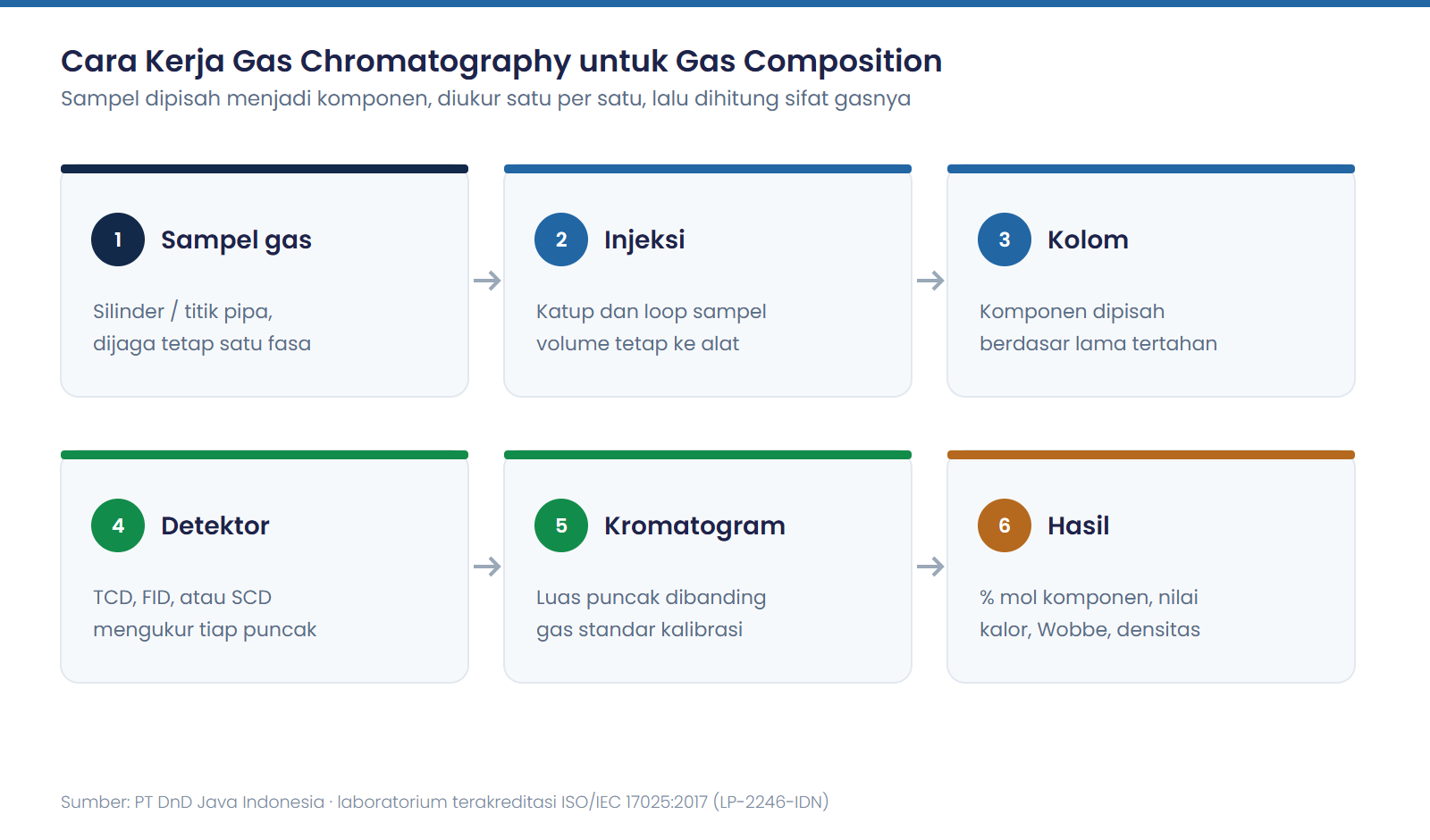
In practice, the heating value of natural gas is not measured by burning the gas but calculated from its composition. A gas chromatograph measures the concentration of each component, and each concentration is multiplied by the heating value of the pure component tabulated in ASTM, ISO, and GPA methods.
The sum is the ideal heating value of the mixture. This figure is then corrected for real-gas behaviour using the compressibility factor, giving the gas heating value at the contract reference conditions.
| Component | Effect on gas heating value |
|---|---|
| Methane | Largest energy contributor in natural gas |
| Ethane | Raises heating value per volume |
| Propane, butane, and pentane | Raise heating value sharply even at low concentrations |
| C6+ fraction | Very low concentration, but assumptions about its properties affect the result |
| Nitrogen | Non-combustible, lowers heating value |
| CO2 | Non-combustible, lowers heating value and raises density |
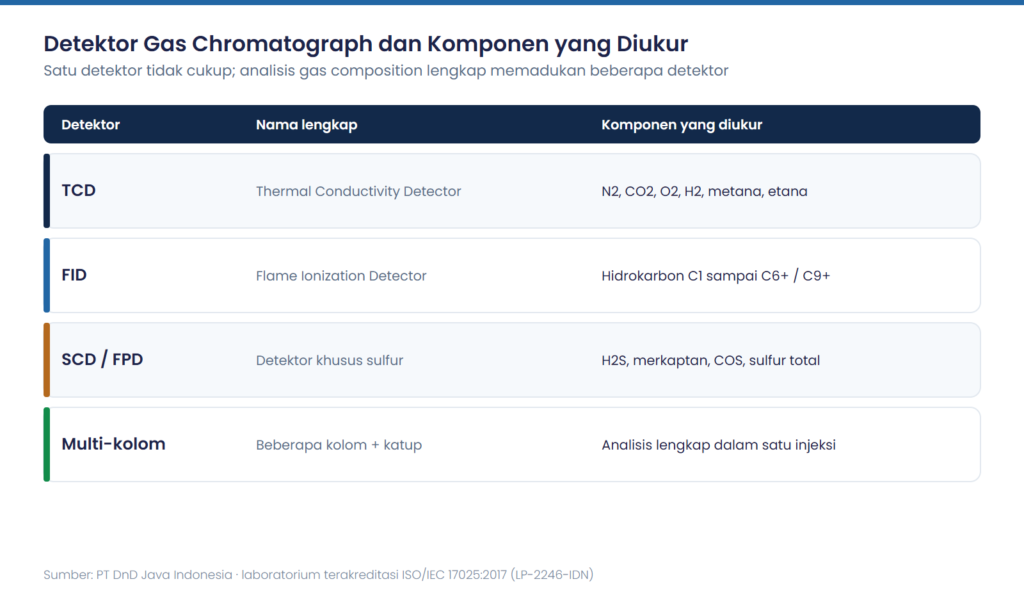
Natural gas composition analysis for this purpose commonly uses methods such as GPA 2261, which measures C1 to C6+, nitrogen, and CO2 in a single analysis. We describe how the instrument and its detectors work in our article on gas chromatography.
5 Steps from Gas Sample to MMBTU Invoice
The gas energy calculation chain can be summarised in five steps. An error at any step carries through to the invoice figure.
- 1. Take a representative sample — from the custody transfer point, with a purged cylinder, at a time that represents the invoicing period.
- 2. Analyse the composition — gas chromatography calibrated with certified standard gas, results in mole per cent.
- 3. Calculate gas heating value and relative density — using the method and reference conditions agreed in the contract.
- 4. Calculate the energy — corrected standard volume multiplied by gas heating value, then expressed in MMBTU.
- 5. Reconcile and document — compare with the other party's figures and keep the report as evidence.
Worked illustration: suppose 50,000 MSCF of gas (thousand standard cubic feet) is recorded in one month. If the gas heating value is 1,050 BTU per standard cubic foot, the energy is 50,000 × 1,050 ÷ 1,000 = 52,500 MMBTU. If the actual heating value is 1,030, the energy is 51,500 MMBTU, a difference of 1,000 MMBTU from the same volume.
All the figures above are examples, not customer data. The illustration shows why gas heating value matters as much as the meter. A difference of about 2% in heating value produces a difference of about 2% in the energy invoiced, every month.
Relative Density (Specific Gravity) and Meter Correction
Composition yields not only the gas heating value but also the relative density and compressibility factor. Both are used to convert meter readings into standard volume.
In orifice meters, relative density goes directly into the flow equation. In turbine and ultrasonic meters, the compressibility factor from the composition is used for pressure and temperature correction. This means a wrong composition can throw off both the volume and the gas heating value at once.
| Meter type | Composition data used | Impact if the composition is wrong |
|---|---|---|
| Orifice | Relative density, compressibility factor | Calculated flow rate shifts |
| Turbine and rotary | Compressibility factor | Correction to standard volume is off |
| Ultrasonic | Compressibility factor, theoretical speed of sound | Volume and meter diagnostics are off |
| All types | Gas heating value | Invoiced energy is off |
Compressibility factor and theoretical speed of sound can be calculated from the composition. Availability of these derived parameters in our report needs to be confirmed per request, so contact us to confirm parameter availability.
Verifying Online GCs and Meters at Custody Transfer Stations
Many custody transfer stations install an online GC that calculates gas heating value every few minutes. The instrument is very useful, but its calibration can drift slowly without showing in the daily figures.
Good practice is to take a spot sample at the same time as the online GC analysis cycle, then analyse it in the laboratory. Differences in composition and gas heating value beyond the agreed limit are a sign that the online GC needs checking.
- Compare composition component by component, not just the final heating value.
- Record the sampling time and the number of the online GC analysis cycle being compared.
- Check the certificates of the standard gases used in the field and their validity.
- Keep the comparison results as a history for the next audit.
Need an independent cross-check for your online GC?
We take spot samples at the custody transfer station and analyse them in an accredited laboratory as a cross-check of gas heating value. Contact us via WhatsApp or email us at [email protected].
Sources of Gas Heating Value Discrepancies between Seller and Buyer
Differences in figures between seller and buyer almost always have a technical cause that can be traced. The following table summarises the most common patterns.
| Source of discrepancy | Example | How to prevent it |
|---|---|---|
| Unrepresentative sampling | Cylinder not purged, air ingress, high nitrogen reading | GPA sampling procedure and recording of conditions |
| Heavy fractions lost | Rich gas sample cools, C6+ condenses | Keep sample temperature above the dew point |
| Different reference conditions | One party uses 60 °F, the other 15 °C | State reference conditions in the contract and report |
| Dry or wet basis | Heating value calculated on dry versus water-saturated gas | Agree on the calculation basis |
| C6+ property assumptions | C6+ fraction treated as hexane or split | Agree on how C6+ is characterised |
| Edition of the calculation method | Component property tables from different editions | State the method and its edition |
| Online GC drift | Field calibration not checked | Periodic laboratory cross-check |
Most discrepancies can be prevented through a detailed contract and an agreed sampling procedure. The rest are resolved with data from an impartial third party.
Split samples and referee samples
When figures are disputed, the fairest approach is joint sampling. Samples are taken at the same time and point, then split: one for the seller, one for the buyer, and one retained as a referee sample for an independent laboratory.
If the seller's and buyer's results differ by more than the agreed limit, the referee sample is analysed and its result is used according to the mechanism in the contract. If the gas turns out to be off-spec, we cover the tracing steps in our article on off-spec gas.
Sampling Representativeness: The Largest Source of Discrepancies
Even the most precise gas chromatograph cannot fix a wrong sample. For gas heating value, three things most determine whether a sample represents the gas being invoiced.
Sampling time
A spot sample only represents the moment it was taken. If supply composition changes during the day or from week to week, a single spot sample can be far from the average for the invoicing period. A composite sampler or more frequent periodic sampling gives a fairer picture.
Sampling point and method
The sampling probe should draw gas from the centre of the flow, not from the bottom of the pipe where liquids can collect. The cylinder is purged several times so that residual old gas or air is not measured.
Transport chain
Cylinders must be tightly closed, labelled, and accompanied by records of pressure, temperature, time, and the sampler's name. This chain of custody documentation makes the gas heating value result traceable back to its sampling point.

Our team takes samples on site following GPA procedures, using cylinders we prepare. Field service details are on our page for Sampling and Onsite Analysis.
Why a KAN-Accredited Independent Laboratory Report Matters
In a gas heating value dispute, figures from one party are easily questioned by the other. A report from an independent laboratory provides impartial common ground.
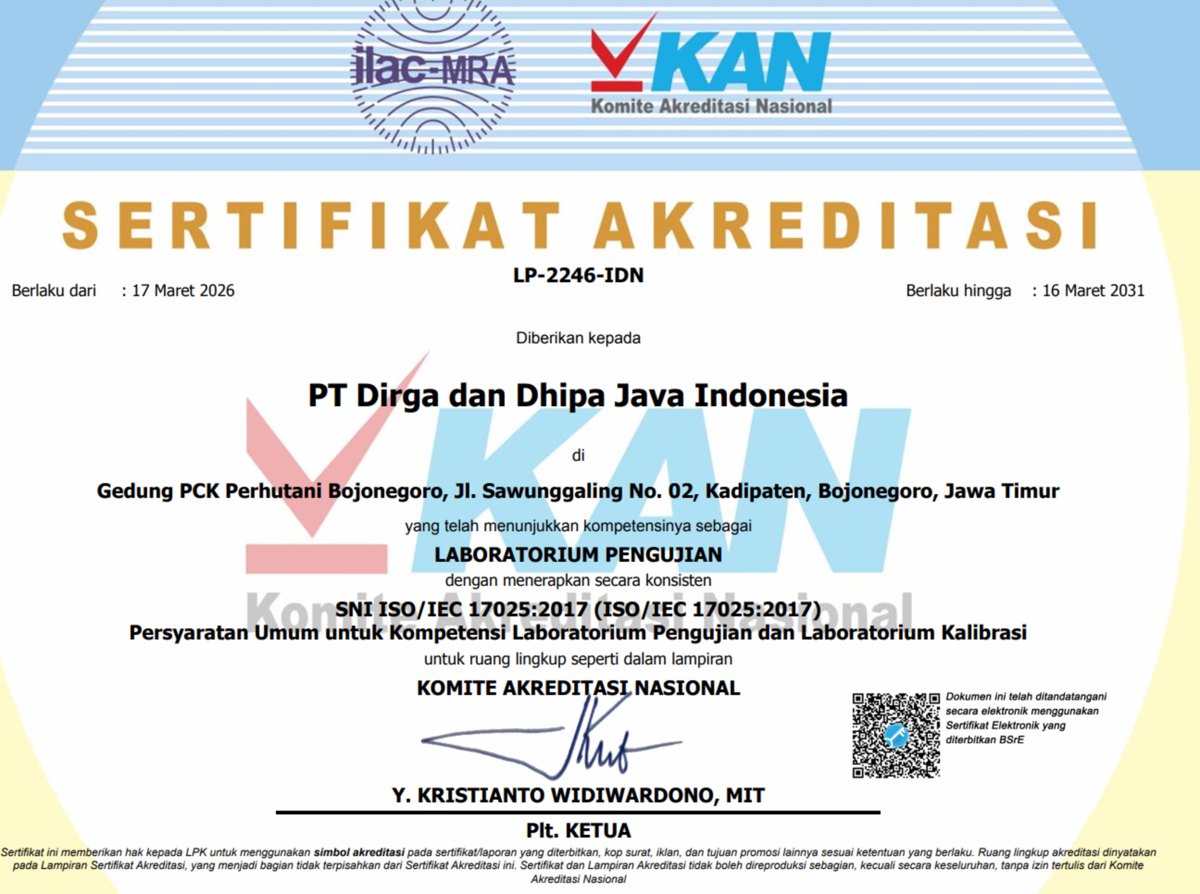
ISO/IEC 17025 accreditation from the National Accreditation Committee (KAN) shows that the laboratory is technically competent, uses calibrated equipment with measurement traceability, and runs an audited quality system. Accreditation applies per method, so make sure the method you request is within its scope.

| What the report should include | Why it matters at custody transfer |
|---|---|
| Composition per component in mol % | A calculation basis that can be rechecked |
| Pre-normalisation total | Indicator of sample and calibration quality |
| Gas heating value, relative density, Wobbe | The figures used for invoicing and specifications |
| Reference conditions and calculation basis | Prevents mismatched comparisons between parties |
| Analysis and calculation methods | Must match those stated in the contract |
| Sampling data and chain of custody | Links results to the custody transfer point and time |
PT DnD Java Indonesia is accredited to ISO/IEC 17025:2017 under number LP-2246-IDN. General information on the governance of the national natural gas sector can be followed on the website of the Directorate General of Oil and Gas.
Reference Conditions and Units for Gas Heating Value
The same gas heating value can look different simply because the reference conditions differ. The reference temperature and pressure for volume, and the reference combustion temperature, change the final figure.
| What must be agreed | Example options | Risk if not written down |
|---|---|---|
| Energy per volume unit | BTU per standard cubic foot, MJ per cubic metre, kcal per cubic metre | Conversion errors during reconciliation |
| Reference temperature and pressure for volume | 60 °F or 15 °C at a specified reference pressure | Small but recurring discrepancy |
| Heating value type | GHV or NHV | Large discrepancy, possibly around ten per cent |
| Water basis | Dry or water-saturated gas | Small but systematic discrepancy |
| Calculation method | ASTM, ISO, or GPA method and its edition | Slightly different results between parties |
One MMBTU equals one million BTU, or about 1.055 GJ. Conversions between units should use the factor also stated in the contract, so that no party rounds differently.
Gas Heating Value for LNG, CNG, and LPG
The same principle applies to gas not delivered by pipeline. For LNG, the liquid sample is vaporised under controlled conditions and then analysed, and the gas heating value is calculated together with LNG density for cargo energy. For details, see our LNG analysis services.

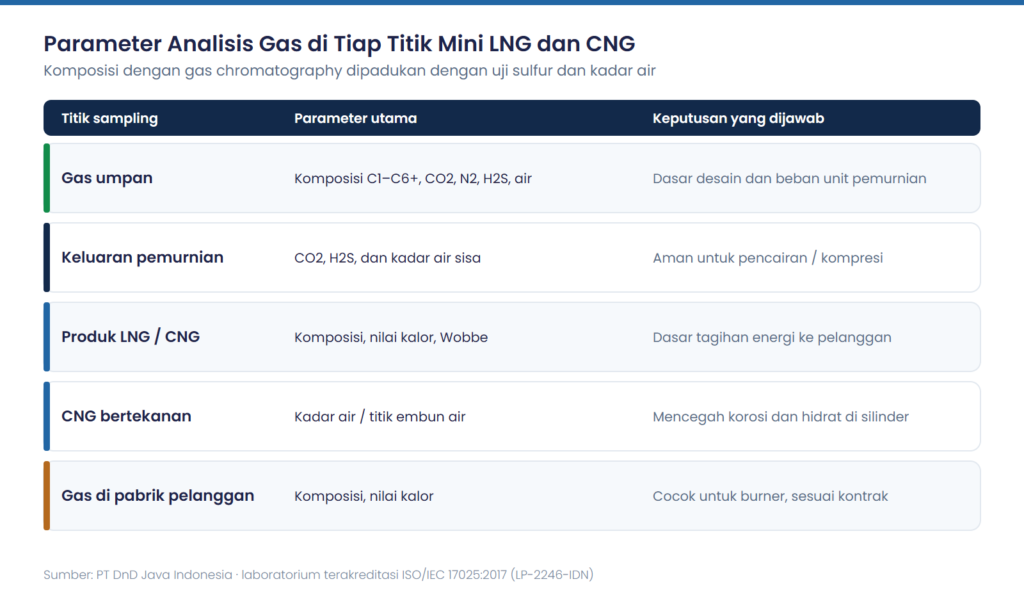
For CNG and mini LNG delivered by truck, the energy per delivery is also calculated from the gas heating value. We discuss the analysis points in our article on mini LNG and CNG.
For LPG, the usual points of contention are the propane-butane ratio, vapour pressure, and residue. The parameters and sampling methods are different and are discussed in our article on LPG analysis.
Contract Clause Checklist for Gas Heating Value
Many disputes start with a contract that lacks detail. Before signing or renewing a gas sales agreement, check whether the following are written down.
- Heating value type and reference conditions — GHV or NHV, reference temperature and pressure, dry or wet basis.
- Analysis and calculation methods — the ASTM, ISO, or GPA method used, including how the C6+ fraction is treated.
- Sampling point and frequency — where, when, by whom, and whether composite or spot.
- Discrepancy tolerance limit — how large a difference is still accepted before the referee sample is analysed.
- Referee laboratory — accreditation requirements and how it is chosen if a dispute arises.
- Online GC and meter verification — comparison schedule and actions if the results deviate.
A detailed contract makes gas heating value a figure anyone can check, not one that simply has to be trusted.
Recommended Gas Heating Value Analysis Schedule
- In line with the invoicing period — for example monthly, as the basis for or a cross-check of the energy invoiced.
- Every change in supply source — new wells, new suppliers, or gas blending.
- Periodically for online GC verification — spot samples at the same time as the instrument's analysis cycle.
- When commissioning a new metering station — composition baseline and settings check.
- When a dispute arises — joint sampling and referee sample analysis.
For buyers, periodic analysis on the receiving side provides their own data to compare against the seller's figures. Sector guides are in our articles on natural gas for industry and natural gas for power generation.
Gas Heating Value Analysis Services from DND Java
We analyse natural gas composition by calibrated gas chromatography, then calculate gas heating value, relative density, and Wobbe index at the reference conditions you specify. Packages and parameters are on our page for the composition, heating value, relative density, and Wobbe index package.
The service covers cylinder preparation, sampling at the custody transfer site, reports with chain of custody data, and periodic programmes with month-by-month trends. For locations outside East Java, see our service areas.
To get started, send your custody transfer point, contract method, and invoicing period via our contact page. An overview of the service is on our page for the Gas Composition service.
Frequently Asked Questions about Gas Heating Value
What is gas heating value?
Gas heating value is the amount of heat produced when one unit volume of gas is completely burned at specified reference conditions. For natural gas, this figure is calculated from the composition obtained by gas chromatography and forms the basis of energy invoicing.
What is the difference between GHV and NHV?
GHV, or gross heating value, also counts the heat from condensing the water vapour produced by combustion, while NHV, or net heating value, does not. Many natural gas contracts use GHV, but the type must be clearly stated in the contract and report.
How is gas energy calculated in MMBTU?
Energy equals gas volume at standard conditions multiplied by gas heating value. For example, volume in thousand standard cubic feet multiplied by heating value in BTU per standard cubic foot, then divided by one thousand, gives MMBTU.
Why can the seller's and buyer's heating values differ?
Common causes are unrepresentative samples, condensed heavy fractions, different reference conditions or water basis, the treatment of the C6+ fraction, different method editions, and drifting online GCs.
Why is a KAN-accredited independent laboratory needed?
An independent laboratory report favours neither the seller nor the buyer. ISO/IEC 17025 accreditation from KAN demonstrates technical competence and measurement traceability for the methods within its scope.
Related Articles and Services
- Gas Composition — composition, heating value, relative density, and Wobbe index
- Natural gas for power generation — turbine and gas engine fuel requirements
- Natural gas for industry — analysis guide by industrial sector
- Sampling and Onsite Analysis — gas sampling at the custody transfer point
- Gas chromatography — how it works and how to read the results
Want to verify the gas heating value on your invoices?
State your custody transfer point, the calculation method in the contract, and the invoicing period. Our team will prepare cylinders, sampling, and a traceable gas heating value report.
WhatsApp 0888-9507-534 · [email protected] · Phone (0353) 8940000